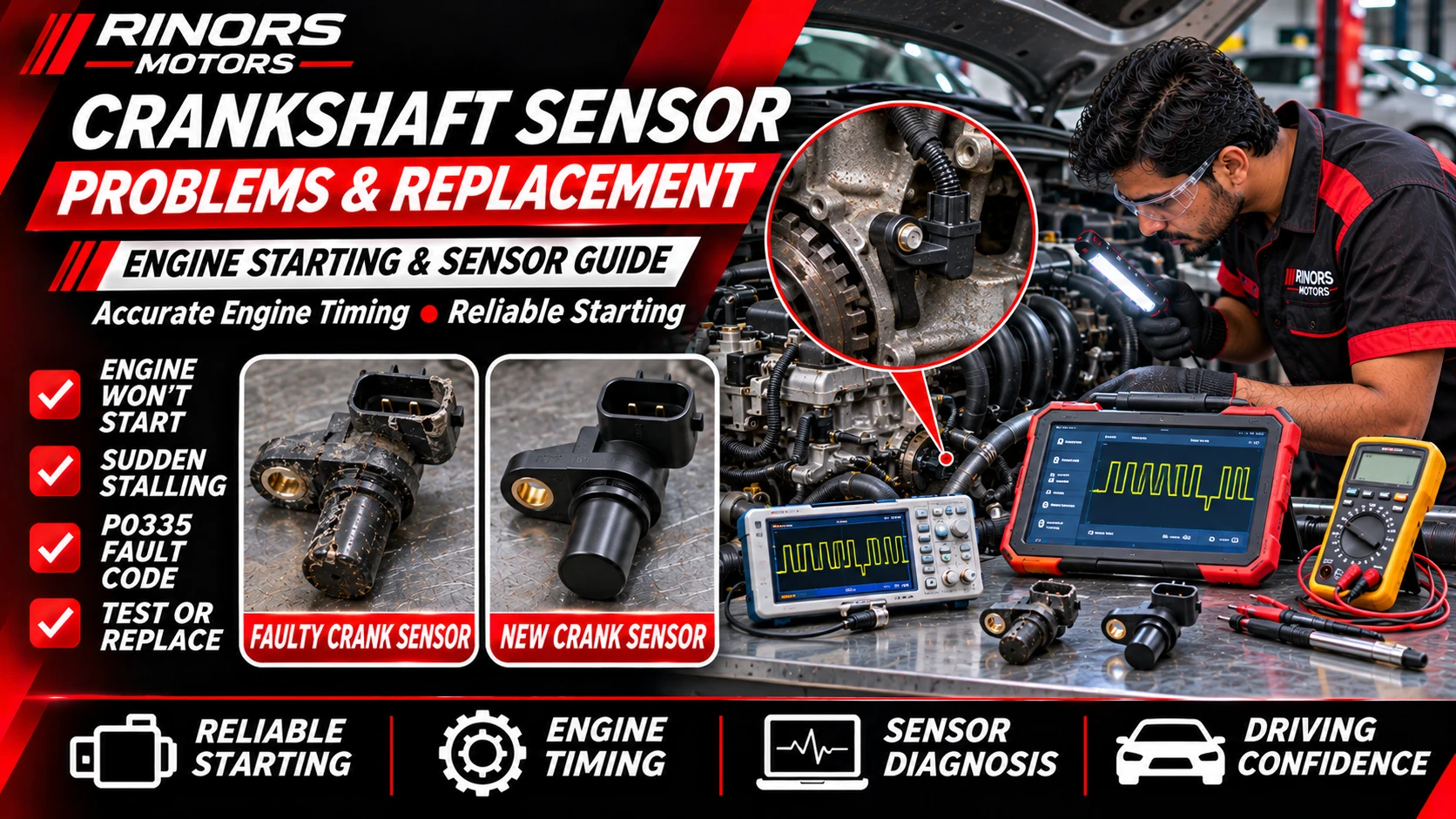
Car Crankshaft Position Sensor Problems in Bangladesh: Complete Diagnosis & Replacement Guide
Does your car crank but refuse to start? Has the engine suddenly stalled while driving, only to restart after several minutes? Is the check engine light showing a P0335 or P0336 fault code?
These symptoms may indicate a problem with the crankshaft position sensor, commonly called the CKP sensor or crank sensor.
The crankshaft position sensor is one of the most important electronic sensors in a modern internal combustion engine. It monitors crankshaft position and rotational speed, providing information the engine control unit uses to coordinate ignition timing, fuel injection, and other engine management functions.
When the crankshaft sensor or its signal circuit develops a fault, the engine may struggle to start, operate irregularly, or stop unexpectedly.
However, similar symptoms can also result from ignition system problems, fuel delivery faults, damaged wiring, or other engine sensors.
In Bangladesh, ageing electrical components, engine-compartment heat, moisture exposure, and demanding everyday vehicle operation can make accurate engine diagnostics particularly valuable.
Whether you drive a Toyota Corolla, Axio, Premio, Allion, Honda Civic, Vezel, Nissan X-Trail, or another vehicle, understanding crankshaft position sensor problems can help prevent unnecessary parts replacement.
This guide explains eight possible warning signs, common diagnostic trouble codes, sensor testing procedures, repair options, and replacement considerations.
What Is a Crankshaft Position Sensor?
The crankshaft position sensor is an electronic device used to measure crankshaft position, rotational speed, or both.
The crankshaft is a major rotating component inside the engine. Its movement is directly related to piston position and engine operating speed.
The CKP sensor provides information that helps the engine control unit determine the appropriate timing for various engine operations.
Main Functions of a Crankshaft Position Sensor
Monitor crankshaft rotational speed.
Provide crankshaft position information.
Support ignition timing control in applicable engines.
Support fuel injection timing.
Help the engine control unit recognize engine rotation during starting.
Work with camshaft position information where applicable.
Support engine synchronization and fault detection.
Help maintain reliable engine operation.
The exact functions depend on the engine management system.
A malfunctioning CKP sensor can cause significant drivability problems, but the symptoms vary by vehicle.
How Does a Crankshaft Position Sensor Work?
Most crankshaft position sensors detect changes associated with a rotating target wheel.
This target is often called a reluctor wheel, trigger wheel, or tone wheel.
The target may be mounted on or integrated with a component rotating in synchronization with the crankshaft.
As the target passes the sensor, it produces a changing electrical signal.
The engine control unit interprets this signal to determine crankshaft speed and position.
Main Components of a Crankshaft Sensor System
Crankshaft position sensor.
Rotating trigger or reluctor wheel.
Sensor electrical connector.
Sensor wiring harness.
Engine control unit.
Relevant power and ground circuits, depending on sensor design.
Sensor mounting bracket or housing.
Some engines use different sensor arrangements, but the underlying purpose remains similar.
Why the Signal Matters
The engine control unit needs suitable engine speed and position information to coordinate engine operation.
If the signal becomes unavailable or unreliable, the engine may experience starting or running problems.
In some vehicle designs, the control system may use alternative information temporarily, but this behavior is not universal.
Types of Crankshaft Position Sensors
Not every CKP sensor operates using the same electrical principle.
Understanding the sensor type is important for correct testing.
1. Inductive or Magnetic Crankshaft Sensor
An inductive sensor, sometimes called a variable reluctance sensor, generates an electrical signal as a suitable rotating target passes its sensing element.
The signal characteristics vary with crankshaft speed and the sensor's design.
These sensors commonly produce an alternating voltage waveform.
2. Hall-Effect Crankshaft Sensor
A Hall-effect sensor uses electronic circuitry to detect changes in a magnetic field.
Many Hall-effect crankshaft sensors require a specified power supply and ground connection.
The sensor typically provides a switching digital signal to the engine control unit.
Why Correct Identification Matters
An electrical test suitable for an inductive sensor may not be appropriate for a Hall-effect sensor.
Incorrect testing can result in a false diagnosis or sensor damage.
The exact electrical configuration should be confirmed using manufacturer service information.
8 Warning Signs of a Bad Crankshaft Position Sensor
A faulty crankshaft sensor can create several engine problems.
However, no single symptom automatically proves that the CKP sensor needs replacement.
1. Engine Cranks but Does Not Start
One of the most important possible symptoms is a crank-no-start condition.
The starter motor rotates the engine, but combustion does not begin or continue normally.
If the engine control unit cannot obtain the crankshaft position information required by its operating strategy, it may be unable to control ignition or fuel injection correctly.
Possible symptoms include:
Starter motor operating normally.
Engine rotating without starting.
Repeated unsuccessful starting attempts.
A crankshaft-related diagnostic code.
However, fuel pressure problems, ignition faults, immobilizer issues, and engine mechanical damage can also cause a crank-no-start condition.
A professional diagnosis should verify the actual CKP signal before replacing the sensor.
2. Sudden Engine Stalling While Driving
A failing crankshaft sensor or an intermittent signal connection may contribute to unexpected engine stalling.
The engine may suddenly stop while the vehicle is moving.
Possible symptoms include:
Engine power disappearing unexpectedly.
Dashboard warning lights appearing after the engine stops.
Difficulty restarting.
Intermittent engine shutdown.
Important: Unexpected engine stalling can create a serious safety hazard.
If your vehicle repeatedly stalls while driving, stop safely and arrange professional inspection rather than continuing normal operation.
3. Intermittent Starting Problems
A crankshaft sensor fault may occur only under certain conditions.
The vehicle may start normally several times before unexpectedly failing to start.
Potential causes include:
Intermittent sensor failure.
Damaged electrical connections.
Loose wiring.
Heat-related electrical faults.
Sensor signal interruptions.
Trigger wheel or mounting problems.
Intermittent faults can be difficult to diagnose because the vehicle may operate normally when it reaches the workshop.
Technicians may need to evaluate the system under conditions similar to those in which the fault occurs.
4. Engine Fails to Start When Hot
Some sensor or wiring faults become more noticeable after the engine compartment reaches operating temperature.
For example, a vehicle may:
Start normally when cold.
Operate for a period.
Stop or fail to restart after becoming hot.
Restart after cooling.
This pattern can suggest a temperature-sensitive electrical fault.
However, fuel system problems, ignition components, and other engine electronics may also produce temperature-dependent symptoms.
A CKP sensor should not be replaced solely because the car is difficult to start when hot.
5. Engine Misfiring or Running Roughly
Certain crankshaft signal problems can interfere with engine timing or synchronization.
Depending on the engine control strategy, this may contribute to:
Rough engine operation.
Hesitation.
Misfires.
Irregular combustion.
Reduced power.
However, spark plugs, ignition coils, fuel injectors, air leaks, and engine mechanical faults are also possible causes.
A professional inspection should distinguish crankshaft sensor faults from other engine performance problems.
6. Jerking, Hesitation, or Loss of Power
An intermittent crankshaft signal may affect engine management in certain vehicles.
The driver may notice sudden hesitation or irregular engine response.
Possible symptoms include:
Engine jerking.
Brief power loss.
Hesitation during acceleration.
Irregular running.
Unexpected changes in engine operation.
These symptoms are not specific to the CKP sensor.
Fuel delivery, ignition, transmission, and other electronic faults should also be considered.
7. Abnormal Engine RPM Signal
The engine control unit uses crankshaft position information to determine engine speed.
If the signal becomes unavailable, diagnostic equipment may show missing or implausible engine RPM data.
In some vehicles, the tachometer may also behave unusually when the engine-speed signal is disrupted.
Possible signs include:
Engine RPM not appearing during cranking on a compatible diagnostic scanner.
Intermittent RPM signal loss.
Abnormal tachometer behavior in certain vehicles.
CKP-related diagnostic codes.
However, not all dashboards display cranking RPM, and some scan tools update information differently.
A zero RPM reading by itself is not a universal CKP failure test.
8. Check Engine Light or Crankshaft Sensor Fault Code
A crankshaft sensor circuit problem may trigger the check engine light.
Common diagnostic codes include:
P0335.
P0336.
P0337.
P0338.
P0339.
However, a damaged sensor is only one possible cause of these codes.
Wiring, connectors, trigger wheel damage, incorrect sensor installation, and other engine control problems must also be evaluated.
Common Crankshaft Position Sensor Fault Codes
Diagnostic trouble codes are important clues, but they do not automatically identify a defective component.
P0335 — Crankshaft Position Sensor A Circuit Malfunction
P0335 generally indicates a problem involving the crankshaft position sensor A circuit or its monitored signal.
Possible causes include:
Defective CKP sensor.
Damaged wiring.
Loose electrical connector.
Electrical circuit faults.
Damaged trigger wheel.
Incorrect sensor installation.
Other engine control faults.
P0336 — Crankshaft Position Sensor A Circuit Range/Performance
P0336 generally indicates that the crankshaft sensor signal does not meet the expected operating characteristics.
Possible causes may involve:
Irregular sensor signal.
Damaged reluctor wheel.
Incorrect sensor positioning.
Wiring problems.
Sensor deterioration.
Other engine synchronization issues.
P0337 — Crankshaft Position Sensor A Circuit Low Input
This code generally relates to a sensor circuit signal detected below the expected range under monitored conditions.
The appropriate electrical testing depends on sensor design and manufacturer specifications.
P0338 — Crankshaft Position Sensor A Circuit High Input
This code generally relates to an unexpectedly high signal or circuit condition.
Possible causes may include electrical faults, connector issues, or sensor problems.
P0339 — Crankshaft Position Sensor A Circuit Intermittent
P0339 indicates an intermittent crankshaft sensor circuit or signal problem under the applicable diagnostic criteria.
Potential causes include:
Intermittent wiring failure.
Loose connector.
Sensor signal interruption.
Heat-related electrical fault.
Damaged trigger wheel.
Other intermittent circuit problems.
P0016 — Crankshaft/Camshaft Position Correlation
This code generally relates to a detected relationship problem between crankshaft and camshaft position information.
Possible causes include:
Timing chain or belt problems.
Incorrect engine timing.
Camshaft timing control faults.
Sensor signal issues.
Damaged timing targets.
Other mechanical or electrical problems.
Important: P0016 does not automatically mean the crankshaft sensor has failed. Mechanical timing faults can also produce this code.
Why Do Crankshaft Position Sensors Fail?
Crankshaft sensors operate in demanding engine environments.
Several factors can contribute to sensor or signal problems.
1. Heat-Related Deterioration
Engine compartments experience repeated heating and cooling.
Certain electronic components may deteriorate over time.
Some failures become noticeable when the engine reaches a particular temperature.
2. Damaged Wiring
CKP sensor wiring may be exposed to vibration, heat, and movement.
Damaged insulation or broken conductors can interrupt the signal.
3. Loose or Corroded Connectors
Poor electrical connections can create intermittent faults.
4. Moisture Contamination
Water entering an electrical connector may contribute to corrosion or unreliable signal transmission.
5. Mechanical Impact Damage
A sensor can be damaged during engine repairs, accidents, or other mechanical incidents.
6. Incorrect Sensor Installation
Improper mounting, unsuitable replacement parts, or incorrect positioning may affect sensor operation.
7. Damaged Reluctor Wheel
A damaged, loose, or incorrectly positioned trigger wheel can produce an abnormal crankshaft position signal.
8. Internal Electronic Failure
Some sensors fail because of internal electrical or electronic deterioration.
9. Incorrect Replacement Components
A sensor that physically fits may still have incompatible electrical characteristics or signal requirements.
Correct part identification is essential.
Crankshaft Sensor vs Camshaft Sensor: What's the Difference?
These two sensors work closely together in many modern engines.
Crankshaft Position Sensor
Monitors crankshaft speed and position.
Its signal is used for engine timing and synchronization.
Camshaft Position Sensor
Monitors camshaft position or related timing information.
The engine control unit may use this information to identify engine operating phases and coordinate fuel injection, ignition, or variable valve timing.
Can Both Cause Starting Problems?
Yes.
Depending on the engine, either sensor or its circuit may contribute to:
Difficult starting.
Engine stalling.
Engine misfires.
Rough running.
Timing-related fault codes.
How Are They Diagnosed?
Professional diagnosis may compare crankshaft and camshaft signals.
A technician may use:
Diagnostic scanner data.
Sensor electrical testing.
Oscilloscope waveform analysis.
Manufacturer timing references.
Mechanical timing inspection when indicated.
A correlation problem should not automatically result in replacing both sensors.
Crankshaft Sensor vs Starter Motor Problems
A starter motor and crankshaft sensor are different components.
Starter Motor
Rotates the engine during starting in conventional starter-equipped vehicles.
Crankshaft Position Sensor
Provides the engine control unit with engine rotation and position information.
Starter Motor Failure
Possible symptoms include:
Engine not rotating.
Clicking without cranking.
Slow or abnormal cranking.
Starter engagement problems.
Crankshaft Sensor Failure
Possible symptoms include:
Engine rotating normally but failing to start.
Sudden stalling.
Missing or irregular crankshaft signal.
CKP-related fault codes.
Why the Difference Matters
If the engine does not rotate at all, a conventional CKP sensor fault is not usually the primary explanation.
The battery, starter circuit, and mechanical engine condition should be evaluated.
If the engine rotates normally but does not start, the crankshaft position sensor becomes one of several possible diagnostic considerations.
Crankshaft Sensor vs Fuel Pump Problems
A failing fuel pump and a faulty crankshaft sensor can both contribute to a crank-no-start condition.
However, their functions are different.
Crankshaft Sensor
Provides information needed by the engine control system to coordinate operation.
Fuel Pump
Supplies fuel to the engine at the pressure and flow required by the fuel system.
Similar Symptoms
Both problems may contribute to:
Difficult starting.
Engine stalling.
Hesitation.
Reduced performance.
No-start conditions.
How Are They Distinguished?
A technician may examine:
Fuel pressure.
Fuel delivery.
Engine RPM information during cranking.
Ignition operation.
CKP sensor signal.
Diagnostic trouble codes.
Related electrical circuits.
A fuel pump should not be replaced simply because the engine cranks without starting.
Likewise, a crankshaft sensor should not be replaced without verifying its signal and circuit.
Can a Bad Crankshaft Sensor Cause Engine Misfires?
Yes, certain CKP signal faults can contribute to abnormal engine timing or synchronization.
Depending on the vehicle, the engine may operate roughly or misfire.
However, conventional ignition-system problems are also common causes of misfires.
Possible alternative causes include:
Worn spark plugs.
Faulty ignition coils.
Fuel injector problems.
Incorrect fuel pressure.
Intake air leaks.
Engine compression problems.
A professional diagnosis should identify whether the misfire is caused by an actual crankshaft signal problem or another engine fault.
How Are Crankshaft Position Sensor Problems Diagnosed?
Professional diagnosis should confirm whether the sensor, wiring, trigger wheel, or another component is responsible.
Step 1: Confirm the Symptoms
The technician determines whether the problem involves:
Crank-no-start.
Intermittent starting.
Engine stalling.
Hot-start failure.
Rough operation.
Check engine warnings.
Missing RPM information.
Step 2: Check Battery and Starting Performance
The vehicle must crank at an appropriate speed for meaningful testing.
A weak battery or defective starting system can complicate diagnosis.
Step 3: Scan Diagnostic Trouble Codes
An appropriate scanner retrieves stored fault codes and related data.
Step 4: Check Engine RPM During Cranking
Where supported, the technician examines engine-speed information on the diagnostic scanner.
Missing or implausible data may suggest a crankshaft signal problem.
However, it is not conclusive by itself.
Step 5: Inspect Sensor Wiring and Connectors
The technician looks for:
Loose terminals.
Corrosion.
Damaged insulation.
Broken wires.
Oil or moisture contamination.
Incorrect connector installation.
Step 6: Identify the Sensor Type
The technician confirms whether the sensor uses Hall-effect, inductive, or another technology.
This determines the correct electrical testing method.
Step 7: Test Electrical Supply and Signal
Depending on sensor design, testing may involve:
Reference or supply voltage.
Ground integrity.
Signal output.
Wiring continuity.
Circuit voltage drop.
Manufacturer-specific resistance or signal tests.
Electrical tests should follow the correct wiring diagram.
Step 8: Evaluate the Signal With an Oscilloscope
Where necessary, an automotive oscilloscope can help identify:
Missing signal pulses.
Irregular waveform patterns.
Intermittent signal interruptions.
Sensor response problems.
Certain trigger wheel defects.
Hall-effect and inductive sensors produce different waveform characteristics.
Step 9: Inspect the Trigger Wheel
If the signal remains abnormal, the technician may inspect the relevant reluctor wheel or timing target.
Step 10: Verify Engine Synchronization
In applicable engines, crankshaft and camshaft signals may be evaluated together.
Step 11: Confirm the Required Repair
The technician determines whether the problem requires:
Sensor replacement.
Wiring repair.
Connector repair.
Trigger wheel repair.
Corrected installation.
Another engine-system repair.
Step 12: Verify Operation After Repair
After servicing, the vehicle is checked for reliable starting, normal operation, and recurring fault codes.
Can You Test a Crankshaft Sensor With a Multimeter?
A multimeter can be useful for certain crankshaft sensor tests.
However, it is not suitable for every diagnostic requirement.
Inductive Sensor Testing
Some inductive sensors can be checked using manufacturer-approved resistance or AC signal tests.
However, these checks may not reveal every intermittent or waveform-related fault.
Hall-Effect Sensor Testing
Hall-effect sensors commonly require suitable power, ground, and signal testing.
Applying an inappropriate resistance test or external voltage may damage certain electronic sensors.
Why an Oscilloscope May Be Better
An oscilloscope can display signal behavior over time.
This can help identify irregular pulses or intermittent faults that a basic multimeter may not reveal.
Important Precaution
Do not assume the sensor type from wire count alone.
Use the manufacturer wiring diagram and testing specifications.
Can a Crankshaft Sensor Be Cleaned Instead of Replaced?
The answer depends on the actual cause of the problem.
Some sensors or their mounting areas may become contaminated.
However, cleaning is not a reliable repair for internal electrical or electronic failure.
When Cleaning or Inspection May Help
In certain applications, a technician may find:
Contamination on the sensing area.
Dirt around the mounting surface.
Moisture or corrosion at an electrical connector.
Debris interfering with the trigger target.
The correct cleaning method depends on the sensor design.
When Replacement May Be Required
Replacement may be necessary when:
Internal electronics have failed.
The sensor housing is damaged.
Signal output is defective.
The sensor cannot meet manufacturer specifications.
The component is not serviceable.
A damaged reluctor wheel or wiring fault will not be repaired merely by cleaning the sensor.
How Is a Crankshaft Position Sensor Replaced?
Replacement procedures vary by engine design and sensor location.
Step 1: Confirm the Fault
The technician verifies that sensor replacement is appropriate.
Step 2: Identify the Correct Sensor
Vehicle information and part numbers are checked.
Step 3: Prepare the Vehicle Safely
The vehicle is switched off and appropriate electrical safety procedures are followed.
Step 4: Locate the Sensor
Depending on the engine, the sensor may be mounted near the crankshaft pulley, engine block, transmission bellhousing, or another crankshaft-related location.
Step 5: Disconnect the Electrical Connector
The connector is removed carefully to avoid damaging the wiring.
Step 6: Remove the Sensor
The relevant fastener or mounting arrangement is released according to manufacturer instructions.
Step 7: Inspect the Mounting Area
The technician checks for contamination, damaged seals, mounting problems, and relevant mechanical defects.
Step 8: Install the Correct Replacement
The sensor is installed with any required seal or mounting components.
Step 9: Reconnect and Secure Wiring
The wiring must be routed away from heat, moving components, and other possible damage.
Step 10: Complete Required Procedures
Any model-specific initialization or diagnostic steps are performed where applicable.
Step 11: Verify Engine Starting
The engine is checked for normal starting and operation.
Step 12: Confirm the Fault Is Resolved
Relevant diagnostic information is reviewed to ensure the original problem has been corrected.
Safety Warning: Crankshaft sensors may be located close to rotating pulleys, belts, or hot engine components. Incorrect testing can also damage electronic circuits. Inspection and replacement should follow professional safety procedures.
Can a Bad Crankshaft Sensor Cause Sudden Engine Shutdown?
Yes.
In some engine management systems, losing a required crankshaft signal can prevent the control unit from maintaining correct ignition or fuel injection control.
The engine may stall unexpectedly.
However, actual behavior depends on the vehicle's engine management strategy.
Some engines may continue operating temporarily using alternative information, while others may stop.
Why This Is Dangerous
An unexpected stall can reduce available power assistance for steering or braking, depending on the vehicle.
It can also create hazards in traffic.
If the engine stalls unexpectedly, move the vehicle to a safe position when possible and arrange professional assistance.
Do not repeatedly road-test a vehicle with unpredictable stalling.
Toyota Crankshaft Position Sensor Problems in Bangladesh
Toyota vehicles are widely used in Bangladesh, but sensor specifications and locations vary by engine.
Toyota Corolla and Axio Petrol
Conventional petrol-powered Corolla and Axio variants use crankshaft position information for engine management.
Possible complaints requiring investigation include:
Crank-no-start.
Intermittent starting.
Unexpected engine stalling.
Check engine light.
CKP-related diagnostic codes.
The exact sensor must be identified using the engine code, production year, and relevant part number.
Toyota Premio and Allion
Different Premio and Allion engines use model-specific crankshaft sensors and wiring arrangements.
An electrical fault or damaged trigger wheel may produce symptoms similar to a defective sensor.
Diagnosis should confirm the actual source before replacement.
Toyota Aqua Hybrid
The Toyota Aqua uses a petrol engine within its hybrid powertrain.
The petrol engine still requires appropriate crankshaft position information.
However, starting behavior differs from that of a conventional petrol-only vehicle.
Many Toyota hybrid systems use a motor-generator to start the petrol engine rather than a conventional starter motor.
If the vehicle does not enter READY mode, the problem should not automatically be attributed to the crankshaft sensor.
Toyota Corolla Axio Hybrid
The Corolla Axio Hybrid also uses a hybrid powertrain with engine management sensors.
A genuine engine synchronization or crankshaft sensor fault must be distinguished from normal hybrid engine stopping and starting.
Important Hybrid Safety Precautions
A hybrid petrol engine may start automatically while the vehicle remains in READY mode.
Technicians must follow the correct vehicle shutdown procedures before engine or sensor inspection.
High-voltage components should only be handled by appropriately trained personnel.
Honda and Nissan Crankshaft Sensor Problems
Honda Civic, Grace, Vezel, Nissan X-Trail, and other models may use different crankshaft sensor configurations.
Potential symptoms include:
Engine stalling.
Hard starting.
Crank-no-start.
Intermittent engine operation.
CKP-related trouble codes.
However, exact sensor construction, signal type, wiring, and mounting location vary.
Some hybrid versions also use different engine starting arrangements.
Correct compatibility should be established before ordering a replacement.
How Much Does Crankshaft Sensor Replacement Cost in Bangladesh?
Crankshaft position sensor replacement costs depend on the exact vehicle and the required repair.
Main Cost Factors
Vehicle manufacturer.
Model and production year.
Engine code.
Original-equipment or compatible aftermarket sensor.
Sensor design.
Component availability.
Sensor accessibility.
Required diagnostic testing.
Installation labor.
Additional wiring or connector repairs.
Warranty.
A sensor located in an accessible engine position may require less labor than one located behind other components.
However, a damaged reluctor wheel or wiring problem may require more extensive work than a straightforward sensor replacement.
An accurate quotation should be based on the confirmed fault and correct part number.
How to Choose the Correct Crankshaft Position Sensor
Crankshaft position sensors are not universally interchangeable.
Even visually similar sensors may use different signal technologies or electrical specifications.
Important Vehicle Details
Manufacturer.
Exact model.
Production year.
Engine code.
Chassis or VIN.
Original sensor part number.
Sensor mounting position.
Important Sensor Specifications
Hall-effect or inductive design.
Electrical connector.
Pin configuration.
Wiring arrangement.
Physical dimensions.
Mounting flange.
Required sensing position.
Compatibility with the engine control unit.
Original vs Aftermarket Crankshaft Sensors
Original-equipment and suitable aftermarket sensors may be available.
However, electrical compatibility and signal accuracy are essential.
A replacement sensor that physically fits may still provide an incompatible signal.
Choose a component with confirmed application compatibility, reliable supplier information, and appropriate warranty support.
How Long Does a Crankshaft Sensor Last?
There is no universal crankshaft sensor replacement interval for all vehicles.
Many CKP sensors are designed to operate for extended periods.
However, actual service life depends on:
Sensor technology.
Engine heat.
Electrical connection condition.
Moisture exposure.
Installation quality.
Vehicle operating conditions.
Component quality.
Overall engine maintenance.
Replacement should normally be based on diagnostic findings or manufacturer recommendations rather than an arbitrary mileage figure.
How to Help Prevent Crankshaft Sensor Problems
Although not every sensor failure can be prevented, proper maintenance can help reduce avoidable problems.
1. Maintain Electrical Connections
Damaged or corroded connectors should be repaired.
2. Protect Sensor Wiring
Ensure wiring is properly secured and kept clear of hot or moving engine components.
3. Investigate Engine Oil Leaks
Oil contamination around connectors and wiring may contribute to certain electrical problems.
4. Address Water Intrusion
Moisture entering electrical connectors should be investigated.
5. Use Compatible Replacement Parts
Install sensors that meet the engine's specifications.
6. Avoid Improper Electrical Testing
Use the correct test procedures for the sensor design.
7. Repair Engine Timing Problems
Mechanical timing faults should be diagnosed promptly.
8. Investigate Repeated Stalling
Unexpected engine shutdown may indicate a serious fault requiring immediate attention.
9. Follow Manufacturer Service Procedures
Proper sensor installation and mounting are important.
10. Confirm Repairs With Diagnostic Testing
A successful repair should restore the required signal and resolve the original symptoms.
Frequently Asked Questions About Crankshaft Position Sensors
What Are the First Signs of a Bad Crankshaft Sensor?
Possible symptoms include difficult starting, crank-no-start, intermittent engine stalling, unusual engine operation, and crankshaft-related diagnostic trouble codes.
However, these symptoms can have other causes.
Can a Bad Crankshaft Sensor Cause a Car Not to Start?
Yes. Certain engine management systems require a valid crankshaft position signal before they can coordinate normal engine operation.
Why Does My Car Start Cold but Not Hot?
A temperature-sensitive crankshaft sensor or wiring fault is one possible cause.
However, ignition, fuel delivery, and other electronic faults may also produce this symptom.
Can a Crankshaft Sensor Cause Engine Stalling?
Yes. An interrupted crankshaft position signal can cause certain engines to stall.
Does P0335 Mean the Crankshaft Sensor Needs Replacement?
No. P0335 indicates a crankshaft sensor circuit or signal problem.
Wiring, connectors, trigger wheel damage, and other faults must also be considered.
Can a Crankshaft Sensor Cause Misfires?
Yes, certain signal problems can interfere with engine timing.
However, spark plugs, ignition coils, injectors, and mechanical faults are also common causes of misfires.
Is a Crankshaft Sensor the Same as a Camshaft Sensor?
No. They monitor different rotating engine components and provide different timing information to the engine control system.
Can a Bad Crankshaft Sensor Cause High Fuel Consumption?
Certain sensor-related engine management faults may affect combustion efficiency.
However, high fuel consumption alone is not a reliable sign of crankshaft sensor failure.
Can a Crankshaft Position Sensor Be Cleaned?
Some contamination may be removable using an approved procedure.
Cleaning cannot repair failed internal electronics, damaged wiring, or a defective trigger wheel.
Can a Car Run Without a Crankshaft Sensor?
This depends on the engine management system.
Many engines cannot start or continue operating normally without the required CKP signal, while some systems may have limited fallback strategies.
Should I Replace Both Crankshaft and Camshaft Sensors?
Not automatically.
Each component should be evaluated individually and replaced only when the diagnosis or manufacturer procedure supports it.
Do Hybrid Cars Have Crankshaft Position Sensors?
Yes. Hybrid vehicles with petrol engines commonly use crankshaft position information for engine management.
However, their starting and engine operating strategies may differ from conventional petrol cars.
Crankshaft Position Sensor Diagnosis & Replacement at Rinors Motors
At Rinors Motors, we understand the importance of accurate engine diagnostics, reliable starting, and dependable vehicle performance for drivers in Bangladesh.
If your vehicle cranks but refuses to start, stalls unexpectedly, experiences intermittent starting problems, or displays a P0335-related fault code, identifying the actual cause is essential.
A professional diagnostic assessment can help distinguish a defective crankshaft position sensor from damaged wiring, camshaft sensor problems, fuel-system faults, ignition problems, and mechanical engine timing issues.
Whether you own a Toyota, Honda, Nissan, or another vehicle, selecting the correct sensor and following the appropriate diagnostic procedures are important for restoring reliable operation.
Contact Rinors Motors to discuss crankshaft sensor problems, engine starting diagnostics, compatible replacement parts, and suitable repair or replacement options for your vehicle.
Rinors Motors — Your Trusted Automotive Partner in Bangladesh.