Car Oxygen Sensor Problems in Bangladesh: Complete Diagnosis & Replacement Guide
Is your car consuming more fuel than usual? Has the check engine light appeared on your dashboard? Does the engine occasionally hesitate, idle roughly, or seem less responsive during acceleration?
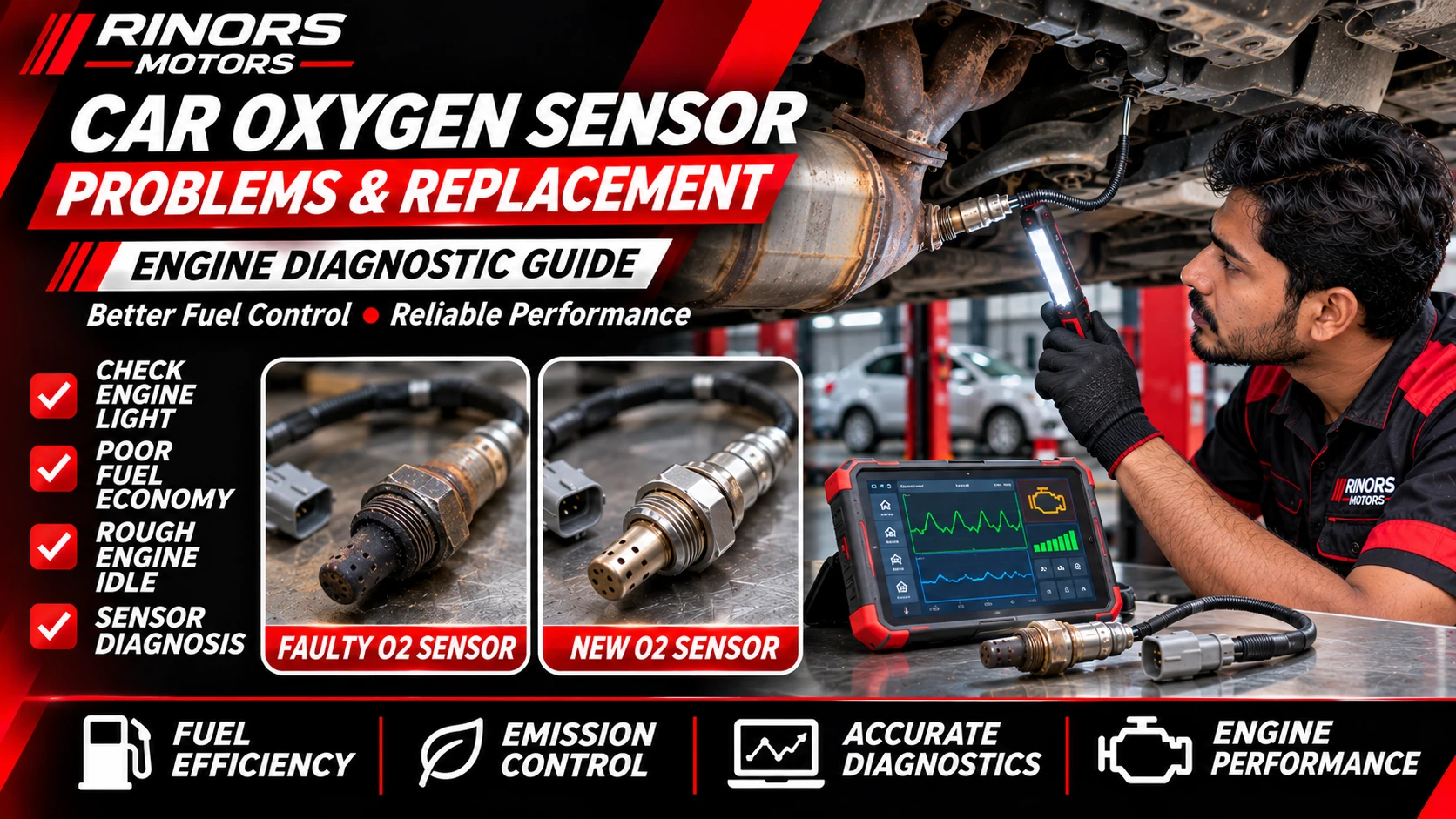
A faulty oxygen sensor, also called an O2 sensor or lambda sensor, could be one possible cause.
Oxygen sensors are important components of modern petrol-engine management systems. They provide information about the oxygen remaining in exhaust gases, helping the engine control system manage the air-fuel mixture and monitor emissions-related performance.
When an oxygen sensor develops a fault, the engine management system may receive inaccurate information or lose an important feedback signal.
However, not every oxygen sensor fault code means the sensor itself is defective. Air leaks, exhaust leaks, fuel delivery problems, wiring damage, and other engine issues can produce similar symptoms.
For drivers in Bangladesh, understanding oxygen sensor problems can help reduce unnecessary repair expenses and support proper engine maintenance.
Whether you own a Toyota Corolla, Axio, Premio, Allion, Aqua, Honda Civic, Vezel, Nissan X-Trail, or another petrol-engine vehicle, this guide explains oxygen sensor functions, warning signs, fault codes, diagnostic procedures, and replacement considerations.
What Is a Car Oxygen Sensor?
An oxygen sensor is an electronic sensor installed in the engine's exhaust system.
It measures or responds to the amount of oxygen remaining in the exhaust gases.
The engine control unit uses this information, together with data from other sensors, to manage engine operation.
Main Functions of an Oxygen Sensor
Provide exhaust oxygen information to the engine control system.
Support accurate air-fuel mixture control.
Help maintain efficient combustion.
Support fuel economy under appropriate operating conditions.
Help control exhaust emissions.
Assist in monitoring catalytic converter performance where applicable.
Provide diagnostic information about engine and emissions-system operation.
The exact function depends on whether the sensor is located before or after the catalytic converter and whether it is a conventional or wideband sensor.
How Does an Oxygen Sensor Work?
A petrol engine requires a suitable mixture of air and fuel to operate efficiently.
The engine control unit calculates fuel injection based on information from several sensors.
An oxygen sensor provides feedback about conditions in the exhaust.
Rich Air-Fuel Mixture
A rich mixture contains more fuel relative to air than the target mixture.
Depending on operating conditions, this can contribute to higher fuel consumption and increased emissions.
Lean Air-Fuel Mixture
A lean mixture contains more air relative to fuel than the target mixture.
A lean condition may result from factors such as unmetered air entering the engine or inadequate fuel delivery.
Closed-Loop Fuel Control
Under suitable operating conditions, the engine control unit uses exhaust sensor feedback to adjust fuel delivery.
This process is commonly known as closed-loop fuel control.
A properly functioning sensor helps the system respond to changes in combustion conditions.
However, modern engines use multiple sensors and control strategies, so oxygen sensor information is only one part of the overall engine management system.
Upstream vs Downstream Oxygen Sensor: What's the Difference?
Many modern petrol vehicles have more than one oxygen-related exhaust sensor.
Their positions and functions are important during diagnosis.
Upstream Oxygen Sensor — Sensor 1
The upstream sensor is positioned before the catalytic converter.
It provides information used for air-fuel control in applicable systems.
On many modern vehicles, the upstream component is a wideband air-fuel ratio sensor rather than a conventional narrowband oxygen sensor.
Possible upstream sensor problems may affect:
Air-fuel mixture feedback.
Fuel trim correction.
Fuel economy.
Engine drivability.
Emissions performance.
Downstream Oxygen Sensor — Sensor 2
The downstream sensor is normally positioned after the catalytic converter.
Its primary purpose in many systems is to help monitor catalytic converter performance.
Depending on the vehicle, its information may also contribute to certain fuel-control or diagnostic functions.
What Do Bank 1 and Bank 2 Mean?
Bank 1 refers to the engine cylinder bank containing cylinder number one.
Bank 2 refers to the other cylinder bank in applicable multi-bank engines.
Most inline four-cylinder engines have only one cylinder bank.
Common Sensor Locations
Bank 1 Sensor 1: Before the catalytic converter on Bank 1.
Bank 1 Sensor 2: After the catalytic converter on Bank 1.
Bank 2 Sensor 1: Before the catalytic converter on Bank 2.
Bank 2 Sensor 2: After the catalytic converter on Bank 2.
Not every vehicle uses all these sensor positions.
Oxygen Sensor vs Air-Fuel Ratio Sensor
The terms oxygen sensor and air-fuel ratio sensor are sometimes used interchangeably, but the technologies can differ.
Conventional Narrowband Oxygen Sensor
A conventional narrowband oxygen sensor is designed to indicate whether the exhaust mixture is relatively rich or lean around a particular operating point.
On certain systems, its signal voltage switches between relatively low and high levels during closed-loop operation.
Wideband Air-Fuel Ratio Sensor
A wideband sensor, sometimes called an A/F sensor, provides more detailed information about air-fuel mixture conditions over a wider operating range.
Its operating principle and diagnostic signals differ from those of a conventional narrowband oxygen sensor.
Why the Difference Matters
A voltage test suitable for a conventional narrowband sensor may not be valid for a wideband sensor.
Using an incorrect testing procedure can result in a false diagnosis or component damage.
Always identify the exact sensor design before testing or purchasing a replacement.
7 Possible Warning Signs of a Bad Oxygen Sensor
Oxygen sensor faults can cause several symptoms, but none of these signs alone confirms sensor failure.
1. Check Engine Light Appears
One of the most common indications of an oxygen-sensor-related problem is an illuminated check engine light.
The engine control unit may detect:
Incorrect sensor signal behavior.
Slow sensor response.
Sensor heater circuit faults.
Electrical circuit problems.
Implausible exhaust oxygen readings.
A diagnostic scanner can retrieve the stored fault codes.
However, these codes must be interpreted alongside other engine data.
2. Increased Fuel Consumption
An oxygen sensor that provides incorrect feedback may affect fuel mixture control.
In some situations, this can contribute to higher fuel consumption.
You may notice that the vehicle requires more fuel than usual for similar journeys.
However, poor fuel economy can also result from:
Incorrect tyre pressure.
Heavy traffic.
Faulty fuel injectors.
Ignition problems.
Intake system faults.
Engine temperature sensor problems.
Other mechanical issues.
Fuel consumption alone is not a reliable oxygen sensor diagnostic test.
3. Rough Engine Idle
A malfunctioning upstream oxygen or air-fuel ratio sensor may contribute to incorrect fuel adjustments under certain conditions.
This can sometimes affect engine smoothness.
Possible symptoms include:
Unstable engine speed.
Engine shaking while stationary.
Occasional hesitation.
Uneven engine operation.
However, spark plugs, ignition coils, throttle body problems, vacuum leaks, and fuel delivery faults can produce similar symptoms.
4. Engine Hesitation During Acceleration
Some air-fuel control problems can contribute to hesitation or inconsistent engine response.
The driver may notice sluggish performance or delayed acceleration.
However, many engines operate with different fuel control strategies during acceleration, and a faulty oxygen sensor is only one possible cause.
Throttle control, ignition, fuel pressure, and transmission problems should also be considered.
5. Increased Exhaust Emissions
Oxygen sensors help support proper fuel control and emissions-system monitoring.
An oxygen sensor fault can contribute to increased exhaust emissions in certain operating conditions.
The vehicle may fail an applicable emissions inspection if the engine or emissions system is not functioning correctly.
However, high emissions may also result from catalytic converter problems, fuel system faults, ignition misfires, or mechanical engine issues.
6. Abnormal Fuel Trim Readings
Professional diagnostic scanners can display fuel trim information.
Fuel trims indicate how the engine control system is adjusting fuel delivery relative to its calculated starting point.
Abnormal short-term or long-term fuel trims may reveal an air-fuel mixture problem.
Possible causes include:
Intake air leaks.
Incorrect airflow measurement.
Fuel pressure problems.
Fuel injector faults.
Exhaust leaks.
Oxygen or air-fuel sensor faults.
Fuel trim readings must be interpreted according to the specific engine and operating conditions.
7. Repeated Emissions-Related Fault Codes
A vehicle may repeatedly record oxygen sensor or fuel mixture trouble codes.
Clearing the codes without correcting the underlying problem often results in the warning returning.
Possible issues include a defective sensor, wiring problem, exhaust leak, or another engine condition.
A proper diagnosis should identify why the code is appearing.
Common Oxygen Sensor OBD-II Fault Codes
Diagnostic trouble codes are useful starting points for identifying oxygen sensor problems.
However, a trouble code does not automatically confirm that a sensor needs replacement.
P0130 — O2 Sensor Circuit Malfunction
This code generally relates to an oxygen sensor circuit problem involving Bank 1 Sensor 1.
Potential causes include wiring faults, sensor problems, connectors, or other conditions affecting sensor operation.
P0133 — O2 Sensor Slow Response
This code can indicate that the oxygen sensor is responding more slowly than expected under the system's monitored conditions.
Possible causes may include sensor deterioration, contamination, wiring problems, or other engine-related conditions.
P0135 — O2 Sensor Heater Circuit Malfunction
This code generally relates to the heater circuit of Bank 1 Sensor 1.
Possible causes include:
Defective sensor heater.
Damaged wiring.
Faulty electrical supply.
Connector problems.
Control circuit faults.
The heater circuit should be tested before replacing the sensor.
P0141 — O2 Sensor Heater Circuit Malfunction
This code commonly relates to the heater circuit of Bank 1 Sensor 2.
A qualified technician should verify the relevant power supply, ground or control circuit, and heater condition.
P0171 — System Too Lean
This code indicates that the fuel control system has detected a lean condition on Bank 1 under the applicable diagnostic criteria.
It is not specifically an oxygen sensor failure code.
Possible causes include air leaks, fuel pressure problems, airflow measurement issues, or other faults.
P0420 — Catalyst System Efficiency Below Threshold
P0420 commonly indicates that the catalytic converter monitoring system has detected performance below the expected threshold on Bank 1.
It does not automatically mean the downstream oxygen sensor is faulty.
Possible causes can include:
Catalytic converter deterioration.
Exhaust leaks.
Engine misfires.
Incorrect air-fuel mixture.
Sensor or wiring problems.
Other emissions-system issues.
Replacing an oxygen sensor without diagnosing the catalytic converter and related systems may not resolve P0420.
Why Do Oxygen Sensors Fail?
Oxygen sensors operate in a demanding environment with high exhaust temperatures and exposure to combustion byproducts.
Several factors can contribute to deterioration.
1. Normal Ageing
Sensor performance may change over time because of repeated thermal cycling and long-term exposure to exhaust gases.
2. Oil Contamination
Excessive engine oil consumption may expose the sensing element to contaminants that interfere with its operation.
3. Coolant Contamination
Certain internal engine problems can allow coolant to enter the combustion process.
Contamination from combustion products may damage the sensor.
4. Fuel-Related Contamination
Certain fuel additives, contaminants, or combustion conditions may affect sensor performance.
5. Wiring Damage
Oxygen sensors are installed near hot exhaust components.
Damaged wires, melted insulation, or poor connections may interrupt the sensor signal or heater circuit.
6. Exhaust Leaks
An exhaust leak near or before the sensor can allow unwanted air into the exhaust stream.
This may affect sensor readings and lead to an incorrect diagnosis.
7. Heater Circuit Failure
Many modern oxygen sensors contain integrated heaters that help the sensor reach its operating temperature.
A heater failure can prevent normal sensor operation during certain conditions.
8. Mechanical Damage
Impact damage, incorrect installation, excessive force, or damaged electrical connectors can affect the sensor.
Can a Bad Oxygen Sensor Cause High Fuel Consumption?
Yes, in certain circumstances.
An upstream oxygen or air-fuel ratio sensor provides important feedback for fuel mixture control.
If the sensor provides inaccurate information, the engine control unit may make inappropriate fuel corrections or use an alternative control strategy.
This can affect fuel economy.
However, the effect depends on:
Sensor location.
Sensor design.
Nature of the fault.
Engine control strategy.
Operating conditions.
Other engine-system problems.
A downstream sensor fault may primarily affect emissions monitoring rather than directly causing a major fuel economy change.
Therefore, high fuel consumption should not automatically be attributed to an oxygen sensor.
Oxygen Sensor vs Catalytic Converter Problems
The oxygen sensor and catalytic converter are different components of the exhaust emissions system.
Oxygen Sensor
Measures or responds to oxygen conditions in the exhaust and provides information to the engine control system.
Catalytic Converter
Uses catalytic reactions to reduce certain harmful exhaust pollutants when operating properly.
Why Are They Confused?
Many vehicles use oxygen sensors before and after the catalytic converter.
The engine control system can compare sensor information to assess aspects of converter performance.
A catalytic converter efficiency code may be recorded when the system detects an abnormal relationship between relevant sensor signals.
However, the actual cause may involve:
Catalytic converter deterioration.
Exhaust leakage.
Air-fuel mixture problems.
Misfires.
Sensor faults.
Electrical problems.
Should You Replace the Oxygen Sensor for P0420?
Not without diagnosis.
A new oxygen sensor will not repair a physically damaged or ineffective catalytic converter.
Likewise, replacing a catalytic converter will not correct an unrelated sensor heater wiring fault.
Proper testing is essential.
Oxygen Sensor Problems vs Fuel Injector Problems
Oxygen sensor and injector faults can produce overlapping symptoms.
Possible Oxygen Sensor Problems
Incorrect exhaust feedback.
Abnormal fuel trim correction.
Sensor circuit fault codes.
Heater circuit problems.
Emissions monitoring faults.
Possible Fuel Injector Problems
Incorrect fuel delivery.
Engine misfires.
Rough running.
Starting problems.
Fuel mixture abnormalities.
A leaking or restricted injector can create exhaust readings that appear abnormal even when the oxygen sensor is operating correctly.
The engine's fuel delivery system should be evaluated before deciding which component is responsible.
How Are Oxygen Sensor Problems Diagnosed?
Professional diagnosis should follow the manufacturer-specific system design.
Step 1: Identify the Vehicle and Sensor
The technician confirms:
Vehicle model.
Engine code.
Sensor type.
Sensor location.
Relevant cylinder bank.
Electrical connector configuration.
Step 2: Scan Diagnostic Trouble Codes
An appropriate OBD-II diagnostic scanner is used to retrieve fault codes and related diagnostic information.
Freeze-frame data may help identify the conditions in which a fault occurred.
Step 3: Inspect the Sensor and Wiring
The technician checks accessible wiring, connectors, insulation, and mounting conditions.
Step 4: Check for Exhaust Leaks
Leaks near the sensor or upstream of it may affect oxygen measurements.
These should be investigated before concluding that the sensor has failed.
Step 5: Review Fuel Trim Data
Short-term and long-term fuel trim readings may help determine whether the engine is correcting a rich or lean mixture.
Step 6: Evaluate Sensor Response
The technician evaluates sensor behavior using procedures appropriate for the exact sensor technology.
Conventional narrowband and wideband sensors require different testing methods.
Step 7: Test the Heater Circuit
If a heater-related code is present, the technician checks the appropriate electrical supply and control circuits.
Step 8: Inspect Related Engine Systems
Depending on the findings, additional inspection may include:
Air intake leaks.
Fuel pressure.
Fuel injectors.
Ignition system.
Engine mechanical condition.
Exhaust system.
Catalytic converter operation.
Step 9: Confirm the Actual Fault
Only after completing appropriate tests should a sensor or another component be recommended for replacement.
Step 10: Verify the Repair
After the repair, the technician checks the relevant sensor information, fault codes, and engine operation.
Where appropriate, the vehicle is operated under the conditions needed for emissions-system self-tests to complete.
Can an Oxygen Sensor Be Cleaned Instead of Replaced?
Oxygen sensors are precision electronic components.
Cleaning a sensor with unsuitable chemicals, abrasive tools, or aggressive mechanical methods may damage its sensing element.
When Cleaning Is Not Appropriate
Cleaning should not be considered a reliable repair for:
A failed heater circuit.
Broken internal sensing components.
Damaged wiring.
An electrically defective sensor.
Significant internal sensor deterioration.
What if the Sensor Has Carbon Deposits?
Visible deposits may indicate an underlying engine problem.
Cleaning the sensor without correcting the cause of contamination may not resolve the issue.
In many applications, a confirmed defective oxygen sensor is replaced rather than internally repaired.
Follow the sensor manufacturer's instructions.
When Should an Oxygen Sensor Be Replaced?
There is no universal replacement interval suitable for every oxygen sensor.
Some vehicle manufacturers specify maintenance or inspection requirements, while others recommend replacement based on confirmed failure.
Factors Affecting Sensor Life
Sensor construction.
Engine operating conditions.
Exhaust temperatures.
Fuel quality and contamination.
Oil or coolant contamination.
Wiring and connector condition.
Vehicle mileage.
Overall engine maintenance.
A sensor should be replaced when manufacturer guidance or diagnostic findings establish the need.
Replacing every oxygen sensor at an arbitrary mileage may create unnecessary expense.
How Is an Oxygen Sensor Replaced?
A professional replacement service may include the following steps.
Step 1: Confirm the Failed Component
The technician identifies the exact sensor and fault.
Step 2: Select the Correct Replacement
The new sensor must match the vehicle's specifications and required location.
Step 3: Prepare the Vehicle Safely
The vehicle is secured, and exhaust components are allowed to cool.
Step 4: Disconnect the Electrical Connector
The sensor's electrical connection is disconnected according to the service procedure.
Step 5: Remove the Old Sensor
A suitable oxygen sensor socket or manufacturer-approved tool may be used.
Step 6: Inspect the Mounting Threads
The exhaust mounting point is checked for damage or contamination.
Step 7: Install the Correct Sensor
The replacement is installed according to the manufacturer's instructions.
Some sensors are supplied with pre-applied thread treatment. Additional compound should not be used unless specifically permitted.
Step 8: Route and Secure the Wiring
The sensor cable is kept clear of hot surfaces, moving parts, and other potential damage.
Step 9: Complete Required Diagnostic Procedures
Relevant fault codes are addressed, and any applicable manufacturer service procedures are performed.
Step 10: Verify Sensor Operation
The technician confirms appropriate sensor operation and checks that the original problem has been resolved.
Safety Warning: Exhaust components can remain extremely hot after the engine is switched off. Oxygen sensor removal can also damage exhaust threads if performed incorrectly. Use qualified technicians and suitable equipment.
Toyota Oxygen Sensor Problems in Bangladesh
Toyota vehicles are common in Bangladesh, but oxygen sensor and air-fuel ratio sensor designs differ by engine.
Toyota Corolla and Axio
Many petrol-powered Corolla and Axio variants use exhaust oxygen feedback to support engine fuel control.
If a check engine warning appears, the technician should verify the exact diagnostic code and sensor configuration.
A fault involving Bank 1 Sensor 1 should not automatically be treated as an identical replacement requirement across different Corolla and Axio generations.
Toyota Premio and Allion
Different Premio and Allion petrol engines may use wideband air-fuel ratio sensors upstream and conventional oxygen sensors downstream.
The exact arrangement depends on the engine and production year.
Correct parts identification is essential.
Toyota Aqua Hybrid
The Toyota Aqua uses a petrol engine as part of its hybrid system.
The petrol engine also uses emissions-related sensors appropriate to its design.
However, hybrid operating behavior differs from that of a conventional petrol-only vehicle.
The engine may stop automatically when the hybrid system does not require petrol engine operation.
This is normal and should not automatically be mistaken for oxygen sensor failure or stalling.
Toyota Corolla Axio Hybrid
The Corolla Axio Hybrid also uses petrol-engine management and emissions control systems.
Diagnosis should follow the exact engine and hybrid vehicle configuration.
Hybrid Safety: Hybrid vehicles may automatically start their petrol engines while the system is active. Proper shutdown procedures are essential before engine or exhaust-system work.
Honda and Nissan Oxygen Sensor Problems
Honda Civic, Grace, Vezel, Nissan X-Trail, and other vehicles also use oxygen-related sensors according to their engine configurations.
However, sensor type, position, connector, and diagnostic procedure may vary.
Some engines use multiple oxygen or air-fuel ratio sensors.
Never assume that all sensors on the same vehicle are interchangeable.
Confirm the exact part number and sensor location before purchasing a replacement.
How Much Does Oxygen Sensor Replacement Cost in Bangladesh?
Oxygen sensor prices in Bangladesh vary depending on the vehicle and required sensor.
Main Cost Factors
Vehicle brand and model.
Engine code.
Upstream or downstream sensor.
Narrowband or wideband sensor design.
Original-equipment or compatible aftermarket part.
Electrical connector configuration.
Accessibility of the sensor.
Diagnostic testing.
Installation labor.
Warranty.
A wideband air-fuel ratio sensor may have a different price from a conventional downstream oxygen sensor.
The total repair cost also depends on whether the problem involves only the sensor or related wiring and engine-system faults.
Request a quotation based on the correct vehicle and part number.
How to Choose the Correct Oxygen Sensor
Correct sensor selection is essential for proper engine operation.
Vehicle Details to Verify
Manufacturer.
Exact model.
Production year.
Engine code.
Chassis or VIN.
Sensor bank.
Sensor number.
Original part number.
Sensor Specifications to Check
Narrowband or wideband design.
Heater configuration.
Electrical connector type.
Wire length and routing.
Sensor thread and mounting specifications.
Compatibility with the engine control system.
Original vs Aftermarket Oxygen Sensors
Original-equipment and suitable aftermarket oxygen sensors may be available.
However, the replacement must meet the vehicle's technical requirements.
A physically similar sensor may have different signal characteristics, heater specifications, or wiring.
Why Universal Sensors Require Care
Some aftermarket oxygen sensors are marketed as universal replacements.
However, fitting them may require specific wiring or connector procedures, and not every vehicle is compatible.
Where possible, a vehicle-specific direct-fit sensor is often the more straightforward choice.
Follow the manufacturer's recommendations.
Can You Drive With a Bad Oxygen Sensor?
The answer depends on the nature of the fault and the vehicle's operating condition.
A faulty oxygen sensor may not immediately prevent the engine from running.
However, continued operation can contribute to:
Incorrect fuel mixture control.
Reduced fuel economy.
Increased emissions.
Poor drivability.
Additional stress on emissions-related components in some situations.
A check engine warning may also indicate another problem unrelated to the oxygen sensor.
When to Stop Driving
Stop safely and arrange assistance if the vehicle develops:
Severe engine hesitation.
Repeated stalling.
Significant loss of power.
Strong overheating symptoms.
Serious abnormal engine noise.
A flashing check engine light associated with severe misfiring.
A flashing check engine light can indicate a condition that risks catalytic converter damage in many vehicles.
Do not continue demanding driving while severe engine faults are present.
How to Help Prevent Oxygen Sensor Problems
Not every oxygen sensor failure is preventable, but proper engine maintenance can reduce avoidable contamination and related problems.
1. Maintain the Ignition System
Faulty spark plugs or ignition coils may cause incomplete combustion and increase emissions-system stress.
2. Repair Excessive Engine Oil Consumption
Oil entering the combustion process can contaminate exhaust components.
3. Address Coolant Leakage Into the Engine
Internal coolant leaks can create serious combustion and exhaust-system problems.
4. Maintain the Fuel System
Incorrect fuel delivery may affect combustion conditions and sensor readings.
5. Repair Exhaust Leaks
Exhaust leaks can distort sensor information and contribute to incorrect diagnosis.
6. Protect Sensor Wiring
Damaged wiring or connectors near hot exhaust components should be repaired.
7. Use Compatible Replacement Parts
Choose the correct sensor design and part number.
8. Follow Manufacturer Maintenance Guidance
Use the appropriate maintenance schedule for the exact vehicle.
9. Investigate Check Engine Warnings
Do not repeatedly clear fault codes without identifying their cause.
10. Avoid Unnecessary Sensor Replacement
Diagnosis should confirm the need before replacing an oxygen sensor.
Frequently Asked Questions About Oxygen Sensors
What Are the Signs of a Bad Oxygen Sensor?
Possible signs include a check engine warning, poor fuel economy, rough idling, abnormal fuel trim readings, and emissions-related faults.
However, these symptoms can have several other causes.
Can a Bad O2 Sensor Increase Fuel Consumption?
Yes. Certain upstream oxygen or air-fuel ratio sensor faults can affect fuel mixture control and contribute to increased fuel consumption.
Can an Oxygen Sensor Cause Rough Idle?
A faulty sensor can contribute to improper fuel adjustments under certain conditions, but ignition faults, air leaks, and other engine problems can cause similar symptoms.
Should Both Oxygen Sensors Be Replaced Together?
Not automatically.
Replace the defective sensor when required by manufacturer instructions or confirmed diagnostic findings.
What Is the Difference Between Sensor 1 and Sensor 2?
Sensor 1 generally refers to the upstream sensor before the catalytic converter.
Sensor 2 generally refers to the downstream sensor after the catalytic converter.
Their functions and technologies may differ.
Does P0420 Mean the Oxygen Sensor Is Bad?
No. P0420 is generally related to catalytic converter efficiency monitoring.
An oxygen sensor fault is only one possible contributing cause.
Can a Faulty O2 Sensor Cause the Check Engine Light?
Yes. Signal, response, and heater circuit problems may trigger diagnostic codes and the check engine light.
Can Oxygen Sensors Be Cleaned?
Cleaning is not a reliable repair for internal electronic failure. Aggressive cleaning methods may damage the sensing element.
How Often Should an Oxygen Sensor Be Changed?
Replacement intervals vary by vehicle and sensor type. Follow manufacturer guidance and replace sensors when necessary based on confirmed condition.
Can I Replace an Oxygen Sensor Myself?
Oxygen sensor replacement requires correct part selection, safe access to exhaust components, suitable tools, and proper installation procedures.
Professional replacement is recommended, especially where sensors are difficult to access or seized in the exhaust.
Do Hybrid Cars Have Oxygen Sensors?
Yes. Petrol-electric hybrid vehicles commonly use oxygen or air-fuel ratio sensors for their petrol-engine management and emissions systems.
Oxygen Sensor Diagnosis & Replacement at Rinors Motors
At Rinors Motors, we understand the importance of accurate engine diagnostics, proper fuel mixture control, and reliable vehicle performance for drivers in Bangladesh.
If your car displays a check engine warning, experiences unexpectedly high fuel consumption, runs roughly, or records an oxygen sensor-related fault code, identifying the actual cause is essential.
A professional diagnostic inspection can help distinguish a defective oxygen sensor from damaged wiring, exhaust leaks, fuel injector problems, ignition faults, and catalytic converter issues.
Whether you own a Toyota, Honda, Nissan, or another vehicle, selecting the correct upstream or downstream sensor is important for proper engine management and compatibility.
Contact Rinors Motors to discuss oxygen sensor diagnostics, air-fuel ratio sensor problems, compatible replacement parts, and appropriate engine repair options for your vehicle.
Rinors Motors — Your Trusted Automotive Partner in Bangladesh.