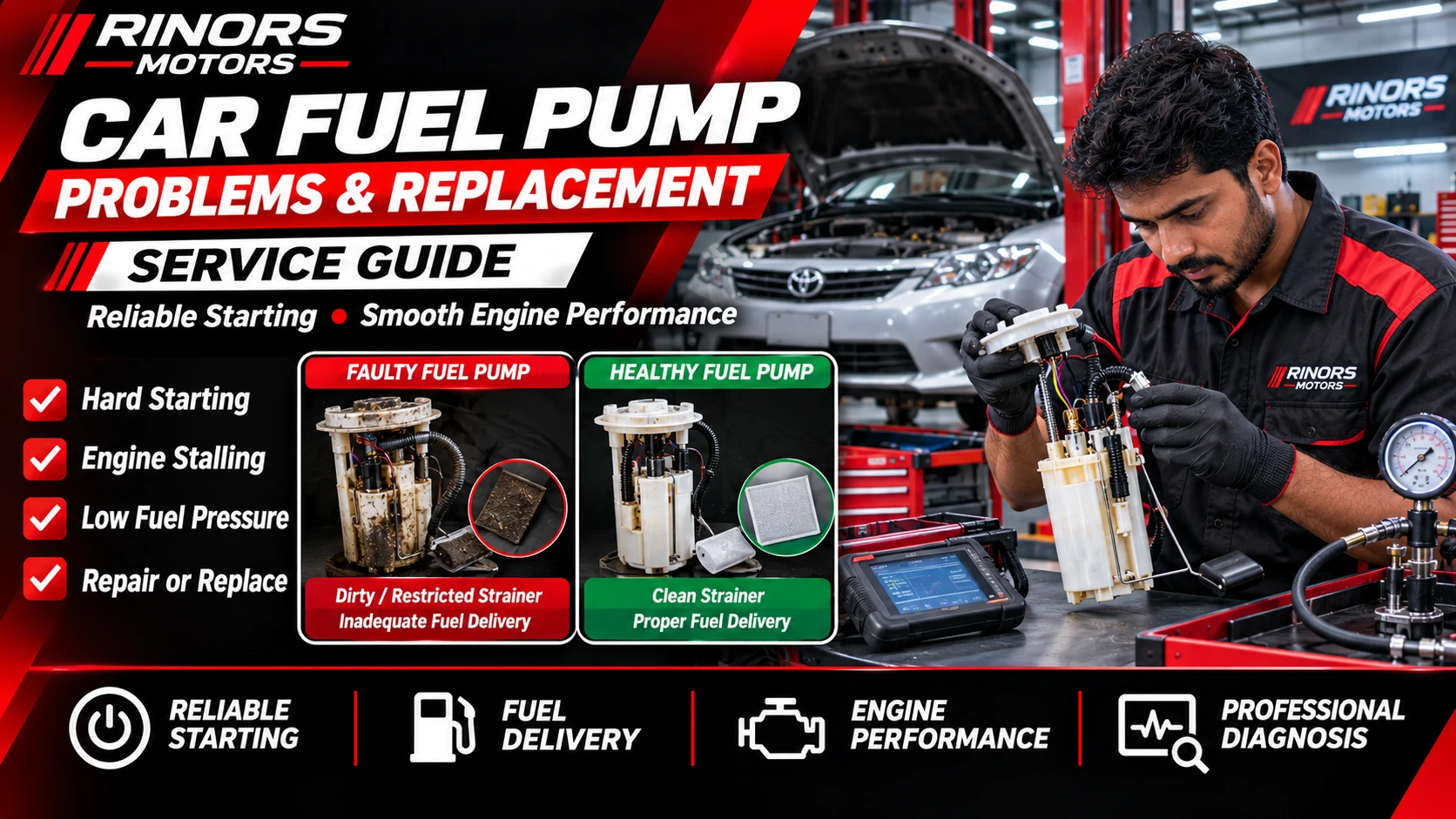
Car Fuel Pump Problems in Bangladesh: Complete Diagnosis & Replacement Guide
Is your car taking longer than usual to start? Does the engine suddenly lose power, hesitate during acceleration, or stop unexpectedly while driving? A faulty fuel pump could be one possible cause.
The fuel pump is an essential component of a vehicle's fuel delivery system. It supplies fuel from the tank to the engine at the pressure and flow required by the specific fuel injection system.
When a fuel pump becomes weak or stops working, the engine may not receive enough fuel to operate correctly.
In Bangladesh, contaminated fuel, electrical problems, ageing components, and demanding driving conditions can contribute to fuel-system issues.
Whether you drive a Toyota Corolla, Axio, Premio, Allion, Aqua, Honda Civic, Vezel, or Nissan vehicle, understanding fuel pump problems can help you recognize warning signs and avoid unnecessary replacement expenses.
This guide explains the symptoms of a failing fuel pump, common causes, professional diagnostic procedures, repair options, and replacement considerations.
What Is a Car Fuel Pump?
A fuel pump is a mechanical or electrically operated device responsible for moving fuel from the tank toward the engine.
Most modern petrol passenger cars use an electric fuel pump located inside the fuel tank.
The pump supplies fuel to the engine's fuel injection system at an appropriate pressure.
Main Functions of a Fuel Pump
Transfer fuel from the tank toward the engine.
Provide the required fuel delivery pressure.
Maintain sufficient fuel flow during engine operation.
Support reliable engine starting.
Help maintain consistent acceleration.
Supply fuel under different engine loads.
Support normal fuel injection system performance.
A properly functioning fuel pump is necessary for reliable engine operation.
How Does a Modern Car Fuel Pump Work?
When the engine control system commands fuel delivery, the electric fuel pump moves fuel from the tank into the fuel supply system.
Depending on the vehicle design, fuel may pass through a filter and pressure-control components before reaching the fuel injectors.
The engine control system coordinates fuel delivery with engine operating conditions.
Main Components of a Fuel Delivery System
Fuel Tank: Stores petrol or diesel.
Electric Fuel Pump: Transfers fuel from the tank.
Fuel Pump Strainer: Helps prevent larger contaminants from entering the pump.
Fuel Filter: Removes contaminants in systems equipped with a separate or integrated filter.
Fuel Pressure Regulator: Controls fuel pressure in applicable designs.
Fuel Lines: Carry fuel through the system.
Fuel Injectors: Deliver controlled quantities of fuel into the engine.
Fuel Pump Control Module or Relay: Controls pump operation, depending on the vehicle.
Fuel Pressure Sensor: Monitors pressure in systems equipped with appropriate sensors.
Not every vehicle uses the same configuration.
Low-Pressure vs High-Pressure Fuel Pumps
Many conventional petrol injection systems use an electric fuel pump to supply fuel at the required injection pressure.
Some gasoline direct-injection engines have two stages:
A low-pressure electric supply pump, commonly located in the fuel tank.
A high-pressure pump that increases fuel pressure for direct injection.
These pumps serve different functions and require different diagnostic procedures.
8 Warning Signs of a Bad Car Fuel Pump
1. Difficulty Starting the Engine
One of the common symptoms of inadequate fuel delivery is prolonged engine cranking.
You may notice that the starter motor turns the engine normally, but the engine takes longer than expected to start.
A weak pump, pressure-retention problem, or another fuel delivery fault may contribute to this symptom.
However, starting problems can also result from:
Weak battery voltage.
Starter-related problems.
Faulty ignition components.
Engine sensor failures.
Fuel injector issues.
Security or immobilizer faults.
A proper diagnosis is necessary before replacing the pump.
2. Engine Cranks but Does Not Start
If the engine turns over but fails to start, insufficient fuel pressure is one possible cause.
A completely failed fuel pump may prevent the engine from receiving the fuel it needs.
However, a crank-no-start condition does not automatically mean the fuel pump has failed.
Technicians must also check ignition, engine control, sensor signals, electrical supply, and other relevant systems.
3. Engine Stalling While Driving
An engine may stall if fuel delivery becomes interrupted.
In some cases, an ageing pump or faulty electrical connection works intermittently, causing the engine to stop unexpectedly.
Possible symptoms include:
Sudden loss of engine power.
Engine stopping during normal driving.
Difficulty restarting after a stall.
Intermittent engine operation.
Important: Unexpected engine stalling can create a serious driving hazard. If your vehicle repeatedly stalls, stop safely and arrange professional inspection.
4. Hesitation During Acceleration
A vehicle that hesitates, jerks, or struggles to accelerate may not be receiving sufficient fuel under load.
A weak fuel pump may provide enough fuel during idle but fail to maintain the required flow during demanding driving conditions.
However, similar symptoms can result from ignition problems, injector faults, air-intake issues, or transmission-related problems.
5. Loss of Power Under Heavy Load
Your engine may require greater fuel flow during acceleration, climbing hills, or carrying additional passengers.
If the fuel delivery system cannot meet this demand, engine performance may deteriorate.
Possible symptoms include:
Reduced acceleration.
Hesitation when climbing hills.
Loss of power at higher engine loads.
Difficulty maintaining normal performance.
The actual cause should be confirmed through diagnostic testing.
6. Unusual Whining Noise From the Fuel Tank
Some electric fuel pumps produce a faint operating sound, which may be normal.
However, a new, unusually loud, or changing whining sound from the fuel tank area may indicate a pump-related problem.
Possible causes include:
Internal pump wear.
Fuel supply restrictions.
Cavitation or inadequate fuel supply.
Other abnormal operating conditions.
Not every noisy pump is defective, and not every failed pump produces an unusual sound.
7. Engine Surging or Unstable Performance
Inconsistent fuel delivery can sometimes contribute to changes in engine power or smoothness.
You may notice unusual engine hesitation or inconsistent performance under steady driving conditions.
However, problems involving sensors, throttle control, ignition, or fuel injectors can produce similar symptoms.
8. Check Engine Light or Fuel Pressure Warning
Certain fuel delivery problems can trigger diagnostic trouble codes.
One example is:
P0087 — Fuel Rail/System Pressure Too Low
This code may indicate that the measured fuel pressure is below the expected range under certain conditions.
However, low fuel pressure does not automatically prove the fuel pump is defective.
Other possible causes include a restricted filter, fuel pressure regulator, sensor, electrical supply issue, or high-pressure fuel system fault.
The complete fuel system must be evaluated.
Why Do Car Fuel Pumps Fail?
Several factors can contribute to fuel pump damage or poor performance.
1. Fuel Contamination
Dirt, water, and other contaminants can enter the fuel system and affect precision components.
Depending on the amount and type of contamination, the pump, strainer, filters, or other fuel-system parts may become damaged.
2. Electrical Connection Problems
Fuel pumps depend on proper electrical supply and control.
Problems may include:
Loose connectors.
Damaged wiring.
Poor ground connections.
Corroded terminals.
Overheated connectors.
Faulty relays or control modules.
A healthy fuel pump may perform poorly if it does not receive the correct electrical supply.
3. Internal Mechanical Wear
Electric fuel pumps contain moving or electrically driven components that may deteriorate over time.
Ageing can lead to reduced efficiency, inconsistent performance, or complete failure.
4. Fuel Supply Restrictions
A restricted pump pickup strainer or fuel filter can interfere with normal fuel delivery.
The source and location of the restriction depend on the vehicle design.
5. Incorrect Replacement Parts
Installing a pump with unsuitable pressure, flow, electrical, or mechanical specifications can cause fuel delivery problems.
Even parts that physically fit may not be appropriate for a particular vehicle.
6. Frequent Operation With Very Low Fuel
Some in-tank pumps rely partly on the surrounding fuel for cooling or lubrication.
Repeated operation with very little fuel may contribute to unfavorable operating conditions in certain designs.
However, fuel pump durability depends on the specific pump design and vehicle.
7. Improper Installation
Damaged seals, incorrect connectors, contaminated fuel tanks, or poorly fitted pump modules can create problems after replacement.
Fuel Pump vs Fuel Injector: What's the Difference?
Fuel pumps and fuel injectors are both part of the fuel delivery system, but their functions are different.
Fuel Pump
The pump moves fuel from the tank and supplies it at the required pressure to the relevant fuel system.
Fuel Injector
The injector delivers a controlled quantity of fuel into the engine's intake port or combustion chamber, depending on the engine design.
Can They Cause Similar Problems?
Yes.
Both pump and injector problems can contribute to:
Difficult starting.
Engine hesitation.
Reduced performance.
Engine misfires.
Poor fuel efficiency.
Check engine warnings.
Because the symptoms overlap, technicians should identify the actual fault rather than replacing components based only on symptoms.
Fuel Pump vs Fuel Filter Problems
A restricted fuel filter can reduce fuel delivery even when the pump itself is functioning correctly.
Possible Fuel Filter Problems
Reduced fuel flow.
Restricted fuel supply.
Reduced performance under load.
Contaminated fuel-system components.
Some vehicles use replaceable external filters.
Others integrate filtration components into the fuel pump module.
The appropriate maintenance procedure depends on the vehicle manufacturer.
How Are Fuel Pump Problems Diagnosed?
Professional fuel pump diagnosis should follow the specific vehicle's fuel-system design.
Step 1: Confirm the Customer's Symptoms
The technician first determines when the problem occurs.
Examples include:
During cold starting.
After the engine becomes warm.
During acceleration.
Under heavy engine load.
After refueling.
During intermittent operation.
These details help identify possible causes.
Step 2: Computerized Diagnostic Scan
An appropriate diagnostic scanner is used to check stored fault codes and relevant engine operating information.
Fuel pressure data may also be available on certain vehicles.
Step 3: Check Electrical Supply
The technician verifies relevant electrical power, ground connections, pump control signals, and associated components.
Depending on the vehicle, this may involve checking fuses, relays, wiring, and a fuel pump control module.
Step 4: Measure Fuel Pressure
Fuel pressure is measured using equipment appropriate for the specific fuel system.
Results are compared with the manufacturer's specifications under the correct operating conditions.
There is no single fuel pressure value suitable for every petrol engine.
Step 5: Evaluate Fuel Delivery
Where the manufacturer's procedures permit, fuel delivery performance may be evaluated to determine whether adequate fuel reaches the engine.
Step 6: Inspect Fuel Filtration
The technician considers restrictions caused by fuel filters, strainers, or contamination.
Step 7: Examine the Pump and Related Components
If test results indicate a pump-related fault, the relevant pump module, connectors, and associated components are inspected as appropriate.
Step 8: Repair and Verification
After identifying the cause, defective components are repaired or replaced.
The system is then checked for proper operation and leaks.
Safety Warning: Petrol is highly flammable, and modern direct-injection systems can contain fuel at extremely high pressure. Fuel-system components should only be opened using approved depressurization procedures and professional safety equipment.
Can a Bad Fuel Pump Be Repaired?
The answer depends on the type of fault and fuel pump design.
When Repair May Be Possible
Some problems can be corrected without replacing the pump itself.
Examples include:
Damaged external wiring.
Faulty electrical connectors.
Defective relays.
Certain serviceable control components.
Other repairable external faults.
When Fuel Pump Replacement May Be Necessary
Replacement may be required when:
The electric pump motor has failed internally.
Internal mechanical wear prevents correct operation.
The pump cannot maintain required performance.
Internal components are damaged and not serviceable.
Manufacturer procedures specify replacement.
Many modern in-tank fuel pumps are replaced as individual pump units or complete fuel pump modules.
The correct service method depends on the vehicle.
Fuel Pump Motor vs Complete Fuel Pump Assembly
Some vehicles allow replacement of the electric pump motor separately.
Other designs use a complete module containing several components.
A Fuel Pump Module May Include
Electric fuel pump.
Pump housing.
Fuel pickup strainer.
Fuel level sender.
Electrical connectors.
Fuel pressure regulation components, depending on design.
Internal fuel lines or related parts.
Which Option Is Better?
Replacing only the pump motor may be appropriate when the vehicle design permits it and the other components remain in good condition.
A complete assembly may be preferable when multiple parts are defective or the manufacturer specifies module replacement.
Before ordering parts, confirm the correct replacement configuration.
Toyota Fuel Pump Problems in Bangladesh
Toyota vehicles are widely used in Bangladesh, but different models and production years use different fuel system designs.
Toyota Corolla and Axio
Petrol-powered Corolla and Axio variants may experience starting or fuel delivery problems involving the pump, electrical system, or related components.
Technicians should verify the exact engine and fuel system before deciding on replacement.
Toyota Premio and Allion
Different Premio and Allion generations use specific fuel pump modules and electrical configurations.
Correct compatibility must be checked before purchasing a replacement pump.
Toyota Aqua and Corolla Axio Hybrid
Many Toyota hybrid vehicles use electric fuel pumps for their petrol engines.
However, their engines operate differently from those in conventional petrol-only vehicles.
The petrol engine may stop automatically while the hybrid system remains ready to drive.
Important: An engine that is not running while a hybrid vehicle displays READY is not necessarily experiencing a fuel pump problem.
A genuine no-start, warning, or fuel delivery problem must be diagnosed using model-specific hybrid procedures.
Honda and Nissan Fuel Pump Problems
Honda Civic, Grace, Vezel, Nissan X-Trail, and other vehicles can also develop fuel delivery problems.
However, pump construction, control systems, fuel pressure requirements, and replacement procedures differ by engine and model year.
Do not assume that a fuel pump from one vehicle is compatible with another based only on appearance.
How Much Does Fuel Pump Replacement Cost in Bangladesh?
Fuel pump replacement costs depend on the vehicle and the required repair.
Main Factors Affecting Cost
Vehicle brand and model.
Engine type.
Low-pressure or high-pressure pump application.
Individual pump versus complete module.
Original-equipment or compatible aftermarket parts.
Availability of the correct replacement.
Fuel tank access and installation labor.
Diagnostic testing.
Replacement seals or related components.
Warranty conditions.
A minor electrical repair can cost substantially less than replacing a complete fuel pump module.
Similarly, the cost of a low-pressure in-tank pump can differ significantly from that of a high-pressure direct-injection pump.
A proper quotation should identify the exact faulty component before replacement.
How to Choose the Correct Fuel Pump
When purchasing a fuel pump in Bangladesh, accurate part identification is essential.
Check Vehicle Information
Confirm:
Vehicle manufacturer.
Model and production year.
Engine code.
Fuel injection system.
Vehicle chassis or VIN information.
Original or compatible part number.
Confirm Technical Compatibility
Important characteristics may include:
Required fuel pressure.
Fuel delivery capacity.
Electrical specifications.
Connector design.
Mounting arrangement.
Module construction.
Compatibility with the vehicle control system.
Original vs Aftermarket Fuel Pumps
Original-equipment and compatible aftermarket pumps are available for many vehicles.
However, replacement parts should meet the required specifications.
Verify the supplier, product authenticity, warranty, and compatibility before purchasing.
Can You Drive With a Failing Fuel Pump?
Driving with a suspected fuel pump problem may become unsafe.
A weak or intermittent pump can cause unexpected engine stalling or loss of power.
This is particularly concerning in heavy traffic or during overtaking.
If your vehicle repeatedly loses power, stalls, or becomes difficult to restart, arrange professional diagnosis rather than continuing normal driving.
What if You Smell Petrol?
A strong petrol smell or visible fuel leakage can indicate a dangerous fuel-system problem.
If you suspect a leak:
Stop the vehicle in a safe location.
Switch off the engine.
Avoid smoking, sparks, and ignition sources.
Do not attempt to disconnect pressurized fuel components.
Arrange professional roadside assistance or towing.
Do not continue driving with an active fuel leak.
How to Help Prevent Fuel Pump Problems
Although not every fuel pump failure is preventable, appropriate maintenance can reduce avoidable fuel-system issues.
1. Buy Fuel From Reliable Stations
Use reputable filling stations to reduce the risk of contaminated fuel.
2. Follow the Maintenance Schedule
Maintain the vehicle according to the manufacturer's recommendations.
3. Replace Serviceable Fuel Filters
Where a fuel filter has a specified replacement interval, follow the appropriate maintenance schedule.
4. Avoid Repeatedly Running Very Low on Fuel
Maintaining a reasonable fuel level can help avoid certain low-fuel operating conditions and unexpected fuel starvation.
5. Investigate Electrical Problems
Damaged fuel pump connectors, wiring, and control circuits should be repaired promptly.
6. Use Correct Replacement Parts
Ensure new pumps, seals, strainers, and modules meet vehicle specifications.
7. Address Fuel Contamination
If contaminated fuel is suspected, have the fuel system inspected rather than repeatedly replacing components.
8. Respond to Performance Changes
Persistent hesitation, stalling, and difficult starting should be professionally diagnosed.
Frequently Asked Questions About Car Fuel Pumps
What Are the First Signs of a Bad Fuel Pump?
Possible early symptoms include long engine cranking, intermittent hesitation, unusual fuel-tank noise, or reduced power under load.
However, these symptoms can have other causes.
Can a Bad Fuel Pump Cause an Engine Misfire?
Yes. Inadequate fuel delivery can contribute to combustion problems and misfires. Ignition and injector faults must also be considered.
Can a Car Start With a Weak Fuel Pump?
Yes. A weak pump may still provide enough fuel under certain conditions but fail to maintain proper delivery during higher engine loads.
Does Every Fuel Pump Make Noise Before Failing?
No. Some pumps fail without noticeable noise. Others may produce unusual sounds while still operating.
Will Replacing the Fuel Filter Fix a Fuel Pump Problem?
A restricted filter can affect fuel delivery, but replacing it will not repair a failed pump motor or damaged electrical circuit.
The actual fault must be diagnosed.
Can a Fuel Pump Fail Without a Check Engine Light?
Yes. Not every fuel pump fault causes the engine control system to store a diagnostic code or illuminate a warning light.
Should I Replace the Fuel Pump if My Car Does Not Start?
Not without testing. Starting failure can be caused by numerous electrical, mechanical, and fuel-system problems.
Do Hybrid Cars Have Fuel Pumps?
Yes. Petrol-electric hybrid vehicles commonly use fuel pumps for their petrol engines, although the fuel-system design varies by model.
Car Fuel Pump Inspection & Replacement at Rinors Motors
At Rinors Motors, we understand the importance of a reliable fuel delivery system for everyday driving in Bangladesh.
If your vehicle is difficult to start, stalls unexpectedly, hesitates during acceleration, or shows signs of a fuel pressure problem, identifying the actual cause is essential.
A proper diagnosis can help distinguish a faulty fuel pump from electrical problems, fuel filtration restrictions, injector faults, and other engine issues.
Contact Rinors Motors to discuss fuel-system diagnosis, fuel pump problems, compatible replacement parts, and appropriate repair options for your vehicle.
Rinors Motors — Your Trusted Automotive Partner in Bangladesh.