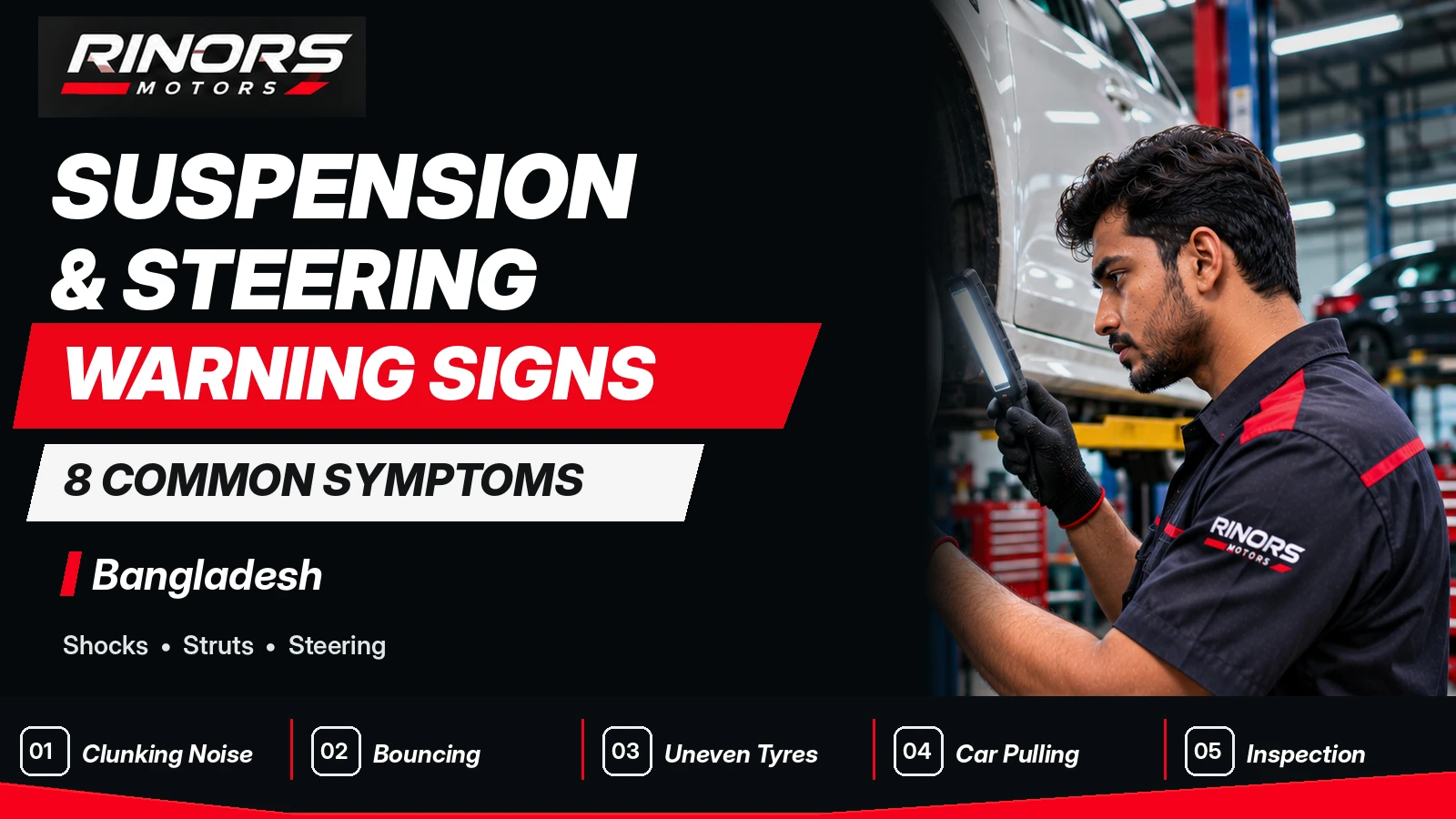
8 Car Suspension & Steering Warning Signs You Should Never Ignore
Your car's suspension and steering systems play an essential role in ride comfort, handling, tire contact, and road safety.
Whether you drive a Toyota Corolla Axio, Toyota Aqua, Toyota Premio, Honda Vezel, Nissan X-Trail, or another vehicle, maintaining these systems is particularly important on Bangladesh's roads.
Potholes, uneven road surfaces, speed bumps, and daily traffic can place significant stress on suspension components.
Understanding the early warning signs can help you avoid unnecessary repairs and address potentially dangerous problems.
1. Knocking or Clunking Noise Over Bumps
One of the most common complaints associated with suspension problems is a knocking or clunking sound when driving over speed bumps or rough roads.
Possible causes include:
Worn stabilizer links
Damaged control arm bushings
Loose or worn ball joints
Worn shock absorber mounts
Other loose suspension components
These components help connect and stabilize different parts of your vehicle's suspension.
A professional inspection is necessary to identify which component is responsible for the noise.
2. Excessive Bouncing After Speed Bumps
Shock absorbers and struts help control the movement of suspension springs.
If your car continues bouncing excessively after crossing a bump, the dampers may not be functioning correctly.
Other symptoms can include unstable handling and reduced ride comfort.
A technician should inspect the shock absorbers, struts, springs, and associated mounting components before recommending repairs.
3. Uneven or Premature Tire Wear
Uneven tire wear can be associated with suspension geometry problems, incorrect wheel alignment, tire pressure, or worn components.
Common wear patterns include:
Excessive wear on one side of a tire
Irregular or patchy tread wear
Rapid tire wear compared with normal expectations
Different wear patterns between tires
Wheel alignment may be necessary, but damaged suspension parts should be repaired before an alignment is performed.
4. Car Pulling to One Side
Does your vehicle drift or pull toward the left or right when driving?
Possible causes include incorrect wheel alignment, unequal tire pressure, worn suspension components, or braking-system faults.
A strong or sudden pull can make the vehicle difficult to control.
If the steering becomes unstable, stop driving safely and arrange professional assistance.
5. Loose Steering or Steering Wheel Vibration
The steering system should provide predictable control and response.
Problems may become noticeable through:
Excessive steering wheel free play
Unusual vibration
Delayed steering response
Knocking sounds while turning
Difficulty maintaining a straight path
Possible causes include worn tie rods, steering rack components, ball joints, wheel or tire problems, and other mechanical faults.
Do not assume that every steering vibration requires wheel balancing; the actual cause must be identified.
6. Excessive Nose Diving or Body Roll
If your vehicle dips unusually far forward during braking or leans excessively when turning, suspension damping may be reduced.
Worn shock absorbers or struts can contribute to these symptoms.
However, vehicle loading, springs, tires, and other suspension conditions may also affect body movement.
Excessive movement should be professionally inspected.
7. Oil Leakage Around Shock Absorbers
Shock absorbers contain fluid that helps control suspension movement.
Visible fluid leakage around a shock absorber or strut may indicate seal damage or component deterioration.
A technician should distinguish between minor surface residue and significant leakage before deciding whether replacement is necessary.
8. Uneven Vehicle Height or Sagging Suspension
If one corner of your car sits visibly lower than the others, there may be a suspension problem.
Potential causes include:
Damaged or weakened springs
Broken spring components
Incorrect vehicle loading
Uneven tire inflation
Other suspension faults
A broken spring or severe suspension damage can create an immediate safety concern.
When Should You Stop Driving?
Not every suspension noise requires emergency towing. However, certain symptoms indicate that continuing to drive may be unsafe.
Stop in a safe location and arrange assistance if you notice:
Sudden loss of steering control
A wheel that appears loose or incorrectly positioned
Severe or rapidly worsening vehicle instability
A broken suspension spring
A tire rubbing against the vehicle body
A strong, unexplained steering pull
Do not attempt to inspect underneath a raised vehicle without appropriate professional lifting equipment and supports.
How Is a Suspension Problem Diagnosed?
Professional suspension and steering inspection may include:
Reviewing the symptoms reported by the driver.
Inspecting tires and tire pressure.
Checking shock absorbers and struts.
Examining control arms, bushings, and ball joints.
Inspecting tie rods and steering components.
Checking stabilizer links and related hardware.
Measuring wheel alignment when appropriate.
Performing a controlled road test when the vehicle is safe to drive.
The final repair recommendations should be based on the actual condition of the components.
How to Protect Your Car's Suspension on Bangladesh Roads
Regular maintenance and careful driving can help reduce premature suspension wear.
Slow down appropriately before potholes and speed bumps.
Avoid overloading the vehicle.
Maintain the recommended tire pressures.
Inspect the suspension after significant pothole impacts.
Check wheel alignment when symptoms indicate a problem.
Replace worn components with compatible, suitable-quality parts.
Follow your vehicle manufacturer's maintenance recommendations.
Frequently Asked Questions
Can Wheel Alignment Fix Suspension Problems?
Wheel alignment can correct certain wheel-angle problems. However, it cannot repair worn ball joints, damaged bushings, broken springs, or faulty shock absorbers.
Why Does My Car Make Noise When Crossing Speed Bumps?
Possible causes include worn stabilizer links, bushings, ball joints, mounts, and other suspension components. Diagnosis is required to identify the source.
Are Worn Shock Absorbers Dangerous?
Severely worn shock absorbers can reduce vehicle stability and contribute to poor handling. They should be inspected and replaced when necessary.
Do Hybrid Cars Need Suspension Servicing?
Yes. Vehicles such as Toyota Aqua, Corolla Axio Hybrid, and Prius have mechanical suspension components that require inspection and maintenance.
Suspension & Steering Repair at Rinors Motors
At Rinors Motors, we understand the importance of dependable suspension and steering performance for everyday driving in Bangladesh.
Our automotive maintenance and repair services include suspension and steering inspection, fault diagnosis, and appropriate repair recommendations.
Whether your vehicle produces knocking noises, experiences uneven tire wear, or develops steering problems, identifying the root cause is the first step toward an effective repair.
Contact Rinors Motors for car suspension inspection, steering repair, shock absorber servicing, and vehicle maintenance assistance in Bangladesh.