Car ABS Sensor Problems in Bangladesh: Complete Diagnosis & Replacement Guide
Is the ABS warning light appearing on your car's dashboard? Have you noticed a traction control warning, unusual brake pedal vibration at low speeds, or problems with wheel-speed-related electronic systems?
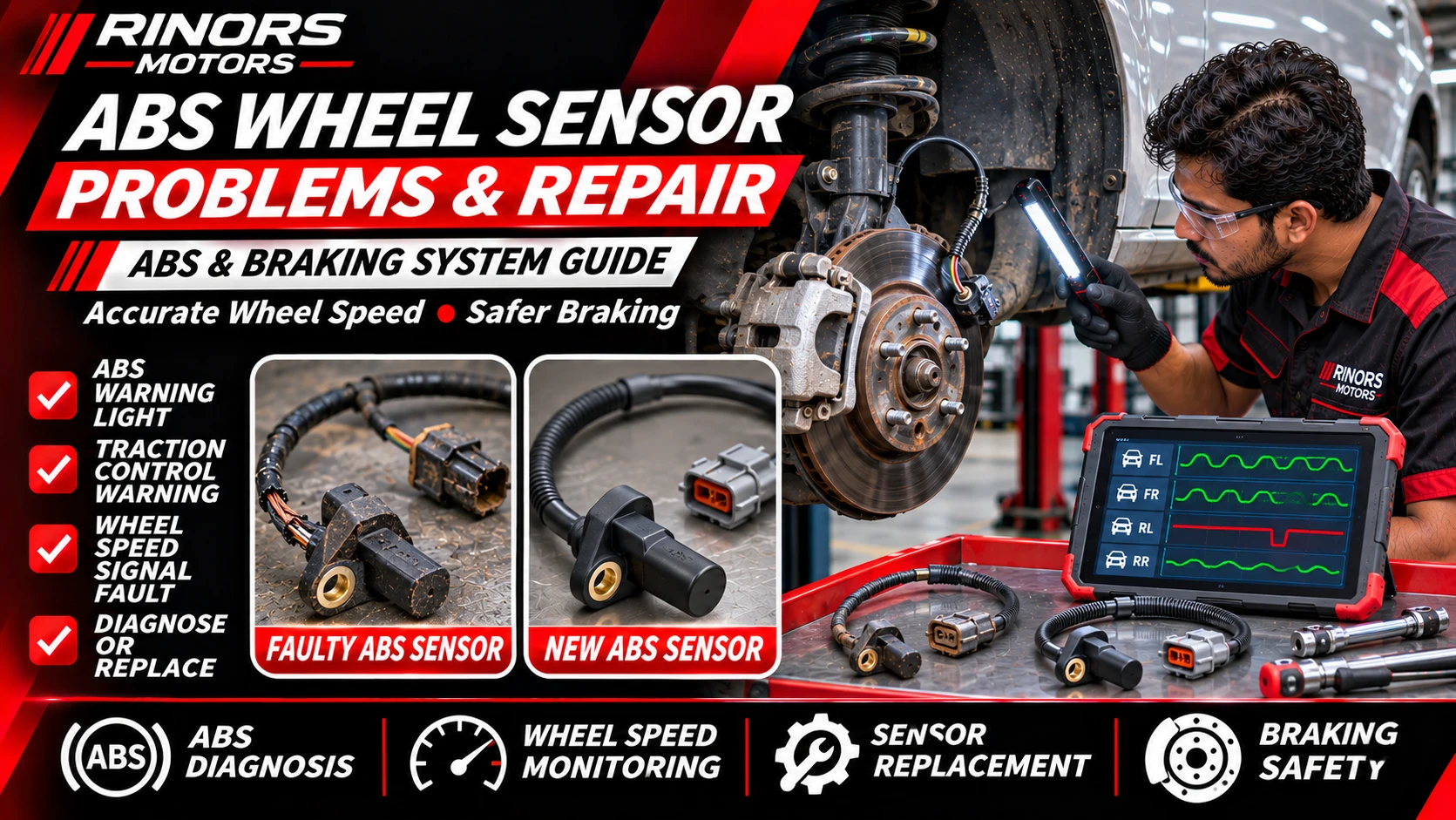
These symptoms may indicate a problem with an ABS wheel speed sensor or another component of the Anti-lock Braking System.
The ABS wheel speed sensor is an important component in modern vehicle braking and stability control systems. It monitors wheel rotation and sends information to the vehicle's electronic control systems.
When a wheel speed sensor provides an incorrect signal, the ABS control module may be unable to determine wheel speed accurately. Depending on the vehicle, this can affect ABS operation, traction control, electronic stability control, and other related functions.
However, an ABS warning does not automatically mean the sensor itself is defective. Damaged wiring, corrosion, a faulty magnetic encoder, wheel bearing problems, and electronic control faults can produce similar warnings.
In Bangladesh, potholes, road impacts, heavy rain, flooding, and normal component ageing make proper wheel-end and electrical-system maintenance important.
Whether you drive a Toyota Corolla, Axio, Premio, Allion, Aqua, Honda Civic, Vezel, Nissan X-Trail, or another vehicle, understanding ABS sensor problems can help you avoid unnecessary parts replacement and maintain braking safety.
This guide explains eight possible warning signs, sensor types, common causes, diagnostic procedures, replacement options, and repair costs in Bangladesh.
What Is an ABS Wheel Speed Sensor?
An ABS wheel speed sensor is an electronic device that detects the rotational speed of a vehicle's wheel.
The sensor sends wheel speed information to the relevant electronic control system.
On many modern vehicles, this information is used by the ABS control module to detect when a wheel is approaching lockup during braking.
Main Functions of an ABS Wheel Speed Sensor
Monitor wheel rotational speed.
Provide wheel speed signals to the ABS control system.
Support anti-lock braking operation.
Assist electronic traction control.
Support electronic stability control where equipped.
Provide information to other vehicle systems when required.
Help the vehicle recognize wheel speed differences.
Support accurate electronic braking intervention.
Most modern four-wheel ABS systems monitor the speed of individual wheels, although sensor arrangements vary by vehicle.
How Does the Anti-lock Braking System Work?
The Anti-lock Braking System helps prevent excessive wheel lockup during braking.
When a wheel locks, it stops rotating while the vehicle is still moving.
This can reduce the driver's ability to steer effectively during braking.
ABS uses wheel speed information to detect conditions suggesting impending wheel lockup.
The system can then modulate hydraulic brake pressure through its control unit and hydraulic components.
Main Components of an ABS System
Wheel Speed Sensors: Monitor wheel rotation.
ABS Control Module: Processes wheel speed and related data.
ABS Hydraulic Modulator: Adjusts brake pressure during ABS operation.
Brake Hydraulic System: Transfers braking force to the wheels.
Wheel Speed Targets: Provide the changing magnetic or mechanical pattern detected by sensors.
Electrical Wiring: Connects sensors to the control system.
Relevant Fuses and Power Supplies: Support electronic operation.
Depending on the vehicle, ABS may share components and information with traction control, electronic stability control, and other systems.
How Does an ABS Wheel Speed Sensor Work?
An ABS sensor detects changes associated with a rotating target attached to or integrated into the wheel hub, axle, or related assembly.
The target may be a toothed metal ring or a magnetic encoder incorporated into a wheel bearing.
As the wheel rotates, the sensor produces or modulates an electrical signal.
The control module interprets this signal to calculate wheel speed.
Example
Imagine a car traveling on a wet road.
During braking, one wheel begins decelerating much more rapidly than the others.
The ABS control module uses wheel speed information to recognize possible wheel lockup.
Where appropriate, the system adjusts braking pressure to help maintain wheel rotation and steering control.
A failed sensor can interfere with this process because the control module may no longer receive reliable information from the affected wheel.
Types of ABS Wheel Speed Sensors
ABS sensors are not all the same.
Two major categories are passive and active wheel speed sensors.
1. Passive or Inductive ABS Sensors
A passive inductive sensor commonly uses a magnet and coil to generate a signal as a metal toothed ring rotates past it.
Its output characteristics depend on rotational speed and sensor design.
These sensors do not normally require the same external electronic power supply used by active sensors.
2. Active ABS Sensors
Active wheel speed sensors use electronic sensing technology.
Common designs include Hall-effect and magnetoresistive sensors.
Depending on the design, they may detect the magnetic pattern of an encoder ring or another suitable target.
Active sensors can provide useful wheel speed information at very low rotational speeds.
Why Sensor Type Matters
Different sensor technologies require different diagnostic procedures.
A resistance test appropriate for certain passive sensors may be unsuitable for an active electronic sensor.
Important: A sensor with two wires is not necessarily passive. Some active sensors also use two-wire connections.
The exact system must be identified before electrical testing.
8 Warning Signs of a Bad ABS Wheel Speed Sensor
These warning signs can help identify a possible sensor or signal problem.
However, none should be used alone to confirm that the sensor requires replacement.
1. ABS Warning Light Stays On
One of the most common indications of an ABS-related problem is an illuminated ABS warning light.
Normally, the warning may illuminate briefly when the ignition is switched on as part of a system self-check.
If it remains illuminated or appears during driving, the system may have detected a fault.
Possible causes include:
Defective wheel speed sensor.
Damaged sensor wiring.
Corroded connector.
Faulty ABS encoder ring.
ABS module problem.
Electrical supply fault.
Other braking-system issues.
An ABS diagnostic scan is necessary to identify the affected system.
2. Traction Control Warning Light Appears
Many modern vehicles use wheel speed information for traction control.
If the system detects an unreliable wheel speed signal, traction control may be restricted or disabled.
Possible symptoms include:
Traction control warning light.
Traction control unavailable message.
ABS and traction control warnings appearing together.
However, traction control warnings can also result from other electronic or mechanical problems.
A faulty wheel speed sensor is only one possibility.
3. Electronic Stability Control Warning
Electronic Stability Control, commonly called ESC, helps the vehicle maintain directional stability under certain driving conditions.
Different manufacturers use names such as VSC, ESP, or other stability-control terminology.
These systems use wheel speed information along with other sensor data.
A wheel speed sensor fault may affect stability-control operation.
Possible dashboard warnings include:
ESC warning.
VSC warning.
Stability control unavailable message.
ABS warning appearing simultaneously.
The actual system and warning terminology depend on the vehicle.
4. Unnecessary ABS Activation at Low Speed
Certain wheel speed signal problems may cause the ABS system to interpret wheel behavior incorrectly.
In some cases, the driver may feel unexpected brake pedal pulsation during gentle braking at low speeds.
Possible causes include:
Incorrect sensor signal.
Damaged reluctor ring.
Magnetic encoder defects.
Corrosion affecting sensor mounting.
Intermittent wiring.
Excessive sensor-target clearance in applicable designs.
However, abnormal brake pedal behavior can also indicate other brake problems.
This symptom requires careful professional diagnosis.
5. Speedometer or Odometer Problems
Some vehicles use wheel speed information from the ABS system for speedometer or other vehicle functions.
If the relevant signal becomes unavailable, speed information may become incorrect or disappear.
Possible symptoms include:
Intermittent speedometer operation.
Unusual speed readings.
Certain speed-related warnings.
Vehicle systems reporting inconsistent speed information.
However, the speedometer information source varies by vehicle.
Not every ABS sensor fault affects the speedometer.
6. Cruise Control or Driver Assistance Becomes Unavailable
Some vehicles use ABS wheel speed information in systems such as cruise control or electronic driver assistance.
When a required signal becomes unreliable, certain functions may be restricted.
Possible symptoms include:
Cruise control refusing to activate.
Cruise control disengaging.
Driver assistance warnings.
Certain speed-dependent features becoming unavailable.
This behavior depends on the vehicle's electronic architecture.
7. Intermittent Warnings After Rain or Road Impacts
A damaged sensor cable or corroded connector may develop an intermittent electrical fault.
The warning may appear after:
Driving through heavy rain.
Traveling on rough roads.
Wheel or suspension repairs.
A severe pothole impact.
Moisture entering a connector.
However, rain or road impacts alone do not prove a sensor fault.
Electrical testing and component inspection are necessary.
8. Abnormal Wheel Speed Readings During Diagnosis
A professional diagnostic scanner may reveal that one wheel reports an incorrect or intermittent speed.
For example, during an appropriate controlled test:
Three wheels report plausible speed information.
One wheel intermittently reports zero.
One wheel displays an implausible value.
A signal disappears unexpectedly.
This may suggest a problem involving the sensor, wiring, target ring, or control circuit.
The technician must identify the actual source before replacing components.
Why Do ABS Wheel Speed Sensors Fail?
Several factors can contribute to ABS sensor faults or unreliable wheel speed information.
1. Damaged Sensor Wiring
Sensor wiring often runs near suspension and wheel components.
Repeated suspension movement, road debris, or incorrect repairs may damage the cable.
2. Corroded Electrical Connectors
Moisture and contamination can affect electrical connections.
Corrosion may interrupt sensor power or signal transmission.
3. Physical Sensor Damage
A sensor may be damaged by impact, improper removal, or incorrect installation.
4. Damaged Reluctor Ring
Some wheel speed systems use a metal toothed ring.
Cracks, corrosion, missing teeth, or incorrect positioning may affect sensor readings.
5. Damaged Magnetic Encoder
Certain wheel bearings contain a magnetic encoder ring.
If the encoder is damaged or the bearing is incorrectly installed, wheel speed information may become unreliable.
6. Incorrect Sensor Installation
Improper positioning, mounting damage, or use of an incompatible replacement sensor can cause signal problems.
7. Wheel Bearing Problems
Excessive bearing movement or damage can affect the relationship between the sensor and its rotating target in certain designs.
8. Internal Electronic Failure
Some sensors fail because of internal electronic deterioration.
9. Poor-Quality Replacement Components
An incompatible sensor may have different electrical characteristics, mounting dimensions, or sensing requirements.
ABS Sensor vs Wheel Bearing: What's the Difference?
These components are closely related but perform different functions.
ABS Wheel Speed Sensor
The sensor monitors wheel rotation and provides electrical speed information.
Wheel Bearing
The wheel bearing supports smooth wheel rotation and carries mechanical loads.
Why Are They Confused?
Some vehicles use a magnetic encoder integrated into the wheel bearing.
The wheel speed sensor reads this encoder.
If the magnetic encoder is damaged, the ABS system may record a wheel speed sensor-related fault even though the sensor itself is functional.
Can Replacing a Wheel Bearing Fix an ABS Problem?
Yes, in certain cases where the confirmed fault involves an integrated encoder or bearing assembly.
However, replacing the wheel bearing will not fix unrelated sensor wiring or electrical problems.
Similarly, replacing the sensor will not repair a damaged magnetic encoder.
Accurate diagnosis prevents unnecessary replacement.
ABS Sensor vs Brake Pad Wear Sensor
An ABS sensor and a brake pad wear sensor are different components.
ABS Sensor
Monitors wheel rotational speed.
It supports anti-lock braking and other applicable vehicle control systems.
Brake Pad Wear Sensor
Monitors or indicates brake pad wear in vehicles equipped with this feature.
Its purpose is to alert the driver when the brake pads reach a specified wear condition.
Why the Difference Matters
A brake pad wear warning does not automatically mean the ABS sensor is defective.
Likewise, an ABS warning does not necessarily mean the brake pads require replacement.
The appropriate braking system should be diagnosed separately.
ABS Warning Light vs Red Brake Warning Light
Understanding dashboard warning lights is important for safety.
Amber or Yellow ABS Warning
If only the ABS warning light is illuminated, many vehicles retain normal hydraulic braking but may not provide anti-lock braking assistance.
However, the exact implications depend on the vehicle and fault.
The ABS should be inspected promptly.
Red Brake Warning Light
A red brake-system warning can indicate a potentially serious braking problem.
Depending on the vehicle, possible causes include:
Low brake fluid.
Parking brake status.
Hydraulic braking-system fault.
Electronic brake system problem.
Other brake-related conditions.
What if Both Lights Appear?
If the ABS warning and red brake warning illuminate together, a more serious braking-system problem may be present.
Stop safely, consult the owner's manual, and arrange professional assistance. Do not continue driving if normal braking performance is uncertain.
Can You Drive With a Bad ABS Sensor?
A faulty ABS sensor may cause the anti-lock braking function or related safety systems to become unavailable.
In many vehicles, normal braking remains possible when only the amber ABS warning is present.
However, the vehicle may not receive the intended assistance from ABS during emergency braking.
Possible Risks
Wheel lockup during hard braking.
Reduced steering control during certain braking situations.
Traction control becoming unavailable.
Stability control being restricted.
Reduced operation of some driver assistance features.
Unexpected or inconsistent electronic braking behavior in certain faults.
What Should You Do?
If the ABS warning appears:
Avoid aggressive driving.
Increase following distance.
Avoid unnecessary hard braking.
Arrange diagnostic inspection promptly.
Follow the vehicle manufacturer's warning instructions.
If braking becomes abnormal, the red brake warning appears, or the vehicle is difficult to control, stop safely and arrange towing or other professional assistance.
How Are ABS Sensor Problems Diagnosed?
A professional ABS diagnosis should identify the actual electrical or mechanical fault.
Step 1: Confirm the Warning
The technician checks which dashboard warnings are illuminated.
Examples include:
ABS.
Traction control.
ESC or VSC.
Red brake warning.
Other relevant electronic system alerts.
Step 2: Scan the ABS Control Module
An appropriate diagnostic scanner is used to read stored ABS fault codes.
A basic engine-only OBD scanner may not provide access to ABS system codes.
Step 3: Identify the Affected Wheel
If the system indicates a wheel speed fault, the technician identifies the relevant wheel position.
Step 4: Inspect Sensor Wiring
The sensor cable and electrical connectors are checked for:
Broken wires.
Damaged insulation.
Loose connectors.
Corrosion.
Incorrect routing.
Impact damage.
Step 5: Inspect the Sensor Mounting
The technician checks the sensor body, mounting position, and surrounding components.
Step 6: Inspect the Tone Ring or Magnetic Encoder
Depending on the design, the technician examines the rotating target for damage or contamination.
Step 7: Check Wheel Bearing Condition
If relevant, the wheel hub and bearing are checked for excessive movement or mechanical damage.
Step 8: Evaluate Wheel Speed Data
A professional scanner may display individual wheel speed information.
The technician compares signals under appropriate controlled conditions.
Step 9: Perform Electrical Testing
The correct tests depend on whether the sensor is passive or active.
The technician may use:
Digital multimeter.
Automotive oscilloscope.
Diagnostic scanner.
Manufacturer wiring diagram.
Appropriate electrical test equipment.
Step 10: Confirm the Repair Requirement
The actual fault may involve:
Sensor replacement.
Wiring repair.
Connector repair.
Tone ring replacement.
Wheel bearing or encoder replacement.
Another ABS electrical or control-system repair.
Step 11: Complete the Repair
The defective component is repaired or replaced using manufacturer-approved procedures.
Step 12: Verify System Operation
After servicing, the technician checks sensor signals, relevant fault codes, warning lights, and ABS system operation according to the vehicle's service requirements.
Can an ABS Sensor Be Tested With a Multimeter?
A multimeter can be useful in certain circumstances, but there is no universal test suitable for every wheel speed sensor.
Passive Sensor Testing
Certain passive inductive sensors can be tested using manufacturer-specified resistance and signal procedures.
However, resistance alone may not reveal an intermittent fault or damaged tone ring.
Active Sensor Testing
Active sensors contain electronic components and require different diagnostic methods.
An ordinary resistance test may be inappropriate and can potentially damage some sensors.
A powered electrical test or oscilloscope evaluation may be necessary.
Why an Oscilloscope Is Useful
An automotive oscilloscope can help technicians examine:
Sensor signal patterns.
Missing pulses.
Intermittent interruptions.
Changes during wheel rotation.
Certain target ring abnormalities.
Important Precaution
Do not identify the sensor type solely by counting wires.
Some active and passive sensors have similar external wiring arrangements.
Use the correct vehicle service information.
ABS Tone Ring Problems
A tone ring, also called a reluctor ring or pulse ring, provides a pattern that the wheel speed sensor detects.
Common Tone Ring Problems
Cracked ring.
Missing or damaged teeth.
Corrosion.
Incorrect alignment.
Excessive movement.
Improper installation.
Symptoms
Depending on the system, tone ring damage may cause:
ABS warning light.
Intermittent sensor signal.
Unexpected ABS activation.
Incorrect wheel speed data.
Traction control warnings.
Can a Tone Ring Be Replaced Separately?
Sometimes.
Certain vehicles use separately serviceable tone rings.
Other designs integrate the target into a hub, axle, or wheel bearing assembly.
The correct repair depends on the component design.
Magnetic ABS Encoder Problems
Many modern ABS systems use magnetic encoders integrated into wheel bearing seals or hub assemblies.
What Is a Magnetic Encoder?
A magnetic encoder contains alternating magnetic poles detected by a compatible wheel speed sensor.
Common Encoder Problems
Physical damage.
Magnetic contamination.
Incorrect bearing installation.
Damaged encoder surface.
Incompatible wheel bearing.
Excessive hub movement.
Why Bearing Installation Matters
Some wheel bearings with integrated encoders must be installed in a specific orientation.
Incorrect installation may prevent the sensor from receiving the expected signal.
Should You Replace the ABS Sensor?
Not automatically.
If the magnetic encoder is defective while the sensor and wiring are functioning correctly, replacing the sensor may not resolve the problem.
The technician should identify the actual defective component.
Can a Faulty ABS Sensor Cause Unexpected Brake Pedal Vibration?
Yes, in certain circumstances.
If the ABS module receives incorrect wheel speed information, it may interpret a normal braking event as potential wheel lockup.
This can cause unnecessary ABS activation.
The driver may feel:
Brake pedal pulsation.
Unexpected vibration during low-speed braking.
Unusual ABS operation.
However, brake pedal vibration can also result from brake disc issues, mechanical faults, and other conditions.
A professional diagnosis should confirm the cause.
ABS Sensor vs ABS Control Module Problems
The ABS sensor and ABS control module have different functions.
ABS Sensor
Produces wheel speed information.
ABS Control Module
Processes wheel speed data and controls ABS operation.
Can Both Cause the ABS Light?
Yes.
However, an ABS warning can also result from hydraulic components, power supply faults, wiring, or other related systems.
Why Diagnosis Matters
Replacing an ABS control module can be expensive and may require programming or initialization.
A module should not be replaced without confirming that the fault actually originates inside the module.
Can an ABS Sensor Be Cleaned Instead of Replaced?
Some sensor-related problems may involve removable contamination.
However, cleaning is not a reliable repair for an internally failed electronic sensor.
When Cleaning May Help
Where manufacturer instructions permit, cleaning may be appropriate when:
Contamination affects an accessible sensing area.
Debris interferes with a tone ring.
Dirt accumulates around a sensor mounting point.
A connector requires approved cleaning and inspection.
When Replacement Is Necessary
Replacement may be required when:
The sensor is internally defective.
The sensor housing is damaged.
Electrical connections cannot be repaired appropriately.
The sensor output does not meet specifications.
The component is non-serviceable.
Important Note
Do not use aggressive chemicals or abrasive tools on magnetic encoder surfaces or sensitive electronic components.
Cleaning a damaged sensor will not restore its internal electronic function.
How Is an ABS Wheel Speed Sensor Replaced?
The replacement procedure depends on the vehicle design.
Step 1: Confirm the Fault
The technician identifies the defective sensor or related component.
Step 2: Select the Correct Replacement
The replacement sensor must match the exact vehicle and wheel position.
Step 3: Prepare the Vehicle Safely
The vehicle is secured and supported using appropriate professional lifting equipment.
Step 4: Access the Wheel Sensor
Depending on the design, the wheel or other components may need removal.
Step 5: Disconnect the Electrical Connector
The sensor wiring is disconnected carefully.
Step 6: Remove the Old Sensor
The technician follows the manufacturer's procedure to remove the sensor without damaging the mounting point or related wheel-end components.
Step 7: Inspect the Mounting Area
The mounting surface, relevant encoder, and wiring path are checked.
Step 8: Install the Replacement Sensor
The correct sensor is installed using the required fasteners and procedures.
Step 9: Secure the Wiring
The cable is routed and secured away from moving suspension parts, rotating components, and heat sources.
Step 10: Reassemble the Vehicle
All removed components are correctly reinstalled.
Step 11: Complete Diagnostic Procedures
Relevant fault codes are addressed.
Some vehicles may require additional system initialization or service procedures.
Step 12: Verify Operation
The technician confirms proper wheel speed readings and checks that the original fault has been resolved.
Safety Warning: ABS sensor wiring is installed near moving wheels, braking components, and suspension parts. Incorrect installation can damage the sensor or compromise related vehicle systems. Professional replacement is recommended.
Toyota ABS Sensor Problems in Bangladesh
Toyota vehicles are widely used in Bangladesh, but ABS sensor designs vary by model and production year.
Toyota Corolla and Axio
Different Corolla and Axio generations use vehicle-specific ABS sensors and wheel bearing assemblies.
Possible symptoms include:
ABS warning light.
Traction control warning.
Intermittent wheel speed readings.
Sensor wiring damage.
Wheel bearing encoder problems.
The correct component should be identified using the exact model and wheel position.
Toyota Premio and Allion
Toyota Premio and Allion vehicles may develop ABS-related problems involving wheel speed sensors, connectors, or related wheel-end components.
However, not every ABS warning is caused by a failed sensor.
Professional diagnosis should establish the actual fault.
Toyota Aqua Hybrid
The Toyota Aqua uses an electronically controlled braking system that works with its hybrid powertrain.
Wheel speed information is important for the vehicle's ABS and related stability functions.
The relationship between regenerative braking and friction braking depends on the vehicle's control strategy.
An ABS or brake-system warning should be diagnosed using Toyota-compatible equipment and the correct model-specific procedure.
Toyota Corolla Axio Hybrid
The Corolla Axio Hybrid also uses electronically managed braking and stability-related systems.
Sensor compatibility and diagnostic requirements depend on the vehicle's exact configuration.
Important Hybrid Safety Precautions
Hybrid vehicles may contain high-voltage components and electronically controlled braking systems.
Technicians must follow the manufacturer's safety and service procedures.
A wheel speed sensor warning should not automatically be mistaken for a hybrid traction battery failure.
Honda and Nissan ABS Sensor Problems
Honda Civic, Grace, Vezel, Nissan X-Trail, and other vehicles use wheel speed information for their applicable braking and stability-control systems.
Possible problems include:
Faulty wheel speed sensor.
Damaged sensor wiring.
Corroded connector.
Damaged tone ring.
Magnetic encoder failure.
Wheel bearing-related signal problems.
However, sensor types, mounting locations, and electrical configurations differ.
The correct replacement must match the exact vehicle.
How Much Does ABS Sensor Replacement Cost in Bangladesh?
ABS sensor replacement prices depend on the vehicle and the required component.
Main Pricing Factors
Vehicle manufacturer.
Exact model.
Production year.
Front or rear wheel position.
Left-side or right-side application.
Passive or active sensor technology.
Original-equipment or compatible aftermarket part.
Wiring harness integration.
Sensor accessibility.
Diagnostic testing.
Installation labor.
Warranty.
A straightforward sensor replacement may cost less than a repair involving a damaged wheel bearing or integrated magnetic encoder.
However, the actual repair should only be priced after confirming the defective component.
ABS Sensor vs Wheel Bearing Replacement Cost
Some ABS faults originate from the sensor itself.
Others involve the rotating target or wheel bearing assembly.
Sensor-Only Replacement
This may involve:
New ABS sensor.
Installation labor.
Electrical connector inspection.
Diagnostic verification.
Wheel Bearing or Encoder Repair
If the fault involves an integrated encoder, the repair may require:
Wheel bearing or hub assembly.
Specialized bearing installation tools.
Additional labor.
Correct fastener replacement where required.
ABS system verification.
Therefore, an ABS warning does not always mean the repair cost will be limited to the sensor.
How to Choose the Correct ABS Wheel Speed Sensor
ABS sensors are precision electrical components.
Compatibility should be verified before purchase.
Important Vehicle Information
Manufacturer.
Exact model.
Production year.
Chassis or VIN.
Wheel position.
Original part number.
ABS system configuration.
Important Sensor Specifications
Active or passive sensor type.
Electrical connector design.
Cable length.
Mounting bracket.
Sensor housing dimensions.
Sensing technology.
Target ring compatibility.
Control-system requirements.
Original vs Aftermarket ABS Sensors
Original-equipment and suitable aftermarket ABS sensors may be available.
However, the replacement must meet the vehicle's mechanical and electrical specifications.
A sensor that physically fits may still provide an incompatible signal.
Choose compatible products from reliable suppliers with suitable warranty information.
How Long Do ABS Wheel Speed Sensors Last?
There is no universal replacement interval suitable for every ABS wheel speed sensor.
Many sensors are designed for extended service life.
However, actual durability depends on:
Sensor construction.
Road conditions.
Moisture exposure.
Wiring condition.
Vehicle maintenance.
Component quality.
Installation procedures.
Wheel-end mechanical condition.
A sensor should normally be replaced when manufacturer guidance or professional diagnosis supports replacement.
Replacing every sensor at an arbitrary mileage may create unnecessary expense.
How to Help Prevent ABS Sensor Problems
1. Inspect Wheel-End Components
Check relevant wheel and suspension components during scheduled maintenance.
2. Protect Sensor Wiring
Ensure sensor cables remain properly secured.
3. Repair Damaged Connectors
Corroded or loose electrical connections should be corrected.
4. Avoid Improper Wheel Bearing Installation
Follow correct procedures for bearings with magnetic ABS encoders.
5. Inspect After Severe Road Impacts
Pothole or accident damage may affect wheel-end sensors and related components.
6. Avoid Aggressive Cleaning
Use manufacturer-approved cleaning methods around magnetic encoders and sensors.
7. Use Compatible Replacement Components
Install parts with the correct specifications.
8. Investigate ABS Warning Lights
Do not repeatedly clear faults without identifying the cause.
9. Maintain the Braking System
Brake fluid, pads, discs, and related components should be serviced according to manufacturer recommendations.
10. Verify Repairs Professionally
After sensor or wheel bearing replacement, confirm correct electronic braking-system operation.
Frequently Asked Questions About ABS Sensors
What Are the Signs of a Bad ABS Sensor?
Possible indications include an ABS warning light, traction control warning, stability-control warning, incorrect wheel speed readings, or unusual ABS activation.
However, these symptoms can have other causes.
Can a Bad ABS Sensor Affect Braking?
Yes. An ABS sensor fault may disable or interfere with anti-lock braking and related electronic functions.
In many vehicles, conventional hydraulic braking remains available when only the amber ABS warning is illuminated, but the vehicle should be inspected promptly.
Can a Bad ABS Sensor Cause Traction Control Problems?
Yes. Many traction control systems depend on accurate wheel speed information.
Can a Bad Wheel Bearing Cause an ABS Warning?
Yes. Some wheel bearings contain magnetic encoders used by ABS sensors.
A damaged or incorrectly installed encoder may affect wheel speed signals.
Can an ABS Sensor Be Cleaned?
Certain contamination may be removable using approved procedures.
Cleaning will not repair a defective internal electronic circuit or damaged sensor.
Is It Safe to Drive With the ABS Light On?
The vehicle may retain normal braking when only the amber ABS warning is present, but anti-lock braking may be unavailable.
Arrange inspection promptly and avoid risky driving conditions.
If the red brake warning is also illuminated or braking feels abnormal, stop safely and seek professional assistance.
Does Every ABS Warning Mean the Sensor Is Bad?
No. ABS warnings can result from wiring, encoder rings, hydraulic components, electrical supply faults, and control-system problems.
Can an ABS Sensor Cause Speedometer Problems?
Yes, in certain vehicles that rely on wheel speed information for speed display.
However, not every ABS sensor fault affects the speedometer.
Should All Four ABS Sensors Be Replaced Together?
No. Replace only the components that require replacement based on confirmed findings and manufacturer procedures.
Is an ABS Sensor the Same as a Brake Pad Sensor?
No. The ABS sensor measures wheel rotation, while a brake pad wear sensor indicates brake pad condition in applicable vehicles.
Can a Faulty ABS Sensor Trigger Stability Control Warnings?
Yes. Electronic stability control systems commonly use wheel speed information.
Do Hybrid Cars Have ABS Wheel Speed Sensors?
Yes. Hybrid vehicles use wheel speed sensors as part of their braking and stability-control systems.
ABS Sensor Diagnosis & Replacement at Rinors Motors
At Rinors Motors, we understand the importance of reliable braking, accurate wheel speed monitoring, and properly functioning vehicle safety systems for drivers in Bangladesh.
If your car displays an ABS warning light, traction control warning, electronic stability control warning, or unusual ABS operation, identifying the actual fault is essential before replacing components.
A professional diagnostic inspection can help distinguish a defective ABS wheel speed sensor from damaged wiring, corroded connectors, tone ring problems, magnetic encoder faults, and wheel bearing damage.
Whether you own a Toyota, Honda, Nissan, or another vehicle, selecting the correct replacement sensor and following the appropriate diagnostic procedures is important for restoring normal system operation.
Contact Rinors Motors to discuss ABS sensor diagnosis, compatible replacement parts, wheel speed signal problems, and suitable repair or replacement options for your vehicle.
Rinors Motors — Your Trusted Automotive Partner in Bangladesh.