Car Exhaust Leak Problems in Bangladesh: Complete Diagnosis & Repair Guide
Is your car making an unusually loud exhaust noise? Do you hear a ticking sound when starting the engine, notice a damaged exhaust pipe, or smell exhaust fumes inside the passenger cabin?
These symptoms may indicate an exhaust system leak.
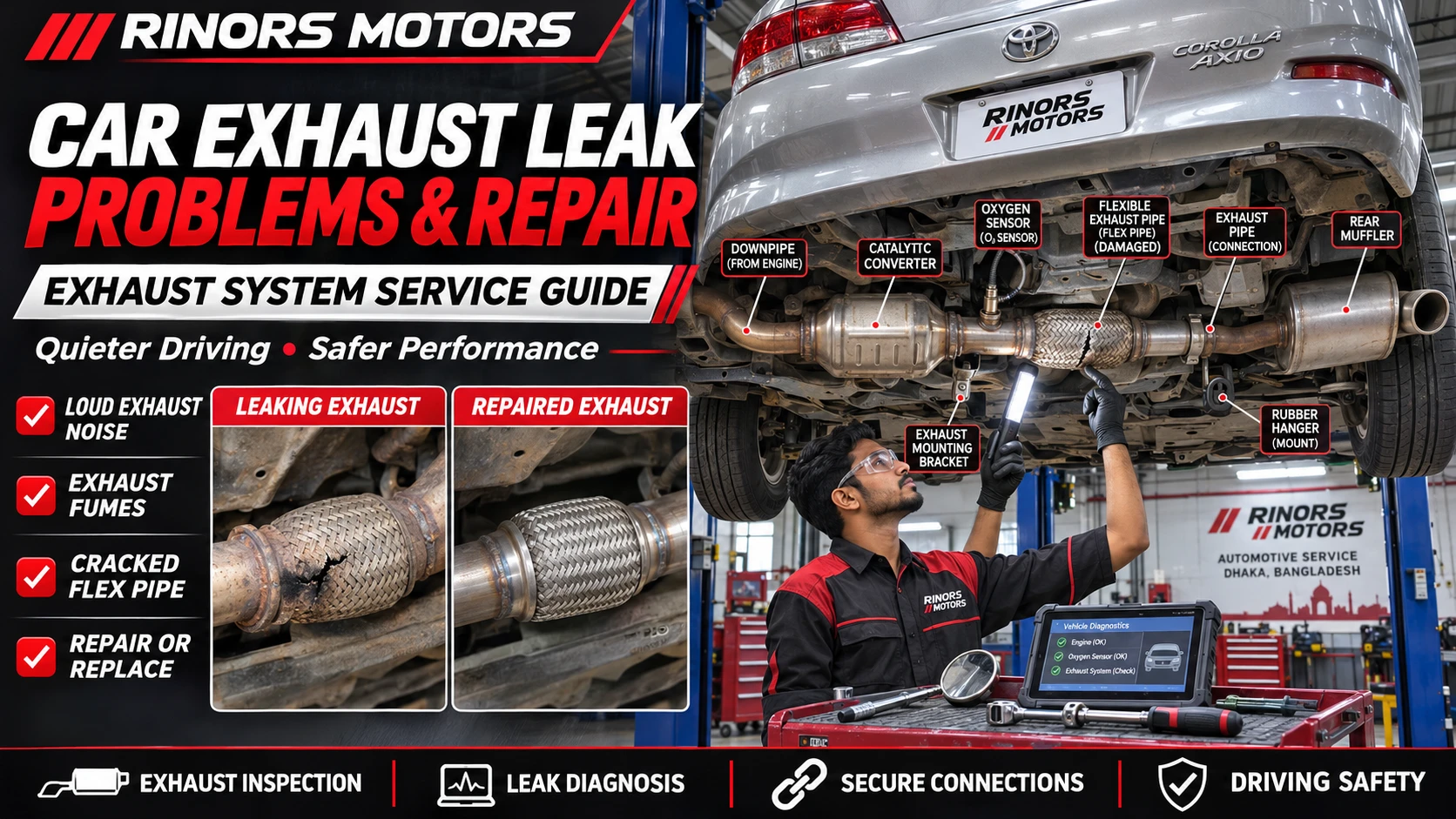
The exhaust system is an important part of a vehicle's engine and emissions-control system. It directs combustion gases away from the engine and passengers, helps reduce noise, and supports the operation of emissions-control components.
When an exhaust pipe, gasket, flexible connection, or other exhaust component develops a leak, the vehicle may experience unusual noise, exhaust gas leakage, or engine performance problems under certain conditions.
More importantly, an exhaust leak can create a serious safety hazard if harmful gases enter the passenger compartment.
In Bangladesh, road impacts, water exposure, damaged speed breakers, corrosion, ageing components, and everyday driving conditions can contribute to exhaust system deterioration.
Whether you drive a Toyota Corolla, Axio, Premio, Allion, Aqua, Honda Civic, Vezel, Nissan X-Trail, or another vehicle, understanding exhaust leak problems can help you recognize warning signs and arrange appropriate repairs.
This guide explains eight possible signs of an exhaust leak, common causes, professional diagnostic procedures, repair options, replacement costs, and maintenance recommendations.
What Is a Car Exhaust Leak?
An exhaust leak occurs when gases escape from the exhaust system through an unintended opening.
A properly functioning exhaust system directs combustion gases through designated exhaust components and releases them outside the vehicle at the intended outlet.
An exhaust leak can develop because of:
Cracked exhaust pipes.
Damaged exhaust manifold gaskets.
Broken flexible pipe sections.
Corroded mufflers.
Loose exhaust connections.
Damaged catalytic converter housings.
Broken mounting hardware.
Failed exhaust seals or welded joints.
The location and severity of the leak determine its potential effects.
Why Exhaust System Sealing Matters
A correctly sealed exhaust system helps:
Direct exhaust gases away from passengers.
Reduce engine exhaust noise.
Support emissions-control operation.
Maintain appropriate exhaust sensor measurements.
Protect nearby vehicle components.
Preserve normal engine performance where exhaust integrity affects control systems.
A leaking exhaust system should be inspected rather than ignored.
Main Components of a Car Exhaust System
Modern vehicles use several exhaust components working together.
1. Exhaust Manifold
The exhaust manifold collects exhaust gases leaving the engine's cylinders.
Depending on the engine, it may be a separate metal component or integrated into another part of the engine assembly.
2. Exhaust Manifold Gasket
The gasket helps seal the connection between the exhaust manifold and cylinder head.
A damaged gasket can allow exhaust gases to escape near the engine.
3. Exhaust Downpipe
The downpipe carries exhaust gases away from the manifold or turbocharger toward the remainder of the exhaust system.
4. Catalytic Converter
The catalytic converter helps reduce certain harmful pollutants in the exhaust through chemical reactions.
Its location varies by vehicle.
5. Oxygen and Air-Fuel Ratio Sensors
These sensors provide exhaust-related information to the engine control system.
Depending on their positions, they support fuel mixture management and emissions monitoring.
6. Exhaust Flex Pipe
The flexible pipe section accommodates controlled movement and vibration between engine-mounted and vehicle-mounted exhaust components.
7. Resonator
Some exhaust systems contain a resonator that helps control particular sound frequencies.
8. Muffler or Silencer
The muffler reduces exhaust noise before gases leave the tailpipe.
9. Exhaust Hangers and Mounting Brackets
These components support and position the exhaust system beneath the vehicle.
Not every vehicle uses exactly the same components or layout.
8 Warning Signs of a Car Exhaust Leak
1. Loud Exhaust Noise
One of the most recognizable symptoms of an exhaust leak is an unusually loud engine or exhaust sound.
The vehicle may suddenly sound louder than normal.
Possible symptoms include:
Increased exhaust rumbling.
Loud noise during acceleration.
A roaring sound from underneath the car.
Unusual exhaust sound at idle.
A sharp puffing sound near an exhaust connection.
The noise may vary depending on the size and location of the leak.
However, some damaged mufflers or loose heat shields can create abnormal noises without the same type of gas leakage.
2. Ticking Noise From the Engine Compartment
A leaking exhaust manifold or manifold gasket may produce a ticking or puffing sound.
The sound can be especially noticeable during a cold engine start.
As components heat up and expand, the noise may change.
However, this pattern is not universal.
Other possible causes of engine ticking include:
Valve train noise.
Injector operation.
Timing-related components.
Loose mechanical parts.
Other engine faults.
The actual source should be confirmed through inspection.
3. Exhaust Smell Inside the Car
An exhaust-related odor inside the passenger cabin is an important warning sign.
Exhaust gases can enter through ventilation openings, damaged seals, or body openings under certain conditions.
Possible contributors include:
Exhaust manifold leakage.
Damaged front exhaust pipe.
Cracked flex pipe.
Exhaust leakage beneath the cabin.
Damaged vehicle body seals.
Incorrect exhaust outlet routing.
Important: Carbon monoxide is colorless and odorless. You cannot determine whether carbon monoxide is present or absent by smell.
If exhaust fumes are entering the passenger cabin, stop using the vehicle and arrange professional inspection.
4. Hissing or Puffing Sound
A small opening in the exhaust system may produce a hissing or rhythmic puffing noise.
The sound may become more noticeable when engine speed changes.
Potential sources include:
Damaged gasket.
Small exhaust pipe crack.
Loose flange.
Leaking exhaust joint.
Cracked exhaust manifold.
A professional inspection can help distinguish exhaust leakage from intake, vacuum, or mechanical noises.
5. Reduced Engine Performance
Certain exhaust leaks may affect engine performance.
This is particularly relevant when leakage occurs near components used for exhaust oxygen measurement.
For example, an upstream exhaust leak may allow outside air to influence sensor readings.
Depending on the engine management system, this can contribute to incorrect fuel adjustments.
Possible symptoms include:
Engine hesitation.
Unstable operation.
Reduced acceleration.
Abnormal fuel trim readings.
However, not every exhaust leak causes reduced performance.
A small leak near the rear muffler may have little direct effect on fuel mixture control.
6. Check Engine Light
Some exhaust leaks can contribute to engine or emissions-related diagnostic trouble codes.
Examples include:
Oxygen sensor-related faults.
Fuel trim abnormalities.
Catalytic converter efficiency warnings.
A code such as P0420 may appear when the emissions monitoring system detects catalytic converter efficiency below its expected threshold.
However, P0420 does not automatically mean the exhaust pipe is leaking.
The catalytic converter, sensors, engine condition, and exhaust system must be evaluated.
7. Visible Soot Around Exhaust Connections
Exhaust gases can leave dark deposits around certain leak locations.
A technician may find soot near:
Exhaust manifold joints.
Exhaust pipe flanges.
Flex pipe cracks.
Welded connections.
Catalytic converter joints.
Muffler seams.
Soot deposits can provide useful diagnostic clues.
However, the absence of soot does not prove the exhaust system is properly sealed.
8. Visible Exhaust Pipe Damage
Sometimes the problem is visible during a professional underbody inspection.
Possible signs include:
Cracked exhaust pipes.
Corroded sections.
Broken flexible couplings.
Loose exhaust clamps.
Damaged mounting brackets.
Separated pipe joints.
Holes in the muffler.
Displaced exhaust components.
Visible damage should be evaluated to determine whether gases are leaking and whether the component remains structurally safe.
9 Common Causes of Car Exhaust Leaks
1. Damaged Exhaust Manifold Gasket
The manifold gasket seals the connection between the exhaust manifold and cylinder head.
A defective gasket may allow combustion gases to escape near the engine.
Possible Symptoms
Ticking sound near the engine.
Exhaust smell around the engine compartment.
Visible soot at the manifold joint.
Unusual exhaust noise.
Repair Options
The repair may involve removing the manifold, inspecting the sealing surfaces, and installing the correct replacement gasket.
Damaged mounting studs or distorted components may also need attention.
2. Cracked Exhaust Manifold
Exhaust manifolds experience repeated heating and cooling.
Over time, some manifolds can develop cracks.
Possible Symptoms
Ticking or puffing noise.
Exhaust leakage near the engine.
Visible cracks.
Soot deposits.
Abnormal exhaust sound.
Repair Options
A cracked manifold may require replacement or an appropriate manufacturer-approved repair.
The decision depends on the material, location, and extent of damage.
3. Damaged Exhaust Flex Pipe
A flexible exhaust coupling helps accommodate engine movement and vibration.
Over time, the flexible section may crack, separate, or deteriorate.
Possible Symptoms
Loud exhaust noise under acceleration.
Rattling near the front underside.
Visible damage to the flexible section.
Exhaust gases escaping beneath the vehicle.
Repair Options
A damaged flex section may be replaced as an individual repair section when the vehicle design and component condition permit.
Other vehicles may require replacement of a larger exhaust pipe assembly.
4. Corroded Exhaust Pipe
Exhaust pipes can deteriorate because of moisture, condensation, corrosion, and environmental exposure.
Corrosion may eventually produce holes or weakened sections.
Possible Symptoms
Increased exhaust noise.
Visible rust.
Small holes in the pipe.
Weak or perforated metal.
Exhaust leakage under the vehicle.
Repair Options
A structurally damaged pipe usually requires replacement of the affected section or assembly.
Temporary patching is not a reliable substitute for repairing severely corroded exhaust components.
5. Damaged Muffler
The muffler reduces exhaust noise.
A muffler can develop corrosion, cracks, or failed welded seams.
Possible Symptoms
Loud exhaust sound near the rear of the car.
Rattling from the muffler.
Visible rust or holes.
Exhaust leakage near the rear underside.
Repair Options
Depending on the design and damage, an approved repair or muffler replacement may be necessary.
6. Loose Exhaust Flange or Connection
Exhaust sections are commonly joined using flanges, clamps, gaskets, and bolts.
A damaged or loose connection may allow gases to escape.
Possible Causes
Corroded bolts.
Damaged flange gasket.
Broken fastener.
Incorrect assembly.
Mechanical impact.
Deformed connection surfaces.
Repair Options
The technician should identify whether the joint requires a gasket, fastener, flange, or other repair.
Simply overtightening damaged hardware may not solve the problem.
7. Catalytic Converter Housing or Connection Damage
Catalytic converters are connected to the exhaust system and may be integrated into other exhaust components.
A cracked housing or leaking connection can allow exhaust gases to escape.
Possible Symptoms
Exhaust noise near the converter.
Visible cracks.
Soot around connections.
Exhaust odor.
Emissions-related warning codes in certain cases.
Repair Options
The defective housing, gasket, or connected component should be evaluated.
A damaged catalytic converter assembly may require replacement.
Removing or bypassing emissions-control equipment is not an appropriate substitute for proper repair.
8. Broken Exhaust Hangers
Rubber hangers and brackets support the exhaust system.
If these components fail, the exhaust pipe may move excessively.
This can place additional stress on:
Flexible pipe sections.
Flanges.
Welded joints.
Muffler connections.
Mounting brackets.
Repair Options
Damaged hangers or brackets should be replaced with compatible components.
Any resulting exhaust leakage should also be corrected.
9. Road Impact Damage
The underside of a car may strike speed breakers, road obstacles, or deep potholes.
Such impacts can damage exhaust components.
Possible Problems
Crushed exhaust pipes.
Broken flex sections.
Cracked catalytic converter housings.
Damaged mounting brackets.
Separated exhaust joints.
Displaced mufflers.
Repair Options
The affected components should be inspected for leakage, restrictions, structural damage, and proper mounting.
Exhaust Flex Pipe Problems: Why Are They Common?
The flex pipe is an important part of many modern exhaust systems.
It helps accommodate controlled movement between the engine and the exhaust components attached to the vehicle body.
Why Flex Pipes Fail
Potential contributing factors include:
Normal material fatigue.
Excessive engine movement.
Damaged engine mounts.
Road impacts.
Corrosion.
Poor previous repairs.
Incorrect exhaust alignment.
Does a Broken Engine Mount Affect the Flex Pipe?
Yes, in some circumstances.
A severely worn engine or transmission mount may allow excessive powertrain movement.
This can place additional stress on the flexible exhaust connection.
Therefore, if a flex pipe repeatedly fails, the technician should inspect the relevant engine mounts and exhaust alignment.
Can a Flex Pipe Be Replaced Separately?
Sometimes.
The answer depends on the exhaust design and availability of an appropriate replacement section.
A correctly fitted repair section must maintain proper alignment, sealing, clearance, and structural support.
Exhaust Manifold Leak vs Muffler Leak
The location of an exhaust leak affects its symptoms and safety implications.
Exhaust Manifold Leak
A manifold leak occurs near the engine.
Possible symptoms include:
Ticking or puffing noise.
Exhaust fumes near the engine compartment.
Soot around the manifold.
Potential disturbance of upstream exhaust sensor readings.
Increased risk of gases entering the cabin under certain conditions.
Muffler Leak
A muffler leak usually occurs farther toward the rear of the vehicle.
Possible symptoms include:
Increased exhaust noise.
Rattling.
Visible corrosion.
Exhaust leakage at the rear underside.
Which Is More Dangerous?
Any exhaust leak requires attention.
Leaks near the engine or passenger compartment may create particular concern because exhaust gases can be drawn into the vehicle.
However, rear exhaust leaks can also create hazards depending on vehicle airflow, outlet position, body openings, and other conditions.
The actual risk must be assessed rather than judged solely by leak location.
Can an Exhaust Leak Cause Carbon Monoxide Poisoning?
Yes.
Vehicle exhaust can contain carbon monoxide, a highly toxic gas.
Carbon monoxide is dangerous because it cannot be detected by smell or sight.
An exhaust leak can allow gases to enter the passenger compartment under certain circumstances.
Possible Carbon Monoxide Exposure Symptoms
Headache.
Dizziness.
Nausea.
Weakness.
Unusual drowsiness.
Confusion.
Chest discomfort.
Fainting or loss of consciousness in severe cases.
These symptoms can have many causes, but possible carbon monoxide exposure is an emergency.
What Should You Do?
If exhaust exposure or carbon monoxide poisoning is suspected:
Stop the vehicle in a safe location.
Switch off the engine.
Get everyone into fresh air immediately.
Seek urgent medical attention if exposure or symptoms are suspected.
Do not return to or continue driving the affected vehicle until it has been professionally inspected and repaired.
Do not rely on opening the windows or changing the air-conditioning setting to make a vehicle with an exhaust leak safe.
Never run a combustion-engine vehicle in a closed garage or other enclosed space.
Can an Exhaust Leak Increase Fuel Consumption?
Certain exhaust leaks can contribute to increased fuel consumption, but not every leak has this effect.
Upstream Exhaust Leaks
An exhaust leak before or near an oxygen or air-fuel ratio sensor may allow outside air to influence the sensor's readings.
Depending on engine design and operating conditions, the engine control system may make inappropriate fuel adjustments.
This can affect fuel consumption or drivability.
Downstream Exhaust Leaks
A leak farther downstream may primarily cause noise or exhaust gas exposure.
It may have less direct influence on normal fuel mixture control.
Other Causes of Poor Fuel Economy
Increased fuel consumption can also result from:
Ignition problems.
Fuel injector faults.
Incorrect tyre pressure.
Heavy traffic.
Faulty engine sensors.
Brake drag.
Air intake problems.
Other engine mechanical issues.
An exhaust leak should be confirmed before it is blamed for poor fuel economy.
Can an Exhaust Leak Trigger P0420?
Yes, certain exhaust leaks can contribute to conditions that affect catalytic converter efficiency monitoring.
However, P0420 is not an exhaust leak code.
It generally indicates that the engine control system has detected catalytic converter efficiency below the expected threshold.
Possible Causes of P0420
Catalytic converter deterioration.
Exhaust leaks affecting sensor readings.
Oxygen sensor problems.
Engine misfires.
Incorrect air-fuel mixture.
Wiring or control-system faults.
Other emissions-system issues.
Why Diagnosis Matters
Replacing the catalytic converter without inspecting the exhaust system may result in unnecessary expense.
Similarly, installing a new oxygen sensor will not repair a cracked exhaust pipe.
The complete relevant system should be evaluated.
Exhaust Leak vs Engine Oil Leak
Drivers sometimes confuse engine oil leaks with exhaust leaks because both can produce unusual smells or smoke.
Engine Oil Leak
An external oil leak occurs when oil escapes through a gasket, seal, housing, or another engine component.
If the oil contacts a hot exhaust surface, it may produce a burning oil smell or smoke.
Exhaust Leak
An exhaust leak occurs when combustion gases escape from an unintended opening in the exhaust system.
How Are They Distinguished?
A professional inspection can identify:
Oil residue.
Exhaust soot.
Visible exhaust damage.
The location of fluid leakage.
The source of the smell or smoke.
A burning smell alone is not enough to determine which system is faulty.
Both problems can also occur simultaneously.
Exhaust Leak vs Catalytic Converter Blockage
An exhaust leak and a restricted catalytic converter are different conditions.
Exhaust Leak
Allows exhaust gases to escape through an opening.
Possible symptoms include noise, fumes, and sensor-related problems.
Catalytic Converter Restriction
A restricted converter can interfere with the normal movement of exhaust gases through the system.
Possible symptoms may include reduced engine power or other operating problems.
Why This Matters
A leaking exhaust pipe should not automatically be diagnosed as a blocked catalytic converter.
A restricted exhaust system requires different tests from a leaking exhaust system.
The technician may use appropriate exhaust pressure, temperature, or other diagnostic procedures when indicated.
How Are Car Exhaust Leaks Diagnosed?
A professional exhaust inspection should identify the actual leak location and determine which components require repair.
Step 1: Confirm the Symptoms
The technician asks when the problem occurs.
Examples include:
Cold engine startup.
Acceleration.
Idling.
Driving over uneven roads.
Operating the ventilation system.
After a recent exhaust repair.
Following a road impact.
Step 2: Identify Safety Concerns
If exhaust fumes may be entering the passenger compartment, the vehicle should not be used normally until the cause is evaluated.
Step 3: Inspect the Exhaust System
With the exhaust cooled and the vehicle properly supported, the technician checks accessible components for:
Cracks.
Rust.
Broken joints.
Damaged flex sections.
Loose brackets.
Missing fasteners.
Failed gaskets.
Soot deposits.
Step 4: Inspect the Exhaust Manifold
The manifold, gasket, mounting hardware, and connected components are examined.
Step 5: Inspect the Flex Pipe
The flexible section is checked for broken material, leakage, or stress damage.
Step 6: Inspect the Muffler and Rear Pipes
The rear exhaust components are examined for corrosion, cracks, and defective connections.
Step 7: Perform an Appropriate Leak Test
A qualified technician may use manufacturer-approved leak detection equipment, including suitable low-pressure smoke testing systems when appropriate.
The exact test method depends on the vehicle and exhaust construction.
Step 8: Evaluate Relevant Diagnostic Data
If the check engine light is illuminated, the technician may review:
Oxygen sensor data.
Fuel trim readings.
Catalyst monitoring information.
Stored fault codes.
Relevant engine operating conditions.
Step 9: Identify the Required Repair
The technician determines whether the problem involves a gasket, pipe, flex section, muffler, manifold, converter connection, or another component.
Step 10: Verify the Repair
After servicing, the technician confirms that the exhaust system is properly sealed and mounted.
Relevant engine and emissions-system warnings are also evaluated.
Exhaust Leak Testing: Important Safety Precautions
Exhaust system diagnosis involves several hazards.
Hot Exhaust Components
Exhaust manifolds, catalytic converters, and exhaust pipes can remain hot long after the engine is switched off.
Carbon Monoxide Exposure
Running an engine in an enclosed area can create dangerous carbon monoxide exposure.
Moving Components
Engine belts, pulleys, fans, and other components may cause injury during testing.
Vehicle Lifting
A vehicle must be supported using appropriate professional lifting equipment.
Never crawl underneath a vehicle supported only by a jack.
Unsafe Testing Methods
Avoid:
Blocking the exhaust outlet without an approved test procedure.
Touching hot exhaust components.
Placing hands near suspected leaks while the engine is running.
Spraying unsuitable liquids onto hot exhaust parts.
Running an engine inside a closed garage.
Performing unapproved welding near fuel systems.
Professional leak detection is safer and more reliable than improvised methods.
Can an Exhaust Leak Be Repaired Without Replacing the Entire System?
Yes.
Many exhaust leaks involve individual components rather than the entire exhaust assembly.
Repairs That May Be Possible
Depending on the design and condition:
Exhaust gasket replacement.
Replacement of damaged clamps.
Exhaust flange repair.
Exhaust hanger replacement.
Replacement of a damaged flex pipe section.
Replacement of an individual exhaust pipe.
Manufacturer-approved joint repair.
When Complete Component Replacement May Be Necessary
Replacement may be required when:
The pipe is severely corroded.
The muffler housing is extensively damaged.
The manifold is cracked beyond suitable repair.
The catalytic converter housing is damaged.
Multiple exhaust sections have deteriorated.
The original assembly is not separately serviceable.
The goal should be to restore correct exhaust sealing, structural integrity, and emissions-system function.
Exhaust Pipe Welding vs Replacement
Some exhaust repairs involve welding, while others require component replacement.
When Welding May Be Appropriate
A professional repair may be possible when the component has sound surrounding metal and the manufacturer or repair method permits it.
Correct fitment, alignment, sealing, and material compatibility are essential.
When Replacement Is Preferable
Replacement may be more appropriate when:
Rust has weakened a large area.
The component has multiple holes.
The flex section has failed.
A critical housing is cracked.
A previous repair has repeatedly failed.
The component is structurally unsafe.
Why Temporary Patches Are Not Always Reliable
Temporary sealants or patches may not withstand repeated exhaust temperature changes, vibration, pressure, or corrosion.
They should not be relied upon to make a vehicle safe when exhaust gases may enter the passenger cabin.
Toyota Exhaust System Problems in Bangladesh
Toyota vehicles are widely used in Bangladesh, but exhaust layouts and components vary by engine and generation.
Toyota Corolla and Axio
Different Corolla and Axio petrol variants use model-specific exhaust manifolds, downpipes, catalytic converters, flex sections, and mufflers.
Possible problems include:
Exhaust gasket leakage.
Cracked flexible connections.
Corroded exhaust pipes.
Damaged muffler joints.
Road impact damage.
The exact exhaust configuration should be identified before ordering replacement parts.
Toyota Premio and Allion
Premio and Allion vehicles may develop exhaust noise or leaks as components age.
However, a loud sound can also come from a loose heat shield or another mechanical component.
Diagnosis should identify the actual source.
Toyota Aqua Hybrid
The Toyota Aqua uses a petrol engine as part of its hybrid powertrain.
It still contains an exhaust system and emissions-control components.
An exhaust leak can occur even though the vehicle can operate with its petrol engine temporarily switched off.
Toyota Corolla Axio Hybrid
The Corolla Axio Hybrid also uses a petrol-engine exhaust system.
Exhaust inspection must follow the exact model's construction and safety requirements.
Hybrid Safety
A hybrid engine can start automatically when the vehicle is in READY mode.
Technicians must follow the correct shutdown procedures before inspecting exhaust components.
Honda and Nissan Exhaust Problems
Honda Civic, Grace, Vezel, Nissan X-Trail, and other vehicles may experience exhaust leaks caused by damaged gaskets, flex pipes, mufflers, or mounting components.
However, exact configurations differ by engine, powertrain, and production year.
Some variants use different exhaust layouts because of hybrid powertrains, turbochargers, or emissions-control equipment.
A replacement part should be selected according to the vehicle's exact specifications.
How Much Does Exhaust Leak Repair Cost in Bangladesh?
The cost of repairing an exhaust leak depends on the location and extent of the damage.
Main Cost Factors
Vehicle manufacturer.
Exact model.
Engine type.
Exhaust leak location.
Gasket or pipe damage.
Flex pipe replacement requirements.
Muffler condition.
Catalytic converter involvement.
Corrosion severity.
Availability of compatible replacement parts.
Welding or fabrication requirements where appropriate.
Installation labor.
Additional diagnostic testing.
Warranty conditions.
Relatively Simple Repairs
Some leaking flanges or damaged gaskets may require limited component replacement.
Moderate Repairs
A damaged flex section or individual pipe may require removal and replacement of the affected exhaust section.
Complex Repairs
A cracked exhaust manifold, damaged catalytic converter housing, or extensively corroded exhaust assembly may require more involved work.
An accurate quotation should identify the actual defective component rather than assuming the complete exhaust system needs replacement.
Exhaust Pipe and Flex Pipe Replacement Cost in Bangladesh
Replacement costs vary based on the vehicle and exhaust construction.
Factors Affecting Parts Pricing
Original-equipment or compatible aftermarket component.
Pipe material.
Pipe diameter and shape.
Flex section dimensions.
Manufacturer-specific mounting points.
Flange or connection requirements.
Integrated catalytic converter design.
Availability of a complete or individual replacement section.
Installation requirements.
A universal-looking exhaust component may not fit properly without matching the required dimensions and configuration.
The appropriate part should be confirmed before purchasing.
How to Choose the Correct Exhaust Replacement Parts
Not all exhaust components are interchangeable.
Important Vehicle Details
Manufacturer.
Exact model.
Production year.
Engine code.
Chassis or VIN.
Petrol, diesel, or hybrid powertrain.
Original exhaust part number.
Important Component Specifications
Pipe diameter.
Overall length.
Bend configuration.
Mounting points.
Flange design.
Gasket type.
Flex coupling dimensions.
Sensor mounting locations.
Catalytic converter compatibility.
Material and heat resistance.
Original vs Aftermarket Exhaust Parts
Original-equipment and compatible aftermarket components may be available.
However, the replacement should maintain the required sealing, support, clearance, and emissions-control characteristics.
A component that looks similar may not provide the correct fitment.
Can You Drive With an Exhaust Leak?
The risk depends on the leak's location, severity, and effect on the vehicle.
A minor rear exhaust noise may have different immediate consequences from a leak near the engine compartment.
However, even a small leak deserves attention because harmful exhaust gases may reach occupied areas under certain conditions.
Possible Risks of Continued Driving
Carbon monoxide exposure.
Other harmful exhaust gas exposure.
Increased exhaust noise.
Damage to nearby components.
Emissions-system problems.
Incorrect sensor readings.
Worsening corrosion or pipe damage.
Loss of exhaust structural support.
When Should You Stop Driving?
Stop safely and arrange professional assistance if:
Exhaust fumes appear to enter the passenger cabin.
Passengers experience headache, dizziness, nausea, or unusual weakness.
The exhaust system is visibly hanging or severely damaged.
A strong exhaust leak develops near the engine or passenger compartment.
The vehicle develops severe performance problems.
The exhaust system contacts other vehicle components or creates a fire hazard.
If carbon monoxide exposure is suspected, get everyone into fresh air and seek urgent medical attention.
How to Help Prevent Exhaust System Problems
Not every exhaust failure can be prevented, but suitable maintenance can reduce avoidable damage.
1. Avoid Severe Road Impacts
Drive carefully around potholes, raised road obstacles, and speed breakers.
2. Inspect Exhaust Mountings
Damaged hangers and brackets can place stress on exhaust connections.
3. Maintain Engine Mounts
Excessive engine movement may contribute to damage to certain flexible exhaust connections.
4. Address Corrosion Early
Inspect visible corrosion and determine whether the component remains structurally sound.
5. Repair Exhaust Leaks Promptly
Small defects can worsen as components experience heat, vibration, and movement.
6. Maintain Engine Performance
Misfires and other engine problems can affect exhaust-system operation and emissions-control components.
7. Use Suitable Replacement Parts
Choose components compatible with the vehicle's exhaust design.
8. Follow Correct Installation Procedures
Proper alignment and fastening help reduce stress on joints and flexible sections.
9. Investigate Unusual Exhaust Noises
A new rumbling, ticking, or hissing sound should be checked.
10. Check After Underbody Damage
If the car strikes a road obstacle, inspect the underbody and exhaust system when appropriate.
Frequently Asked Questions About Car Exhaust Leaks
What Are the First Signs of an Exhaust Leak?
Possible signs include louder exhaust noise, ticking near the engine, hissing sounds, visible soot, exhaust odors, and damaged exhaust components.
However, these symptoms can have other causes.
Can an Exhaust Leak Cause a Check Engine Light?
Yes, certain leaks can influence exhaust sensor readings or emissions-system monitoring.
However, the warning does not automatically prove an exhaust leak is present.
Can a Small Exhaust Leak Be Dangerous?
Yes. Even a relatively small leak can create a hazard if exhaust gases enter the passenger compartment.
The actual risk depends on several conditions.
Can an Exhaust Leak Cause Carbon Monoxide Poisoning?
Yes. Vehicle exhaust can contain carbon monoxide, which is colorless and odorless.
Suspected exposure requires immediate fresh air and urgent medical assessment.
Why Is My Car Exhaust Louder Than Before?
Possible causes include a cracked pipe, damaged flex section, leaking gasket, corroded muffler, or loose exhaust connection.
Can an Exhaust Leak Reduce Fuel Economy?
Certain leaks near upstream oxygen sensors can influence fuel control.
However, not every leak has a noticeable effect on fuel consumption.
Does P0420 Mean the Exhaust Is Leaking?
No. P0420 generally relates to catalytic converter efficiency monitoring.
An exhaust leak is one possible contributing cause among several.
Can a Damaged Exhaust Flex Pipe Be Replaced?
Yes, in some vehicles, a compatible flex section can be replaced separately.
Other systems may require a larger exhaust assembly.
Is Exhaust Welding Better Than Replacement?
It depends on the material, severity of damage, and suitability of the repair.
A heavily corroded or structurally weakened pipe may require replacement.
Can a Muffler Leak Cause a Loud Noise?
Yes. A corroded or damaged muffler can produce increased exhaust noise.
Do Hybrid Cars Have Exhaust Systems?
Yes. Petrol-electric hybrid vehicles still use exhaust systems for their petrol engines.
Should I Replace the Entire Exhaust System?
Not automatically.
The defective component should be identified, and only the parts requiring replacement should be changed unless the system's condition or manufacturer guidance indicates otherwise.
Exhaust Leak Inspection & Repair at Rinors Motors
At Rinors Motors, we understand the importance of proper exhaust sealing, reliable vehicle performance, and safe driving conditions for car owners in Bangladesh.
If your car produces unusually loud exhaust noises, ticking near the engine, damaged flex pipe symptoms, or exhaust fumes around the vehicle, identifying the actual cause is essential.
A professional inspection can help distinguish exhaust manifold gasket leaks, cracked flex pipes, damaged mufflers, corroded exhaust pipes, loose connections, and emissions-related problems.
Whether you own a Toyota, Honda, Nissan, or another vehicle, selecting the correct replacement components and following appropriate repair procedures is important for long-term reliability.
Contact Rinors Motors to discuss exhaust system inspection, compatible exhaust replacement parts, damaged flex pipes, and suitable repair or replacement options for your vehicle.
Rinors Motors — Your Trusted Automotive Partner in Bangladesh.