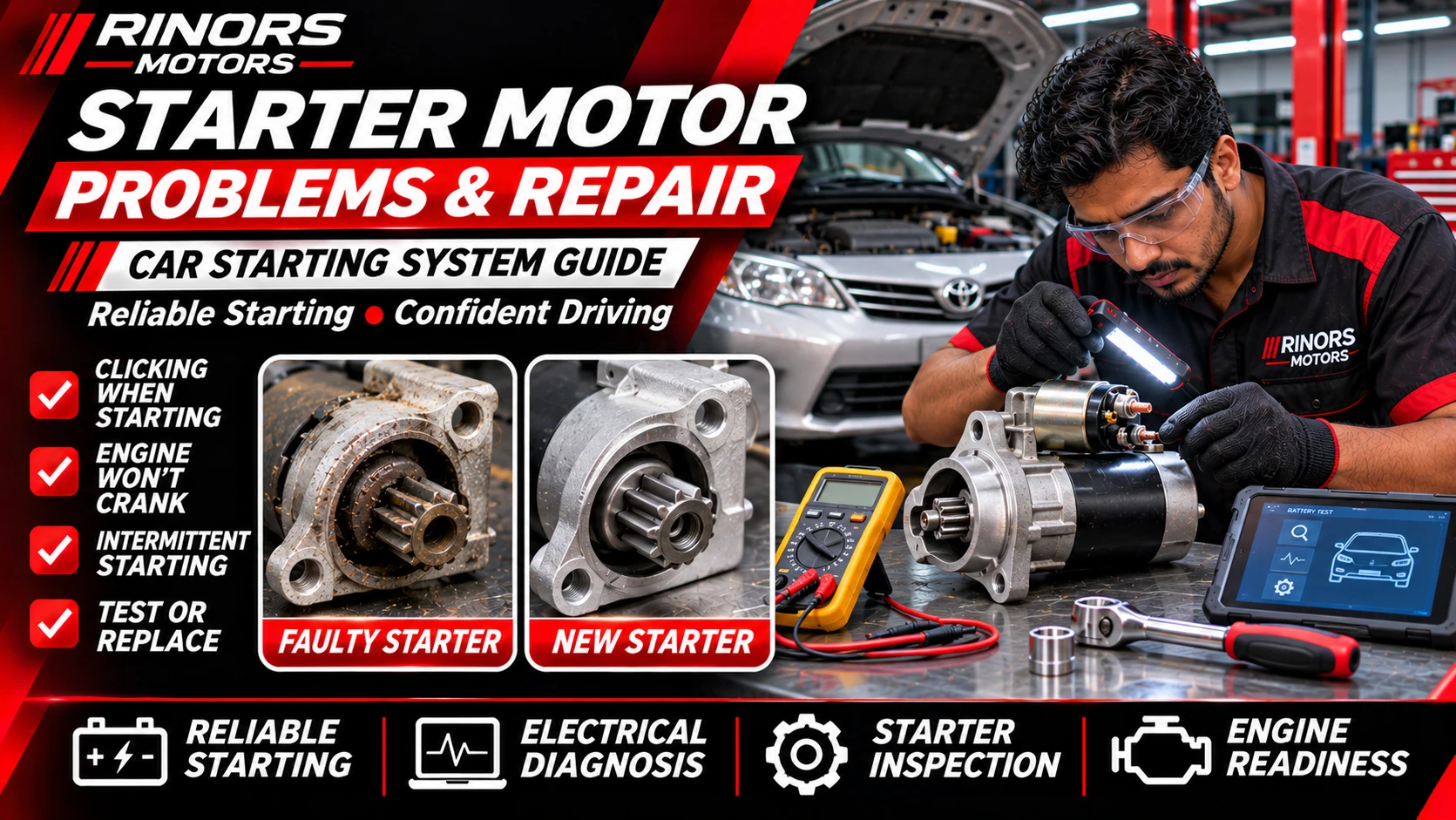
Car Starter Motor Problems in Bangladesh: Complete Diagnosis & Replacement Guide
Does your car make a clicking sound when you try to start the engine? Does the dashboard light up normally, but the engine refuses to crank? Or does the car sometimes start perfectly and sometimes fail without warning?
These symptoms may indicate a problem with the starter motor or another component in the vehicle's starting system.
The starter motor is an essential electrical component in most conventional petrol and diesel vehicles. It uses electrical power from the battery to rotate the engine during the starting process.
When the starter motor fails, the engine may not turn over even if the battery, fuel system, and other engine components are functioning correctly.
However, not every starting problem is caused by the starter motor. A weak battery, corroded battery terminal, faulty ignition switch, damaged wiring, or engine mechanical problem can produce similar symptoms.
In Bangladesh, frequent short trips, ageing electrical components, high engine-compartment temperatures, and everyday vehicle use make reliable starting-system maintenance important.
Whether you drive a Toyota Corolla, Axio, Premio, Allion, Honda Civic, Nissan X-Trail, or another conventional petrol-powered vehicle, understanding starter motor problems can help you avoid unnecessary replacement expenses.
This guide explains how starter motors work, eight potential warning signs, common causes of failure, professional diagnostic procedures, repair options, and replacement considerations.
What Is a Car Starter Motor?
A starter motor is a powerful electric motor that turns a vehicle's internal combustion engine during the starting process.
When the driver turns the ignition key or presses the engine start button, the starting system activates the starter motor under the appropriate conditions.
The starter engages with the engine's flywheel or flexplate ring gear and rotates the engine until combustion can begin.
After the engine starts, the starter disengages.
Main Functions of a Starter Motor
Rotate the engine during starting.
Provide sufficient cranking torque.
Engage the engine's starting ring gear.
Help initiate normal engine operation.
Disengage after the engine starts.
Support reliable starting under different operating conditions.
A correctly functioning starter motor is essential for dependable engine starting in vehicles equipped with a conventional starter system.
How Does a Car Starter Motor Work?
The starting process involves several electrical and mechanical components.
When the driver requests engine starting, the vehicle's control system checks relevant conditions and sends a command to the starter circuit.
Depending on the vehicle, this may involve the ignition switch, starter relay, engine control module, transmission range sensor, or other safety and authorization systems.
Step 1: Start Command
The driver turns the ignition key or presses the start button.
The vehicle verifies the conditions required for engine starting.
Step 2: Starter Solenoid Activation
The starter solenoid receives an electrical command.
In a typical pre-engaged starter, the solenoid moves the pinion mechanism toward the engine ring gear and closes the electrical contacts supplying the starter motor.
Step 3: Starter Motor Rotation
The battery supplies substantial electrical current to the starter motor.
The motor rotates the engine through the engaged pinion gear.
Step 4: Engine Combustion Begins
The engine's fuel and ignition or combustion systems begin operating.
The engine becomes capable of running independently.
Step 5: Starter Disengagement
The starter stops operating and disengages from the engine's ring gear.
The exact sequence and control method vary by vehicle design.
Main Components of a Starter Motor
A conventional starter motor assembly may contain the following components.
Electric Motor
Produces the rotational force required to crank the engine.
Starter Solenoid
Controls starter engagement and the high-current electrical connection in many conventional starter designs.
Pinion Gear
Engages with the engine's flywheel or flexplate ring gear.
Overrunning Clutch
Helps prevent the running engine from driving the starter motor at excessive speed.
Armature
A rotating electrical component inside the starter motor.
Brushes and Commutator
Provide electrical contact in many conventional brushed starter designs.
Bearings or Bushings
Support the rotating assembly.
Starter Housing
Protects and supports the internal components.
Electrical Terminals
Connect the starter assembly to the vehicle's battery and starting control circuit.
Not every starter motor uses identical internal construction.
8 Warning Signs of a Bad Starter Motor
A failing starter motor may produce several recognizable symptoms.
However, these warning signs can also result from battery, wiring, control-system, or engine problems.
1. A Single Clicking Sound but No Engine Cranking
One of the possible signs of a starter-related problem is a single clicking sound when attempting to start the engine.
The click may come from the starter solenoid or another electrical component.
Possible causes include:
Worn starter solenoid contacts.
Defective starter motor.
Insufficient electrical supply.
High-resistance battery cables.
Poor ground connection.
Mechanical resistance preventing engine rotation.
A single click does not confirm starter motor failure.
Battery and circuit testing should come first.
2. Engine Does Not Crank
A no-crank condition occurs when the engine does not rotate after the driver requests starting.
Possible symptoms include:
Dashboard lights illuminate.
Engine does not turn.
Start button produces no apparent engine response.
A clicking noise occurs without cranking.
Possible causes include:
Defective starter motor.
Weak or discharged battery.
Starter relay problems.
Faulty ignition switch.
Starter circuit wiring fault.
Transmission range switch problem.
Immobilizer or starting authorization fault.
Engine mechanical problem.
The technician must identify whether the starter receives the correct electrical command and power supply.
3. Intermittent Starting Problems
A starter motor may function normally during one attempt and fail during another.
Possible reasons include:
Worn internal electrical contacts.
Intermittent solenoid operation.
Damaged brushes.
Loose wiring.
Poor electrical connections.
Temperature-related component faults.
Intermittent faults can be difficult to diagnose because the problem may disappear temporarily.
A technician should attempt to reproduce the customer's symptoms under safe, controlled conditions.
4. Slow Engine Cranking
A worn starter motor may rotate the engine more slowly than expected.
The engine may sound unusually sluggish during starting.
However, slow cranking is commonly associated with:
Weak battery condition.
Low battery charge.
Corroded battery terminals.
High-resistance battery cables.
Poor engine ground connection.
Excessive engine mechanical resistance.
A starter should not be replaced simply because the engine cranks slowly.
Battery load testing and circuit voltage-drop testing are important.
5. Grinding Noise During Starting
A grinding sound during an attempted start may indicate a mechanical engagement problem.
Possible causes include:
Damaged starter pinion teeth.
Worn flywheel or flexplate ring gear teeth.
Incorrect starter alignment.
Starter engagement problems.
Other mechanical faults.
Repeated attempts to start the engine while grinding occurs may cause additional damage.
Arrange inspection instead of repeatedly operating the starter.
6. Starter Motor Spins but the Engine Does Not Turn
In some cases, a driver may hear a fast whirring sound when attempting to start the engine.
The starter motor may be rotating without properly engaging the engine ring gear.
Possible causes include:
Defective starter drive mechanism.
Failed overrunning clutch.
Damaged pinion gear.
Solenoid engagement problem.
Ring gear damage.
This symptom requires mechanical inspection.
A technician should distinguish a starter motor spinning freely from other unusual engine starting noises.
7. Burning Smell or Smoke During Starting
An electrical or mechanical starter problem may cause excessive heat under certain fault conditions.
Possible causes include:
Starter motor overheating.
Electrical short circuits.
Damaged electrical connections.
Excessive resistance.
A jammed starter mechanism.
Repeated prolonged cranking.
Important: If smoke or a strong burning smell appears during starting, stop immediately and arrange professional assistance.
Do not continue repeated starting attempts.
8. Starter Continues Operating After the Engine Starts
A starter that remains engaged after the engine begins running can suffer serious damage.
Possible causes include:
Sticking starter solenoid.
Defective ignition or starter control circuit.
Faulty starter relay.
Mechanical engagement problems.
A persistent grinding or high-speed whirring sound after engine startup should be treated seriously.
Switch off the engine safely and have the vehicle inspected before further operation.
Rapid Clicking vs Single Clicking: What's the Difference?
Drivers frequently describe both sounds as a starter motor problem.
However, the distinction can provide useful diagnostic information.
Rapid Repeated Clicking
A rapid series of clicks often occurs when there is insufficient electrical power to keep the starter solenoid engaged.
Possible causes include:
Weak battery.
Discharged battery.
Corroded terminals.
Poor cable connections.
Other electrical supply problems.
Rapid clicking does not automatically mean the starter motor is defective.
One Heavy Click
A single heavy click may indicate that the solenoid is attempting to engage but the starter is not cranking the engine.
Possible causes include:
Starter motor failure.
Solenoid contact problems.
High-resistance cables.
Insufficient battery current.
Mechanical engine resistance.
No Click at All
If the engine does not crank and there is no clicking sound, the starting control circuit may require attention.
Possible causes include:
Ignition or start switch problems.
Starter relay faults.
Wiring faults.
Starting authorization problems.
Transmission range switch issues.
Certain starter solenoid faults.
The absence of a click is not definitive proof of any one failure.
Why Do Starter Motors Fail?
Several factors can contribute to starter motor deterioration.
1. Normal Internal Wear
Starter motors contain electrical and mechanical components that experience repeated loads.
Over time, internal contacts, brushes, bearings, or drive components may deteriorate.
2. Worn Starter Solenoid Contacts
The solenoid contains electrical components that help connect battery power to the motor.
Worn contacts may interfere with normal starter operation.
3. Damaged Carbon Brushes
In brushed starter designs, brushes provide electrical contact with the rotating motor assembly.
Excessive wear can reduce contact quality or prevent the motor from operating.
4. Electrical Connection Problems
Loose or corroded terminals can restrict current flow.
A healthy starter motor may fail to operate properly if the electrical connections are defective.
5. Damaged Starter Pinion Gear
The pinion gear engages the engine ring gear.
Mechanical damage can prevent correct engagement.
6. Repeated Excessive Cranking
Prolonged or repeated cranking can overheat the starter motor.
Follow the manufacturer's starting instructions and allow the system to recover between unsuccessful attempts.
7. Heat and Contamination
Starter motors operate near the engine and may be exposed to high temperatures, moisture, oil leakage, and road contamination.
These conditions can contribute to deterioration.
8. Incorrect Replacement Parts
Installing a starter with unsuitable mounting points, electrical specifications, or drive geometry can cause starting problems and mechanical damage.
Starter Motor vs Car Battery: What's the Difference?
The starter motor and battery work together, but their functions are different.
Car Battery
The battery stores electrical energy and provides the power needed for starting.
Starter Motor
The starter uses that electrical energy to rotate the engine.
Symptoms That May Suggest Battery Problems
Rapid clicking.
Weak headlights before starting.
Multiple electrical functions becoming weak.
Slow cranking.
Low battery charge.
Failed battery load test.
Symptoms That May Suggest Starter Problems
Correct battery condition but no engine cranking.
Confirmed electrical supply reaching the starter without normal operation.
Starter engagement grinding.
Starter spinning without cranking the engine.
Confirmed solenoid or internal motor failure.
Why Testing Matters
A discharged battery can make a healthy starter appear defective.
Similarly, a defective starter can prevent engine starting even when the battery is fully charged.
Both components should be evaluated before replacement.
Starter Motor vs Alternator: What's the Difference?
The starter and alternator are different electrical components.
Starter Motor
Uses battery power to rotate the engine during starting.
Alternator
Generates electricity while the engine runs in conventional alternator-equipped vehicles.
How Alternator Problems Affect Starting
A failed alternator may prevent the battery from charging properly.
The battery can gradually become discharged, making the engine difficult or impossible to start.
However, the actual starting failure may be caused by insufficient battery charge rather than a defective starter.
How Starter Problems Differ
A failed starter can prevent the engine from cranking even when the battery and charging system are in good condition.
Therefore, battery condition, charging performance, and starter operation should be tested separately.
Car Cranks but Won't Start: Is the Starter Motor Bad?
Usually, a normal cranking sound suggests that the starter is performing its main function.
A crank-no-start condition means the engine rotates but combustion does not begin or continue normally.
Possible causes include:
Fuel pump problems.
Fuel pressure faults.
Ignition system failures.
Crankshaft or camshaft sensor problems.
Immobilizer issues.
Engine mechanical faults.
Other engine control problems.
A starter motor should not be replaced simply because the engine cranks but does not start.
No-crank and crank-no-start are different diagnostic conditions.
How Are Starter Motor Problems Diagnosed?
Professional starting-system diagnosis should be systematic.
Step 1: Confirm the Symptoms
The technician identifies whether the vehicle:
Does not crank.
Cranks slowly.
Produces a single click.
Produces rapid clicking.
Makes a grinding sound.
Starts intermittently.
Spins the starter without rotating the engine.
Step 2: Check Battery Condition
The battery is tested for adequate charge and performance.
An appropriate battery load or conductance test may be used.
Step 3: Inspect Battery Terminals
The technician checks:
Terminal security.
Corrosion.
Cable condition.
Ground connections.
Relevant electrical connections.
Step 4: Inspect Starter Power Supply
The main starter power circuit is examined using appropriate test instruments.
Step 5: Perform Voltage-Drop Testing
Voltage-drop testing helps identify excessive electrical resistance in cables and connections during a controlled starting attempt.
The results are compared with relevant specifications.
Step 6: Check the Starter Control Circuit
The technician verifies whether the starter receives the required activation command.
This may involve checking:
Starter relay.
Ignition switch.
Push-button start control.
Transmission range sensor.
Clutch interlock switch.
Control-module commands.
Related wiring.
Step 7: Evaluate Starter Operation
Where appropriate, the technician assesses starter current draw, motor performance, and engagement behavior.
Step 8: Inspect Mechanical Components
If necessary, the starter pinion and engine ring gear are examined for damage.
A mechanical engine problem must also be considered when testing indicates abnormal resistance.
Step 9: Identify the Defective Component
The technician determines whether the actual fault involves the starter assembly, battery, electrical circuit, control system, or engine.
Step 10: Repair and Verify
After the appropriate repair, the starting system is tested to confirm reliable operation.
Can a Bad Starter Motor Be Repaired?
Some conventional starter motors can be repaired.
However, repairability depends on the starter design and condition.
When Repair May Be Possible
Certain serviceable starter motors may allow replacement of:
Starter solenoid.
Carbon brushes.
Bearings or bushings.
Certain electrical contacts.
Serviceable drive components.
Other manufacturer-supported internal parts.
External electrical wiring and connector faults may also be repaired without replacing the starter.
When Replacement May Be Necessary
Complete replacement may be appropriate when:
Internal motor windings have failed.
Multiple components are damaged.
The starter housing is damaged.
The motor is not economically repairable.
Suitable internal components are unavailable.
Manufacturer procedures specify assembly replacement.
Repair should restore the starter to appropriate electrical and mechanical performance.
Starter Motor Repair vs Replacement: Which Is Better?
The correct decision depends on the actual fault.
Starter Motor Repair
Repair may be appropriate when the defective component is serviceable and the remaining assembly is in good condition.
Starter Motor Replacement
Replacement may be preferable when the starter has extensive damage or a complete replacement provides a more reliable solution.
Factors to Consider
Nature of the failure.
Condition of the starter motor.
Vehicle compatibility.
Availability of internal repair parts.
Repair labor.
Replacement part quality.
Warranty.
Long-term reliability.
Total repair cost.
A proper diagnosis should come before either decision.
What Should You Do if Your Car Won't Crank?
If your vehicle fails to crank, there are several basic checks you can make without opening the starter system.
1. Check the Dashboard
Observe whether the dashboard lights illuminate normally or appear unusually weak.
2. Confirm the Transmission Position
For automatic vehicles, follow the owner's manual and make sure the transmission is in an approved starting position, normally Park or Neutral.
Keep the brake applied and the vehicle securely parked.
3. Check for Battery-Related Symptoms
Weak electrical accessories or rapid clicking may indicate a battery or connection problem.
4. Try the Correct Spare Key Procedure
If the vehicle displays a security or key detection warning, consult the owner's manual.
5. Avoid Excessive Starting Attempts
Repeated prolonged cranking can overheat starting-system components.
6. Do Not Short Starter Terminals
Never bridge starter terminals with a screwdriver or another metal object.
This can cause sudden engine cranking, electrical damage, sparks, or serious injury.
7. Arrange Professional Assistance
If the vehicle will not crank, professional diagnosis can prevent unnecessary replacement of expensive components.
Is It Safe to Jump-Start a Car With a Bad Starter?
Jump-starting supplies external electrical assistance to a vehicle with an insufficiently charged battery.
It does not repair a mechanically or electrically defective starter motor.
When Jump-Starting May Help
A jump-start may help when the primary problem is a discharged battery and the vehicle's starting system is otherwise functional.
When Jump-Starting May Not Help
It may not resolve:
A failed starter motor.
Damaged starter solenoid contacts.
Broken starter wiring.
A defective starter relay.
Engine mechanical binding.
Important Safety Precautions
Jump-start procedures vary by vehicle.
Use only the manufacturer-approved connection points and procedure.
Incorrect jump-starting can damage vehicle electronics or cause injury.
Some hybrid vehicles have special jump-start requirements and must not be treated like conventional petrol cars.
How Is a Starter Motor Replaced?
Starter replacement procedures vary significantly depending on the vehicle.
A professional service may include the following steps.
Step 1: Confirm Starter Failure
Battery, circuit, and mechanical faults should be ruled out before replacement.
Step 2: Identify the Correct Starter
The replacement part is selected using vehicle specifications and the original part number.
Step 3: Prepare the Vehicle
The technician follows the manufacturer's electrical isolation and safety procedures.
Step 4: Access the Starter Motor
Some starters are accessible from the engine compartment.
Others require access from underneath the vehicle or removal of nearby components.
Step 5: Disconnect Electrical Connections
Starter electrical cables and control connections are safely disconnected.
Step 6: Remove the Defective Starter
The starter is removed from its mounting position.
Step 7: Inspect Related Components
The technician examines relevant mounting surfaces, electrical connections, and ring gear condition where appropriate.
Step 8: Install the Replacement
The correct starter is installed with the required mounting and electrical connections.
Step 9: Tighten Fasteners Correctly
Mounting and electrical fasteners are secured according to manufacturer specifications.
Step 10: Verify Starting Performance
The technician checks for:
Reliable engine cranking.
Normal engagement.
Proper starter disengagement.
Unusual sounds.
Electrical connection problems.
Recurring starting failures.
Safety Warning: Starter motors use high-current electrical circuits. Improper testing or installation can cause short circuits, burns, fire, or unexpected engine movement. Professional servicing is recommended.
Toyota Starter Motor Problems in Bangladesh
Toyota vehicles are widely used in Bangladesh, but starting-system designs vary between petrol-only and hybrid models.
Toyota Corolla and Axio Petrol
Many conventional petrol-powered Corolla and Axio variants use a traditional electric starter motor.
Possible problems include:
Worn starter solenoid.
Internal starter motor wear.
Damaged electrical connections.
Pinion engagement problems.
Starting relay or control-circuit faults.
Correct diagnosis requires identification of the installed engine and starting system.
Toyota Premio and Allion
Conventional petrol Premio and Allion models also use model-specific starting components.
A starter motor from one engine configuration may not be compatible with another.
Part numbers, mounting arrangements, and electrical requirements should be verified.
Toyota Aqua Hybrid
The Toyota Aqua uses a hybrid starting arrangement rather than the conventional starter design found in many petrol-only vehicles.
In Toyota's hybrid architecture, a motor-generator within the hybrid transaxle is used to start the petrol engine.
Therefore, an Aqua that does not enter READY mode should not automatically be diagnosed as having a failed conventional starter motor.
Possible problems may involve:
12-volt auxiliary battery condition.
Hybrid system warnings.
Starting authorization.
Control-system faults.
Other hybrid-related problems.
Toyota Corolla Axio Hybrid
The Corolla Axio Hybrid also uses a hybrid motor-generator system for petrol engine starting.
Diagnosis must follow the appropriate hybrid service procedures.
Important: Hybrid vehicles contain high-voltage components. Motor-generator, inverter, and high-voltage electrical diagnosis should only be performed by appropriately trained personnel.
Honda and Nissan Starter Motor Problems
Honda Civic, Nissan X-Trail, and other conventional petrol models may use traditional starter motors.
However, exact designs vary by engine and production year.
Honda Grace, Honda Vezel, and other vehicles may also be available with different conventional or hybrid powertrains.
Some hybrid systems use different starting architectures from conventional petrol engines.
Before diagnosing or purchasing a starter motor, confirm:
Vehicle model.
Production year.
Engine code.
Conventional or hybrid powertrain.
Exact starter system.
Original part number.
Do not assume every vehicle with a petrol engine uses a separate conventional starter motor.
How Much Does Starter Motor Repair Cost in Bangladesh?
Starter motor repair costs depend on the actual problem.
Main Cost Factors
Vehicle manufacturer.
Model and engine.
Internal starter motor condition.
Solenoid repair requirements.
Brush or bearing replacement.
Electrical wiring repair.
Availability of repair parts.
Diagnostic testing.
Labor requirements.
Warranty.
A minor electrical connection repair may cost substantially less than rebuilding or replacing a complete starter motor.
The correct estimate should be based on confirmed diagnostic findings.
Starter Motor Replacement Cost in Bangladesh
Complete starter motor replacement costs vary by vehicle and component type.
Main Pricing Factors
Vehicle brand and model.
Engine configuration.
Starter motor output and construction.
Original-equipment or aftermarket component.
New or professionally remanufactured replacement.
Component availability.
Installation accessibility.
Additional wiring or mounting repairs.
Labor charges.
Product warranty.
A compact starter used in one petrol engine may have a different price from a more complex unit used in another vehicle.
An accurate quotation requires the correct replacement part number.
How to Choose the Correct Starter Motor
Starter motors are not universally interchangeable.
Even components that look similar may have different mechanical and electrical specifications.
Important Vehicle Details
Manufacturer.
Exact model.
Production year.
Engine code.
Transmission configuration.
Chassis or VIN.
Original starter motor part number.
Required electrical specifications.
Mechanical Compatibility
Check:
Starter mounting points.
Pinion gear design.
Pinion engagement geometry.
Starter housing dimensions.
Electrical terminal positions.
Relevant mounting requirements.
Electrical Compatibility
The replacement must meet the vehicle's electrical and control requirements.
An incompatible starter can cause poor cranking, engagement problems, or electrical faults.
Original vs Aftermarket Starter Motors
Original-equipment and suitable aftermarket starter motors may be available.
Choose components that meet the required quality and compatibility standards.
A professionally remanufactured starter may also be an option if it has been properly rebuilt and tested.
How Long Does a Starter Motor Last?
There is no universal replacement interval for every starter motor.
Service life depends on several factors.
Factors Affecting Starter Durability
Starter construction.
Vehicle usage.
Frequency of starting.
Engine operating conditions.
Electrical supply quality.
Heat exposure.
Contamination.
Installation quality.
Overall vehicle maintenance.
A starter motor may function for many years without repair, while another may fail earlier because of electrical or mechanical damage.
Replacement should generally be based on confirmed condition rather than an arbitrary mileage figure.
How to Help Prevent Starter Motor Problems
1. Maintain the Car Battery
A weak battery can create starting difficulties and complicate starter operation.
Follow appropriate battery maintenance and testing procedures.
2. Keep Electrical Connections Secure
Loose or corroded battery and starter connections should be inspected and repaired.
3. Avoid Excessive Cranking
Do not hold the starter engaged for longer than recommended by the vehicle manufacturer.
4. Repair Starting Problems Promptly
Repeated clicking or grinding should not be ignored.
5. Maintain the Charging System
A healthy alternator or appropriate charging system helps maintain the battery's charge.
6. Address Engine Oil Leaks
Oil contamination near electrical components should be investigated.
7. Use Correct Replacement Parts
Install a starter motor compatible with the exact vehicle.
8. Follow Professional Installation Procedures
Incorrect mounting or wiring can damage starter components.
9. Avoid Improper Electrical Modifications
Poorly installed electrical accessories or aftermarket starting systems may cause electrical problems.
10. Investigate Intermittent Starting Faults
An intermittent starting problem may become more frequent over time.
Early diagnosis can reduce inconvenience and unnecessary replacement expenses.
Frequently Asked Questions About Starter Motors
What Are the First Signs of a Bad Starter Motor?
Possible symptoms include intermittent no-crank conditions, a single click without cranking, slow cranking despite a healthy battery, grinding noises, or the starter spinning without engaging the engine.
However, battery and electrical faults can produce similar symptoms.
Why Does My Car Click but Not Start?
Clicking may indicate insufficient battery power, poor electrical connections, starter solenoid problems, or other starting-system faults.
The cause depends partly on whether the sound is a single click or rapid repeated clicking.
Can a Bad Starter Drain the Battery?
Certain starter circuit faults may cause abnormal electrical consumption, and repeated unsuccessful starting attempts can discharge the battery.
However, a failed starter motor does not automatically cause continuous battery drain while parked.
Can a Car Start With a Bad Starter Motor?
An intermittently failing starter may operate normally on some attempts and fail on others.
However, a completely inoperative conventional starter will generally prevent normal engine cranking.
Is a Starter Motor the Same as an Alternator?
No. A starter motor turns the engine during starting, while an alternator generates electrical power during engine operation in conventional alternator-equipped vehicles.
Can a Bad Starter Cause Slow Cranking?
Yes. Internal starter motor wear can contribute to slow cranking.
However, weak batteries, cable resistance, and engine mechanical problems must also be considered.
Can a Starter Motor Be Repaired Instead of Replaced?
Some serviceable starters can be repaired by replacing solenoids, brushes, bearings, or other components.
Severely damaged or non-serviceable units may require replacement.
Should I Replace the Battery When Replacing the Starter?
Not automatically.
The battery should be tested and replaced only when its condition warrants replacement.
What Happens if the Starter Does Not Disengage?
A starter that continues operating after the engine starts can suffer serious damage.
Switch off the engine safely and arrange professional inspection.
Can a Faulty Starter Cause the Check Engine Light?
A conventional starter fault does not necessarily trigger a check engine light.
However, some modern vehicles can record starting-system or electrical diagnostic codes.
Do Toyota Hybrid Cars Have Conventional Starter Motors?
Many Toyota hybrid models, including the Aqua and Corolla Axio Hybrid, use a motor-generator arrangement to start the petrol engine rather than a separate conventional starter motor.
Is It Safe to Drive With a Bad Starter?
A conventional starter is generally needed to start the engine, not to keep it running after startup.
However, a vehicle with an unreliable starter may leave you stranded after stopping.
Grinding, overheating, or a starter that remains engaged can indicate more serious conditions requiring immediate attention.
Starter Motor Inspection & Replacement at Rinors Motors
At Rinors Motors, we understand the importance of dependable engine starting and properly functioning automotive electrical systems for drivers in Bangladesh.
If your car makes clicking noises, refuses to crank, starts intermittently, or produces unusual grinding sounds during startup, identifying the actual cause is essential before replacing expensive components.
A professional diagnostic assessment can help distinguish starter motor failure from weak batteries, damaged wiring, faulty relays, ignition switch problems, and other starting-system issues.
Whether you own a Toyota, Honda, Nissan, or another vehicle, choosing the correct starter motor and following the appropriate repair procedures are important for reliable operation.
Contact Rinors Motors to discuss starter motor diagnosis, starting-system problems, compatible replacement components, and suitable repair or replacement options for your vehicle.
Rinors Motors — Your Trusted Automotive Partner in Bangladesh.