Car Central Locking Problems in Bangladesh: Complete Diagnosis & Repair Guide
Is your car refusing to lock or unlock with the remote key? Does one door remain locked while the others work normally? Are you hearing clicking or buzzing noises from inside a door?
These symptoms may indicate a problem with the vehicle's central locking system, door lock actuator, or related electrical components.
Central locking is an important convenience and security feature in modern cars. It allows the driver to lock or unlock multiple doors through a remote key, interior switch, or keyless entry system.
When central locking stops working correctly, the cause may be relatively simple, such as a weak key fob battery, or more complicated, such as a failed actuator motor, damaged wiring, or malfunctioning body control module.
In Bangladesh, where Toyota Corolla, Axio, Premio, Allion, Aqua, Honda Civic, Vezel, and Nissan vehicles are commonly used, central locking problems can develop because of ageing components, electrical faults, moisture exposure, or previous repair work.
This guide explains eight common causes of central locking failure, warning signs, professional diagnostic procedures, repair options, and replacement costs in Bangladesh.
What Is a Car Central Locking System?
A central locking system allows several vehicle doors to be locked or unlocked through a coordinated control system.
Depending on the vehicle, the system may operate through:
Remote key fob.
Driver-side door lock switch.
Interior central locking button.
Physical key.
Smart key or keyless entry system.
Automatic locking functions.
The system uses electrical commands to operate door lock actuators that move the mechanical locking mechanisms.
Main Functions of Central Locking
Lock or unlock multiple doors.
Support remote key operation.
Improve vehicle access convenience.
Help secure the vehicle when parked.
Coordinate with certain alarm systems.
Support automatic locking features where equipped.
Work with smart key systems on compatible vehicles.
The exact functions depend on the vehicle model and installed equipment.
How Does Car Central Locking Work?
When a driver presses the lock button on the remote, the remote transmits a command to the vehicle's receiver or electronic control system.
The control module processes the request and activates the relevant door locking components.
Each powered door lock contains an actuator or integrated locking mechanism that physically moves the lock.
Main Components of a Central Locking System
1. Remote Key Fob
Transmits locking and unlocking commands to the vehicle.
2. Door Lock Actuator
Uses an electric motor or other actuator mechanism to operate the door lock.
3. Door Latch Assembly
Secures the door in the closed position and contains mechanical locking components.
4. Body Control Module (BCM)
Coordinates central locking and other body electrical functions on many modern vehicles.
5. Central Locking Switch
Allows the driver or passengers to control door locking from inside the vehicle.
6. Electrical Wiring
Connects the locking components to power supplies and control systems.
7. Fuses and Control Circuits
Protect and control the relevant electrical systems.
8. Door Position and Lock Status Switches
Provide information about whether doors are open, closed, locked, or unlocked in applicable designs.
Some vehicles combine the actuator, latch, and status switches into a single assembly.
8 Common Causes of Car Central Locking Not Working
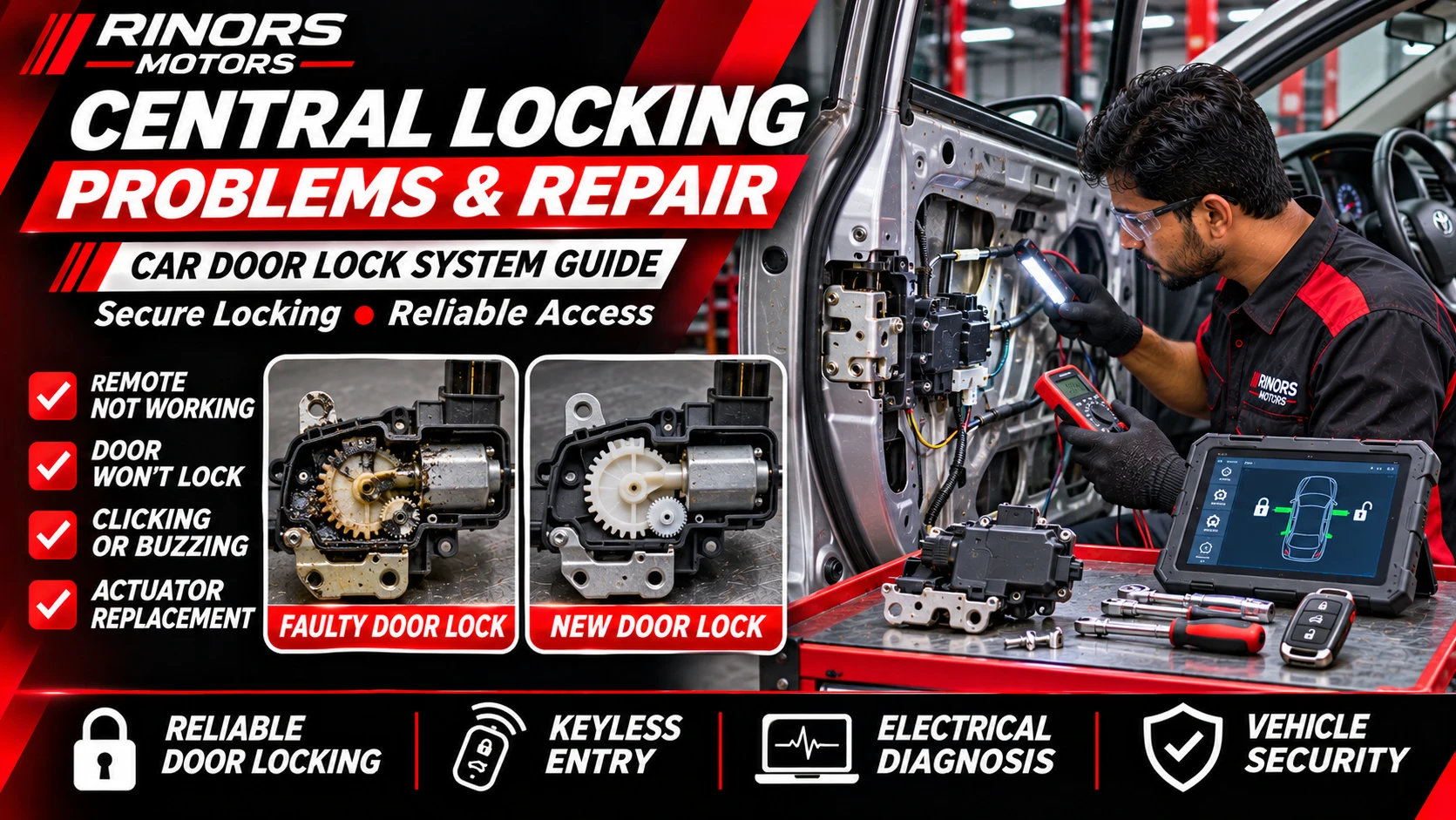
1. Faulty Door Lock Actuator
A defective door lock actuator is one possible cause of central locking failure.
The actuator normally contains a small electric motor and mechanical components that move the door lock.
Over time, these components may wear out or stop operating correctly.
Common Symptoms
One door does not lock.
One door does not unlock.
The actuator makes a buzzing sound.
Door locking becomes intermittent.
A lock operates slowly.
Several button presses are needed.
If one door fails while the others operate correctly, that door's actuator, wiring, or mechanical linkage should be inspected.
However, actuator replacement should only follow confirmation of the fault.
2. Weak or Dead Key Fob Battery
The remote key contains a small battery that powers its wireless communication functions.
When the battery becomes weak, the remote may stop transmitting reliably.
Common Symptoms
Remote works only near the vehicle.
Locking becomes intermittent.
The car does not respond to button presses.
A key battery warning appears on compatible vehicles.
The spare remote still works normally.
Possible Solution
Replace the key fob battery with the correct type and follow the manufacturer's instructions.
If the problem continues, the remote, vehicle receiver, and related systems may need diagnosis.
3. Blown Fuse
Central locking components require electrical power.
A blown fuse can interrupt power to part or all of the locking system.
Common Symptoms
Multiple locks stop working.
Interior locking switches do not respond.
The remote produces no locking response.
Other related body electrical functions may also stop working.
Possible Solution
A technician should identify the relevant fuse and determine why it failed.
Repeatedly replacing a fuse without addressing a short circuit can create additional electrical damage.
Never install a fuse with a higher rating than the manufacturer specifies.
4. Damaged Door Wiring
Electrical wiring passes between the vehicle body and the doors.
On many vehicles, the wiring harness runs through a flexible rubber boot near the door hinges.
Repeated door opening and closing can place stress on the wiring.
Common Symptoms
Locking works intermittently.
One door does not respond.
Locking changes when the door moves.
Other electrical functions in the same door malfunction.
Door wiring connectors show damage or corrosion.
Possible Solution
The wiring harness, connectors, and relevant circuits should be inspected and repaired according to the manufacturer procedures.
A failed actuator should not be assumed until electrical supply and control have been checked.
5. Faulty Central Locking Switch
The interior locking switch provides a command to the vehicle's locking control system.
A damaged switch may fail to send the expected command.
Common Symptoms
Remote locking works but the interior button does not.
The locking switch operates intermittently.
One direction of the switch fails.
The button feels physically damaged.
Possible Solution
The switch and related wiring should be tested.
If the switch is defective, replacement may be appropriate.
6. Body Control Module or Control-System Problem
Many modern vehicles use a Body Control Module to coordinate door locking, lighting, alarms, and other functions.
A control-related fault can affect the operation of several locks.
Possible Symptoms
Multiple doors fail to respond.
Locking behavior becomes unpredictable.
Other body electrical functions malfunction.
Diagnostic trouble codes appear in the relevant module.
Remote and interior locking commands behave inconsistently.
Possible Solution
Professional electronic diagnosis may include checking:
Power supply.
Ground connections.
Control signals.
Communication networks.
Stored fault codes.
Related switches and sensors.
A control module should not be replaced without confirming the problem.
7. Damaged Door Latch or Mechanical Linkage
Not every locking failure is electrical.
Mechanical components inside the door can wear out, become misaligned, or suffer damage.
Common Symptoms
Lock actuator makes a sound, but the door remains unlocked.
The lock mechanism moves only partially.
The manual lock feels unusually stiff.
The door latch sticks.
The door does not open or close normally.
Possible Solution
The mechanical latch, rods, cables, and connecting components should be inspected.
Depending on the condition, an appropriate repair or complete latch replacement may be necessary.
8. Keyless Entry, Receiver, or Security-System Fault
Vehicles equipped with remote or smart key systems use additional electronic components.
A fault in the receiver, antennas, door handle sensors, or related control systems may prevent remote unlocking.
Possible Symptoms
The remote works intermittently.
Smart entry does not recognize the key.
Touch-sensitive door handles stop responding.
The interior lock button works while remote operation fails.
A key detection warning appears.
Possible Solution
The technician should distinguish between remote key problems and vehicle-side communication faults.
Depending on the diagnosis, the solution may involve battery replacement, wiring repair, receiver diagnosis, or manufacturer-approved key programming.
One Car Door Not Locking: What Does It Mean?
When only one door refuses to lock or unlock, the cause is often localized to that door.
Possible Causes
Defective door lock actuator.
Damaged wiring near the door hinge.
Faulty electrical connector.
Jammed locking mechanism.
Damaged latch assembly.
Mechanical linkage problems.
How Is It Diagnosed?
The technician compares the affected door with the doors that operate normally.
Relevant checks may include:
Testing the remote key.
Testing the interior lock switch.
Listening for actuator operation.
Checking the mechanical lock movement.
Inspecting electrical supply and control signals.
Examining relevant wiring.
Identifying the defective component.
If the actuator receives the correct command but cannot operate the lock properly, actuator or mechanical failure becomes more likely.
However, correct electrical testing is essential before ordering parts.
All Car Doors Not Locking: Common Causes
If every powered door lock stops working simultaneously, the problem may involve a component shared by the system.
Possible Causes
Weak remote battery.
Faulty central locking fuse.
Vehicle battery or electrical supply problem.
Remote receiver failure.
Central locking control-system fault.
Damaged main wiring.
Defective interior control switch.
A system-specific safety or door-open condition.
What Should Be Checked First?
Determine whether the problem occurs with:
The remote key only.
The interior lock switch only.
Both remote and interior switches.
One key or all available keys.
These observations can help narrow the fault.
For example, if the interior switch locks every door normally but neither remote works, the diagnostic process should focus on the remote and keyless-entry system before replacing door actuators.
Door Lock Actuator Problems: Common Warning Signs
A faulty door lock actuator may develop gradually or stop working suddenly.
Slow Locking
The locking mechanism moves more slowly than usual.
This may indicate an actuator, mechanical friction, or electrical supply problem.
Clicking or Buzzing Noise
An actuator with damaged internal gears or a struggling motor may create unusual noises.
Intermittent Locking
The lock sometimes responds and sometimes fails.
Possible causes include electrical connections, mechanical resistance, or actuator deterioration.
Locking Works Only in One Direction
A door may unlock but fail to lock, or lock but fail to unlock.
The cause may involve the actuator, control circuit, or mechanical linkage.
Repeated Button Presses Required
A weak actuator or intermittent electrical connection may prevent consistent operation.
Lock Moves but Does Not Fully Engage
The actuator may operate without moving the latch mechanism through its complete travel.
This requires mechanical and electrical inspection.
Why Does My Car Lock and Immediately Unlock Again?
Some vehicles automatically unlock when the control system detects a condition that should prevent locking.
Other times, the behavior can result from a fault.
Possible Causes
Door not fully closed.
Faulty door position sensor.
Incorrect lock status signal.
Damaged latch switch.
Key-detection or anti-lockout function.
Body control system fault.
Aftermarket alarm or central locking problem.
What Should You Do?
Check that all doors and the luggage compartment are fully closed.
If the system repeatedly locks and unlocks without an obvious reason, a technician should examine the relevant door status information and locking controls.
Do not assume that the actuator motor is faulty based only on this symptom.
Car Remote Not Working but Manual Lock Works
If the physical key or manual lock works while remote central locking fails, the mechanical locking components may still be functional.
Possible causes include:
Weak key fob battery.
Damaged remote buttons.
Remote circuit problems.
Vehicle receiver faults.
Key synchronization issues.
Relevant control-module problems.
Other keyless-entry system faults.
Simple Checks Before Repair
Try the spare remote key, if available.
Check for a low key battery warning.
Use the correct replacement battery.
Confirm the battery is installed properly.
Test the interior central locking switch.
Check the owner's manual for the correct remote operation procedure.
Avoid unnecessary key programming or replacement before determining the actual cause.
Key Fob vs Smart Key: What's the Difference?
Although the terms are sometimes used interchangeably, remote keys and smart keys may have different functions.
Remote Key Fob
Usually requires the driver to press a button to lock or unlock the vehicle.
Smart Key
May support passive entry, allowing the vehicle to detect an authorized key near the door.
Depending on the vehicle, the driver may use a door handle button or touch sensor.
Smart Key Problems
Possible symptoms include:
Key not detected warning.
Passive entry not working.
Door handle sensor not responding.
Remote function becoming unreliable.
Low smart key battery warning.
The correct diagnosis depends on the vehicle's keyless-entry system.
Central Locking vs Immobilizer: What's the Difference?
The central locking system and immobilizer have different purposes.
Central Locking System
Controls locking and unlocking of vehicle doors.
Immobilizer System
Helps prevent unauthorized engine starting by verifying an approved key or electronic authorization.
Can They Be Related?
Some vehicles integrate several security and key functions into shared electronic control systems.
However, a central locking failure does not automatically mean the immobilizer is defective.
A car may have a functioning engine immobilizer while the remote locking buttons fail.
Similarly, a vehicle may unlock normally but fail to start because of a separate immobilizer or starting-system problem.
Accurate diagnosis is important.
Central Locking vs Power Window Problems
Power door locks and power windows are separate systems, although they may share some electrical components.
Central Locking Problems
Typically involve:
Door lock actuator.
Locking switch.
Door latch.
Remote receiver.
Body control module.
Locking-related wiring.
Power Window Problems
Typically involve:
Window motor.
Window regulator.
Window control switch.
Window wiring.
Window control electronics.
What if Both Stop Working on the Same Door?
If the power window and central locking fail together on one door, shared electrical wiring, connectors, or control components may deserve attention.
However, one failed component does not prove that the other is defective.
How Are Car Central Locking Problems Diagnosed?
Professional diagnosis should identify the specific electrical or mechanical fault before replacement.
Step 1: Identify the Symptoms
The technician determines whether:
One door fails.
All doors fail.
Only remote locking fails.
Only interior switch operation fails.
The system works intermittently.
Locking works in one direction only.
Step 2: Check the Remote Key
The remote battery, buttons, and relevant signal functions are evaluated.
Step 3: Check Vehicle Battery Condition
Low vehicle voltage can affect electronic locking systems.
Step 4: Inspect Relevant Fuses
The central locking circuit and associated power supplies are checked according to the manufacturer's wiring diagram.
Step 5: Test the Interior Lock Switch
The technician verifies whether the switch sends the appropriate command.
Step 6: Inspect Door Wiring
Relevant wiring, especially near door hinges, is checked for damage or corrosion.
Step 7: Check Actuator Command and Operation
Using suitable diagnostic instruments, the technician checks whether the actuator receives the correct electrical command.
The precise test method depends on the vehicle's control system.
Step 8: Inspect Mechanical Lock Components
The door latch, linkage, and locking mechanisms are examined.
Step 9: Scan Electronic Control Modules
Where supported, a professional diagnostic scanner is used to inspect body-system fault codes and relevant door status information.
Step 10: Confirm the Repair
After servicing, the technician tests all affected locking functions and ensures the problem has been resolved.
Can a Faulty Door Lock Actuator Be Repaired?
The answer depends on the actuator design and cause of failure.
When Repair May Be Possible
Some problems can be corrected without replacing the actuator assembly.
Examples include:
Damaged external wiring.
Loose electrical connectors.
Repairable mechanical linkage.
Defective switches.
Certain serviceable lock components.
When Replacement May Be Necessary
Replacement may be appropriate when:
The actuator motor has failed.
Internal gears are damaged.
The mechanism cannot complete its movement.
Internal electrical components are defective.
The assembly is non-serviceable.
Manufacturer procedures specify replacement.
Many modern vehicles use integrated door latch and actuator assemblies.
In these designs, replacing only the small electric motor may not be a manufacturer-supported repair.
Door Lock Actuator vs Complete Door Latch Assembly
The terms are often used interchangeably in the automotive parts market, but the components may differ.
Door Lock Actuator
The actuator provides the movement needed to lock or unlock the door.
Door Latch Assembly
The latch mechanically secures the door in its closed position.
Some latch assemblies contain the actuator and related switches.
Which Part Should You Replace?
The correct choice depends on:
Vehicle design.
Fault location.
Component serviceability.
Replacement part availability.
Manufacturer recommendations.
Mechanical condition of the latch.
Replacing a complete latch assembly may be necessary on some vehicles, while others allow separate actuator replacement.
How Is a Door Lock Actuator Replaced?
Door lock actuator replacement varies by vehicle.
A professional procedure may include the following stages.
Step 1: Confirm the Fault
The actuator should be tested before replacement.
Step 2: Identify the Correct Replacement Part
The technician checks the vehicle and door position.
Step 3: Prepare the Vehicle
The vehicle is secured and relevant electrical safety procedures are followed.
Step 4: Remove the Door Trim Panel
The interior trim panel is carefully removed using suitable tools.
Step 5: Protect the Window and Door Components
The technician avoids damaging the glass, window regulator, wiring, and door sealing components.
Step 6: Access the Locking Mechanism
The actuator or latch assembly is located inside the door.
Step 7: Disconnect Electrical and Mechanical Connections
Relevant connectors, rods, or cables are disconnected according to the manufacturer's instructions.
Step 8: Replace the Defective Component
The correct replacement part is installed and secured.
Step 9: Reassemble the Door
All components, trim panels, seals, and electrical connections are restored.
Step 10: Test the System
The technician confirms:
Remote locking.
Interior locking switch.
Manual key operation where equipped.
Door handle operation.
Door latch engagement.
Door status warnings.
Child safety lock operation where applicable.
Safety Warning: Vehicle doors can contain side-impact sensors, airbag-related components, wiring, sharp metal edges, and moving window mechanisms. Improper repairs may damage safety systems or prevent the door from opening correctly. Professional servicing is recommended.
Can a Door Lock Problem Affect Vehicle Security?
Yes.
A door that does not lock properly may leave the vehicle vulnerable to unauthorized access.
A door that cannot open normally may also create a safety concern.
Possible Risks
A door remaining unlocked when the vehicle is parked.
An alarm failing to arm correctly on certain vehicles.
Unexpected locking or unlocking behavior.
A passenger being unable to open an affected door.
A damaged latch failing to secure the door properly.
Important Safety Distinction
A door that will not lock is a vehicle security concern.
A door that will not latch or open correctly may create a more immediate occupant safety issue.
If the door does not remain securely closed or passengers cannot open it normally, avoid using the vehicle until the problem is inspected.
Child Lock vs Central Locking: Are They Different?
Yes.
A rear-door child safety lock is designed to prevent the door from being opened using the interior handle.
This is different from the vehicle's main central locking mechanism.
How a Child Safety Lock Works
Depending on the vehicle, the child lock may be mechanical or electronically controlled.
When activated, it typically prevents the affected rear door from opening using the interior handle.
The door may still open from outside when otherwise unlocked.
Why Owners Sometimes Confuse the Two
A passenger may report that the rear door does not open from inside even though the central locking system works normally.
In such cases, the child safety lock setting should be checked.
However, if the door also fails to open from outside or does not latch correctly, professional inspection is necessary.
Toyota Central Locking Problems in Bangladesh
Toyota vehicles are widely used in Bangladesh, but their locking systems differ by model and generation.
Toyota Corolla and Axio
Possible complaints include:
One door not responding to the remote.
Intermittent actuator operation.
Damaged door wiring.
Defective interior locking switch.
Integrated latch or actuator problems.
The exact component should be identified using the vehicle's model, production year, and door position.
Toyota Premio and Allion
Different Premio and Allion generations may use model-specific door lock actuators and electronic systems.
Before purchasing replacement parts, confirm the correct assembly and connector configuration.
Toyota Aqua Hybrid
The Toyota Aqua uses a 12-volt electrical system for various body electrical functions, including door locking.
If the central locking system behaves abnormally, the technician should consider key fob condition, vehicle electrical supply, wiring, actuators, and relevant control systems.
A locking problem does not automatically indicate a high-voltage hybrid battery fault.
Toyota Corolla Axio Hybrid
The Corolla Axio Hybrid also uses vehicle-specific body electronics and locking assemblies.
Correct diagnosis should be based on the exact vehicle configuration.
Important: Hybrid vehicles may have special vehicle shutdown and electrical service requirements. Repairs should follow manufacturer safety procedures.
Honda and Nissan Central Locking Problems
Honda Civic, Grace, Vezel, Nissan X-Trail, and other vehicles may experience central locking or door actuator problems.
However, actuator construction, control modules, smart key systems, and replacement procedures vary.
Possible problem areas include:
Remote key battery.
Door lock actuator.
Integrated latch assembly.
Door wiring.
Smart key antenna or receiver.
Interior locking switch.
Body electrical control system.
The correct component should be selected using the exact vehicle model and part number.
How Much Does Central Locking Repair Cost in Bangladesh?
Central locking repair prices depend on the actual fault.
Main Factors Affecting Repair Cost
Vehicle brand and model.
One-door or multi-door problem.
Remote key or vehicle-side fault.
Wiring repair requirements.
Door trim removal complexity.
Actuator or integrated latch design.
Original-equipment or aftermarket parts.
Smart key programming requirements.
Diagnostic testing.
Labor and warranty.
Replacing a remote key battery may cost much less than replacing an integrated door latch and actuator assembly.
Similarly, a wiring repair may solve a problem without requiring a new actuator.
The correct repair cost should be determined after inspection.
Door Lock Actuator Replacement Cost in Bangladesh
The price of a replacement actuator depends on several factors.
Main Pricing Factors
Vehicle manufacturer.
Exact model.
Production year.
Front or rear door.
Left-side or right-side location.
Separate actuator or complete latch assembly.
Original-equipment or compatible aftermarket part.
Component availability.
Installation labor.
Product warranty.
A complete electronic latch assembly may cost more than a basic separate actuator.
Avoid buying a replacement solely because a component looks similar to the original.
How to Choose the Correct Door Lock Actuator
Door locking components are not universally interchangeable.
Before ordering a replacement, confirm the relevant vehicle information.
Important Details
Vehicle brand.
Exact model.
Production year.
Chassis or VIN.
Front or rear door.
Left or right side.
Original part number.
Electrical connector design.
Lock linkage arrangement.
Smart entry compatibility where relevant.
Original vs Aftermarket Actuators
Original-equipment and suitable aftermarket actuators may be available.
However, the replacement should meet the vehicle's mechanical, electrical, and security requirements.
Why Compatibility Matters
An incompatible component may:
Fail to fit the mounting points.
Use the wrong connector.
Move the latch incorrectly.
Lack the required status switch.
Interfere with keyless entry functions.
Fail to secure the door properly.
Verify compatibility before purchasing.
How to Help Prevent Central Locking Problems
Not every central locking problem is preventable, but appropriate care can reduce avoidable damage.
1. Replace Weak Remote Batteries
Use the manufacturer-recommended battery type.
2. Protect Remote Keys From Water
Moisture can damage remote key electronics.
3. Avoid Forcing Door Locks
Do not repeatedly force a jammed lock mechanism.
4. Maintain Door Seals
Properly fitted seals help reduce unwanted moisture entry.
5. Repair Damaged Wiring
Inspect and repair relevant wiring when door electrical functions become intermittent.
6. Address Door Latch Problems
A door that does not close correctly should be checked promptly.
7. Avoid Poor-Quality Electrical Modifications
Improper aftermarket central locking or alarm installation can create electrical faults.
8. Use Compatible Replacement Components
Select the correct actuator or latch assembly.
9. Check All Doors After Repairs
Confirm that every affected door locks, unlocks, opens, and closes correctly.
10. Investigate Intermittent Problems Early
Occasional locking failures may become more frequent as a component deteriorates.
Frequently Asked Questions About Car Central Locking
Why Is My Car Central Locking Not Working?
Possible causes include a weak key fob battery, blown fuse, damaged wiring, faulty door lock actuator, defective switch, or body control-system problem.
Why Does Only One Car Door Not Lock?
A problem limited to one door may involve that door's actuator, wiring, connector, or mechanical locking components.
Can a Door Lock Actuator Be Repaired?
Some external wiring and linkage problems can be repaired. An internally failed or non-serviceable actuator may require replacement.
Why Does My Car Door Make a Buzzing Sound When Locking?
A buzzing sound may indicate a struggling actuator motor, worn internal gears, or mechanical resistance in the locking mechanism.
Can a Weak Car Battery Affect Central Locking?
Yes. Low vehicle electrical voltage may interfere with electronic door locking functions.
Will Changing the Key Fob Battery Fix Central Locking?
It may solve a problem caused by a weak remote battery. However, it will not repair a failed actuator, damaged wiring, or vehicle control-system fault.
Why Does the Car Lock and Then Unlock Automatically?
Possible reasons include an open door, lock status sensor fault, anti-lockout function, or other control-system problem.
Is Central Locking the Same as an Immobilizer?
No. Central locking controls door access, while the immobilizer helps prevent unauthorized engine starting.
Do I Need to Program a New Door Lock Actuator?
Many conventional door lock actuators do not require programming, but certain integrated electronic components or control modules may require manufacturer-specific procedures.
Can a Damaged Door Lock Affect the Alarm?
Yes. Some vehicle alarm systems depend on door position and locking status information.
Can I Drive With a Broken Door Lock?
A failure to lock may create a security concern. However, a door that cannot latch securely or cannot open normally can pose a serious safety risk and should be repaired before use.
Do Hybrid Cars Use Central Locking Actuators?
Yes. Hybrid vehicles commonly use conventional 12-volt body electrical systems to operate central locking components.
Central Locking & Door Lock Actuator Repair at Rinors Motors
At Rinors Motors, we understand the importance of reliable door locking, convenient vehicle access, and dependable automotive electrical systems for drivers in Bangladesh.
If your car does not respond to the remote key, one door refuses to lock, the locking mechanism makes unusual noises, or the central locking system operates intermittently, identifying the actual fault is important.
A professional diagnostic inspection can help distinguish defective door lock actuators from weak remote batteries, damaged wiring, mechanical latch problems, switches, and body control-system faults.
Whether you own a Toyota, Honda, Nissan, or another vehicle, selecting the correct door lock actuator or latch assembly is essential for proper operation and compatibility.
Contact Rinors Motors to discuss central locking problems, remote door lock diagnosis, compatible replacement parts, and appropriate electrical or mechanical repair options for your vehicle.
Rinors Motors — Your Trusted Automotive Partner in Bangladesh.