Car Power Window Problems: Complete Diagnosis & Repair Guide in Bangladesh
Is your car's power window stuck, moving slowly, or making unusual noises? Does the window switch work sometimes but fail at other times? These are common signs of problems within a vehicle's electric window system.
Power windows make driving more convenient by allowing passengers to raise or lower the door glass using electrical switches. However, the system contains several mechanical and electrical components that can develop faults over time.
In Bangladesh, frequent window operation, dust, rainwater, humidity, and wear can affect power window performance.
Whether you drive a Toyota Corolla, Axio, Premio, Allion, Aqua, Honda Civic, Vezel, Nissan X-Trail, or another vehicle, understanding power window problems can help you identify warning signs and avoid unnecessary parts replacement.
This guide explains why power windows stop working, how the window regulator and motor operate, and when professional repair or replacement may be necessary.
How Does a Car Power Window System Work?
A power window system uses an electric motor and a window regulator mechanism to raise and lower the door glass.
When the driver or passenger presses the window switch, the electrical control system operates the motor in the required direction.
The regulator converts the motor's rotational movement into controlled movement of the window glass.
Main Components of a Power Window System
Power Window Motor: Generates the movement required to raise or lower the glass.
Window Regulator: Mechanical assembly that guides and moves the glass.
Power Window Switch: Allows passengers to operate the window.
Master Window Switch: Usually located on the driver's door and may control multiple windows.
Window Lock Switch: Restricts operation of certain passenger windows.
Electrical Wiring: Connects the switches, control system, and motor.
Fuses and Control Components: Protect and manage the electrical circuit.
Window Glass Guide Channels: Help guide the glass as it moves.
Anti-Pinch System: On equipped vehicles, detects certain obstructions and may reverse the window's movement.
A malfunction in any of these components may affect the window's operation.
8 Common Causes of Car Power Window Problems
1. Faulty Power Window Motor
The window motor provides the mechanical force needed to move the glass.
When the motor becomes worn or develops electrical faults, the window may move slowly, stop intermittently, or fail completely.
Possible symptoms include:
The window does not move when the switch is pressed.
The window works intermittently.
The motor makes unusual noises.
Window movement becomes slow or inconsistent.
However, these symptoms do not automatically confirm that the motor is defective.
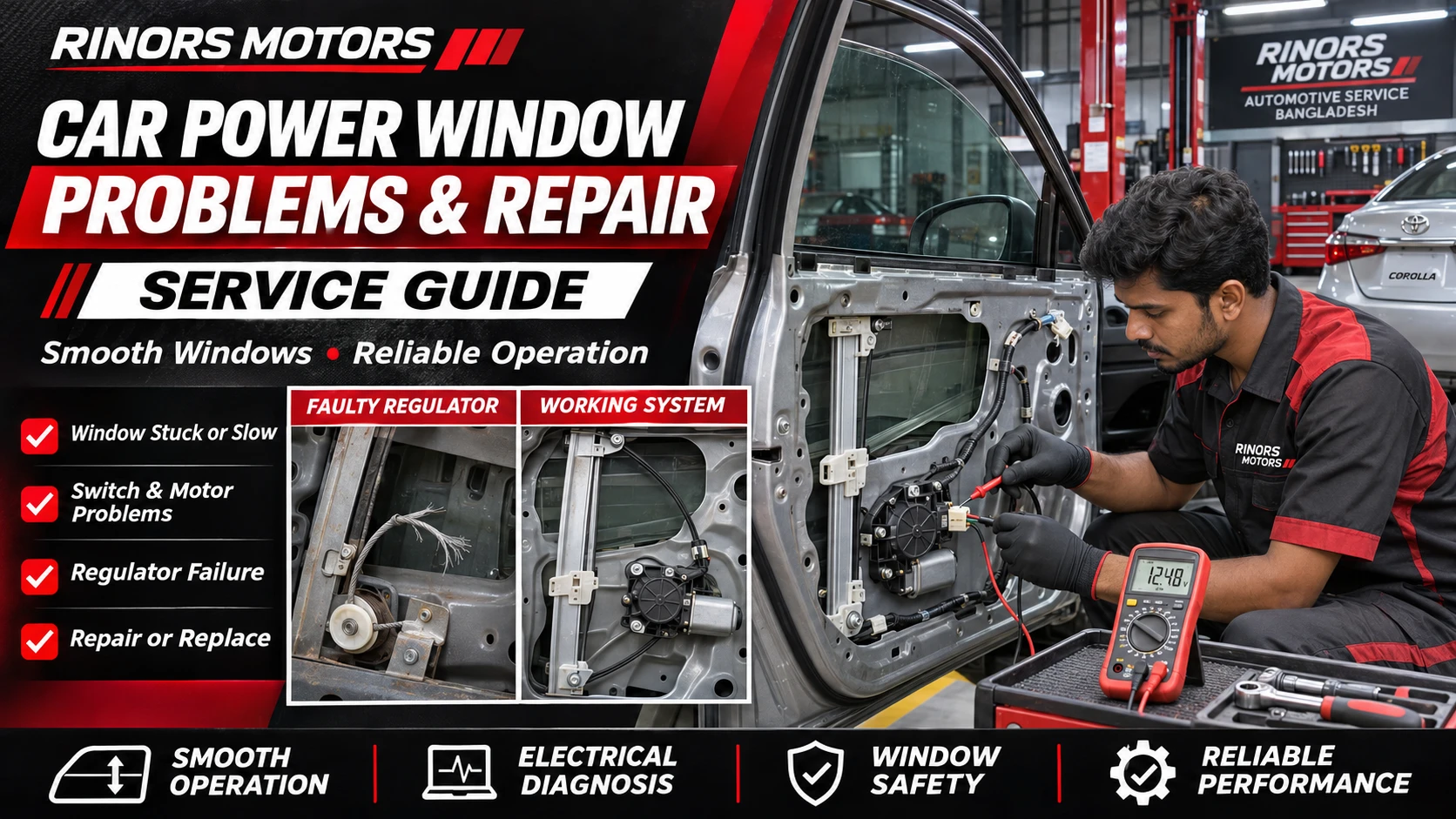
2. Damaged Window Regulator
The window regulator is the mechanical assembly responsible for guiding the glass up and down.
Depending on the vehicle, it may use cables, pulleys, gears, or other lifting mechanisms.
A damaged regulator can cause:
Window glass becoming stuck.
Grinding or clicking noises.
Glass moving unevenly.
Window dropping into the door.
Motor operating while the glass remains stationary.
If the regulator cable breaks or its supporting mechanism fails, replacement may be necessary.
3. Defective Power Window Switch
Power window switches can become worn or electrically defective.
Symptoms may include:
The window works from one switch but not another.
The switch operates intermittently.
Excessive force is required to activate the switch.
One direction works while the other fails.
A technician should examine the switch and related wiring before deciding to replace it.
4. Blown Power Window Fuse
Electrical circuits are protected by fuses.
If a power window fuse blows, one or more windows may stop working, depending on the vehicle's electrical design.
A blown fuse may be caused by an electrical short circuit or an overloaded motor.
Important: Never install a fuse with a higher amperage rating than the manufacturer specifies.
If a replacement fuse blows again, the underlying electrical fault must be diagnosed.
5. Damaged Door Wiring
Electrical wires pass between the vehicle body and the doors.
Repeated door opening and closing can place stress on wiring inside the flexible rubber conduit near the door hinges.
Damaged or broken wires may cause intermittent window operation.
Other door-mounted electrical features may also be affected.
6. Window Glass Misalignment
Window glass travels through guide channels.
If the glass becomes misaligned or a guide component is damaged, the window may bind during movement.
Symptoms can include:
Uneven glass movement.
Unusual rubbing noises.
Difficulty closing the window.
The glass tilting inside the door.
Misalignment may place additional stress on the regulator and motor.
7. Dirt or Obstruction in Window Channels
Dust, dirt, damaged weatherstripping, or other obstructions can interfere with smooth glass movement.
The motor may struggle to overcome the additional resistance.
In some vehicles, the anti-pinch system may reverse the window if excessive resistance is detected.
8. Power Window Control or Initialization Problems
Some modern vehicles use electronic window control modules and automatic one-touch functions.
After certain battery disconnections, electrical repairs, or component replacements, a model-specific initialization procedure may be required.
A window may operate manually but lose its automatic up or down function.
However, the correct procedure varies by vehicle, and not every problem can be corrected by resetting the system.
7 Warning Signs Your Power Window Needs Repair
1. The Window Does Not Move
Pressing the switch produces no glass movement.
Possible causes include electrical supply problems, switches, motors, or regulators.
2. The Window Moves Very Slowly
A slow window may indicate motor weakness, increased friction, a binding regulator, or electrical voltage problems.
3. Grinding or Clicking Sounds
Mechanical noises inside the door may indicate damaged regulator gears, cables, or other moving components.
4. The Glass Drops Into the Door
If the glass suddenly drops, a regulator or glass-support component may have failed.
Stop operating the window and arrange inspection.
5. The Window Moves Unevenly
Glass that tilts or moves at an angle may have a regulator or guide-channel problem.
6. The Window Works Only Sometimes
Intermittent operation can result from switches, wiring, connectors, control components, or failing motors.
7. The Window Reverses Before Closing
On vehicles with anti-pinch protection, a window that repeatedly reverses may be detecting excessive resistance or have an initialization or sensor-related problem.
Never disable the anti-pinch system to force a window closed.
Power Window Motor vs Regulator: What's the Difference?
Many car owners assume the motor and regulator are the same component.
Although they work together, they serve different purposes.
Power Window Motor
The motor converts electrical energy into rotational movement.
It powers the mechanism that moves the window glass.
Window Regulator
The regulator transfers that movement to the glass and controls its vertical travel.
How to Identify the Problem
If a motor can be heard operating but the glass does not move correctly, a regulator problem may be suspected.
If there is no motor sound, the motor, switch, electrical supply, wiring, and control system should be examined.
Neither symptom is conclusive without testing.
Some vehicles use a combined motor-and-regulator assembly, while others allow individual components to be replaced.
Why Is My Car Window Stuck in the Open Position?
A window that becomes stuck open can create immediate problems.
Rainwater may enter the interior, damaging upholstery, door electronics, and other components.
An open window can also reduce vehicle security.
What Should You Do?
Move the vehicle to a safe, sheltered location if possible.
Check whether the ignition or power mode is correct for window operation.
Confirm the window lock switch is not restricting operation.
Avoid repeatedly forcing a jammed mechanism with the switch.
Do not pull the glass forcefully or insert tools into the door.
Arrange inspection if the window remains stuck.
Forcing the glass upward can damage the regulator, break the glass, or create an injury risk.
If temporary weather protection is needed, arrange a secure covering that does not interfere with safe driving.
Why Are All the Power Windows Not Working?
When multiple windows stop functioning at the same time, the problem may involve a shared electrical component.
Possible causes include:
Power window fuse or power supply.
Driver's master switch.
Window lock settings.
Relevant vehicle control module.
Shared wiring or ground connections.
Required ignition or accessory power mode.
A professional diagnostic check should begin with the shared components before assuming that several individual motors have failed.
Why Does Only One Power Window Stop Working?
When only one window fails, the issue may be specific to that door.
Possible causes include:
A faulty local switch.
Damaged wiring.
A defective window motor.
A broken regulator.
An obstruction in the glass channel.
A loose electrical connector.
Checking whether the same window works from the driver's master switch can provide useful diagnostic information.
Power Window Reset: When Is It Necessary?
Certain cars feature automatic window operation and anti-pinch protection.
These systems may require initialization after specific repairs or electrical interruptions.
Common Situations
Battery disconnection.
Power window motor replacement.
Certain electrical repairs.
Loss of automatic one-touch operation.
Control-system initialization faults.
Important Considerations
There is no universal reset procedure for all vehicles.
The correct process depends on the manufacturer, model, and window control system.
Use the vehicle owner's manual or manufacturer service instructions.
Never attempt to bypass an obstruction or disable anti-pinch protection.
If the window continues to reverse unexpectedly or fails to initialize, arrange professional diagnosis.
How Are Car Power Window Problems Diagnosed?
A professional power window inspection may involve several steps.
Step 1: Verify the Problem
The technician checks whether the affected window moves, makes noise, or responds intermittently.
Step 2: Check Window Lock and Power Supply
Confirm the relevant control settings, fuse condition, and electrical supply.
Step 3: Test Window Switches
Check whether the local and master switches operate correctly.
Step 4: Inspect Door Wiring
Examine relevant wiring and connectors, including areas near the door hinges.
Step 5: Check Motor Operation
Using appropriate diagnostic equipment, verify whether the motor receives the required electrical supply and control signals.
Step 6: Inspect the Regulator
Where necessary, inspect the regulator, guide channels, and glass mounting points.
Step 7: Repair or Replace Components
Repair damaged wiring or replace defective components according to the diagnostic findings.
Step 8: Test Window Operation
Confirm smooth opening and closing, correct glass alignment, and proper operation of applicable automatic and anti-pinch functions.
Safety Note: Vehicle door assemblies may contain side airbags, sharp metal components, and spring-loaded or moving mechanisms. Window glass must be properly supported during regulator repairs. Professional procedures should be followed.
Can a Power Window Regulator Be Repaired?
Repair options depend on the design and extent of damage.
When Repair May Be Possible
Minor problems such as certain loose connections, serviceable mounting hardware, or guide-channel issues may be corrected without replacing the complete regulator.
When Replacement May Be Necessary
Replacement may be appropriate when:
The regulator cable has snapped.
Lifting gears are severely worn.
The regulator frame is damaged.
The lifting mechanism is no longer serviceable.
The manufacturer specifies replacement of the complete assembly.
A technician should determine whether repair or replacement provides a safe, reliable result.
How Much Does Power Window Repair Cost in Bangladesh?
Power window repair costs vary depending on the vehicle and the faulty component.
Main Cost Factors
Vehicle brand and model.
Front or rear door.
Driver or passenger side.
Switch, wiring, motor, or regulator problem.
Individual component versus combined assembly.
Original-equipment or compatible aftermarket parts.
Labor required to remove the interior door panel.
Glass alignment or initialization requirements.
A minor wiring repair may cost less than replacing a complete motor-and-regulator assembly.
However, the exact cost should be determined after inspection.
Toyota Power Window Problems
Toyota Corolla, Axio, Premio, Allion, Aqua, and other models use power window systems that vary by model year and specification.
Common Areas to Inspect
Driver's master window switch.
Passenger window switches.
Window motors.
Regulator assemblies.
Door wiring and connectors.
Glass guide channels.
Automatic window initialization, where applicable.
Not every Toyota vehicle uses the same regulator, motor, or switch assembly.
Part compatibility should be confirmed using the vehicle's chassis or VIN information and appropriate parts documentation.
Honda and Nissan Power Window Problems
Honda Civic, Grace, Vezel, Nissan X-Trail, and other vehicles may develop similar electrical or mechanical window faults.
However, their door electronics, window regulators, and control procedures may differ.
Model-specific diagnosis is important before ordering replacement components.
How to Choose the Correct Replacement Parts
Before purchasing power window components, verify:
Vehicle brand and model.
Model year and variant.
Front or rear door position.
Left-side or right-side application.
Motor and regulator design.
Electrical connector compatibility.
Original or properly cross-referenced part number.
Whether the component includes an automatic window control function.
A regulator from a visually similar vehicle may not fit correctly.
Using incompatible components can create mechanical binding or electrical problems.
How to Prevent Power Window Problems
1. Keep Window Channels Clean
Dust and dirt accumulation can increase resistance during window movement.
2. Avoid Forcing Stuck Windows
Do not repeatedly operate a window that is jammed or making grinding noises.
3. Inspect Damaged Weatherstripping
Deteriorated seals and guides may affect glass movement or allow additional contamination.
4. Repair Electrical Faults Promptly
Intermittent switch or motor problems should be investigated before more extensive failure occurs.
5. Prevent Water Damage
Have damaged door seals and water-management components inspected when water enters the door or interior abnormally.
6. Use Compatible Replacement Parts
Select components suitable for the vehicle and door configuration.
7. Maintain Window Safety Features
Ensure automatic and anti-pinch systems function correctly after relevant repairs.
Frequently Asked Questions
Why Is My Car Window Not Going Up?
Possible causes include a defective window switch, motor, regulator, electrical wiring, or an obstruction in the glass channels.
Can a Power Window Motor Be Repaired?
Some faults may be repairable depending on the motor design. However, internal damage or manufacturer restrictions may make replacement necessary.
Can a Broken Regulator Cause the Window Glass to Fall?
Yes. A failed regulator cable or glass-support component can allow the window to drop or become misaligned.
Why Does My Window Work From One Switch but Not Another?
The problem may involve the local switch, driver's master switch, window lock control, or related wiring.
Does Disconnecting the Battery Fix Power Window Problems?
Not generally. Some vehicles may need window initialization after battery disconnection, but disconnecting the battery will not repair a broken regulator, damaged motor, or wiring fault.
Is It Safe to Drive With a Broken Power Window?
It depends on the condition. A window that is securely closed may mainly create a convenience issue, while loose glass, an unsecured open window, or a malfunctioning mechanism can present safety and security risks.
Car Power Window Inspection & Repair at Rinors Motors
At Rinors Motors, we understand how important properly functioning power windows are for convenience, vehicle security, and everyday driving in Bangladesh.
If your car's window is stuck, moving slowly, making unusual noises, or failing to respond to its switch, the first step is identifying the actual cause.
Contact Rinors Motors to discuss power window inspection, electrical diagnosis, motor and regulator problems, compatible replacement parts, and suitable repair options for your vehicle.
Rinors Motors — Your Trusted Automotive Partner in Bangladesh.