Car Throttle Body Problems in Bangladesh: Complete Cleaning & Replacement Guide
Is your car shaking while idling, experiencing unstable engine RPM, or responding slowly when you press the accelerator? A dirty or malfunctioning throttle body could be one possible cause.
The throttle body is an important component of a petrol engine's air intake system. It regulates airflow entering the engine, allowing the engine management system to maintain appropriate operating conditions.
Over time, carbon deposits, oily residue, mechanical wear, or electrical faults may affect throttle body operation.
In Bangladesh, frequent stop-and-go traffic, dusty road conditions, and demanding everyday driving can make proper engine maintenance particularly important.
Whether you drive a Toyota Corolla, Axio, Premio, Allion, Aqua, Honda Civic, Vezel, Nissan X-Trail, or another petrol-engine vehicle, understanding throttle body problems can help you identify warning signs and avoid unnecessary repairs.
This guide explains throttle body functions, common symptoms, cleaning procedures, electronic throttle problems, replacement considerations, and maintenance recommendations.
What Is a Car Throttle Body?
A throttle body is a component located in the engine's air intake system.
In many petrol engines, it contains a circular throttle plate, often called a butterfly valve, that controls the amount of air flowing into the engine.
When the throttle plate opens, more air can enter the engine. The engine management system coordinates airflow with fuel injection and other engine operating parameters.
Main Functions of a Throttle Body
Regulate airflow entering the engine.
Support stable engine idling.
Help control engine output.
Respond to accelerator pedal requests.
Support smooth acceleration and deceleration.
Work with engine sensors and electronic control systems.
Help maintain appropriate engine operating conditions.
A correctly functioning throttle body contributes to predictable engine response and smooth driving.
How Does an Electronic Throttle Body Work?
Modern petrol vehicles commonly use electronic throttle control, sometimes called drive-by-wire.
Instead of directly opening the throttle plate using a mechanical cable, the accelerator pedal sends electronic signals to the engine control unit.
The control unit determines the required throttle opening based on several operating conditions.
An electric motor inside the throttle body moves the throttle plate to the commanded position.
Main Components of an Electronic Throttle System
Throttle Plate: Controls the airflow passage.
Throttle Body Housing: Contains the throttle plate and related components.
Throttle Actuator Motor: Moves the throttle plate.
Throttle Position Sensor: Reports throttle position to the control system.
Accelerator Pedal Position Sensor: Communicates driver accelerator input.
Engine Control Unit (ECU): Calculates and commands the required throttle operation.
Electrical Connectors and Wiring: Transfer electrical power and control signals.
Some throttle bodies integrate multiple components into one assembly.
Different manufacturers use different designs and control strategies.
8 Warning Signs of a Dirty or Faulty Throttle Body
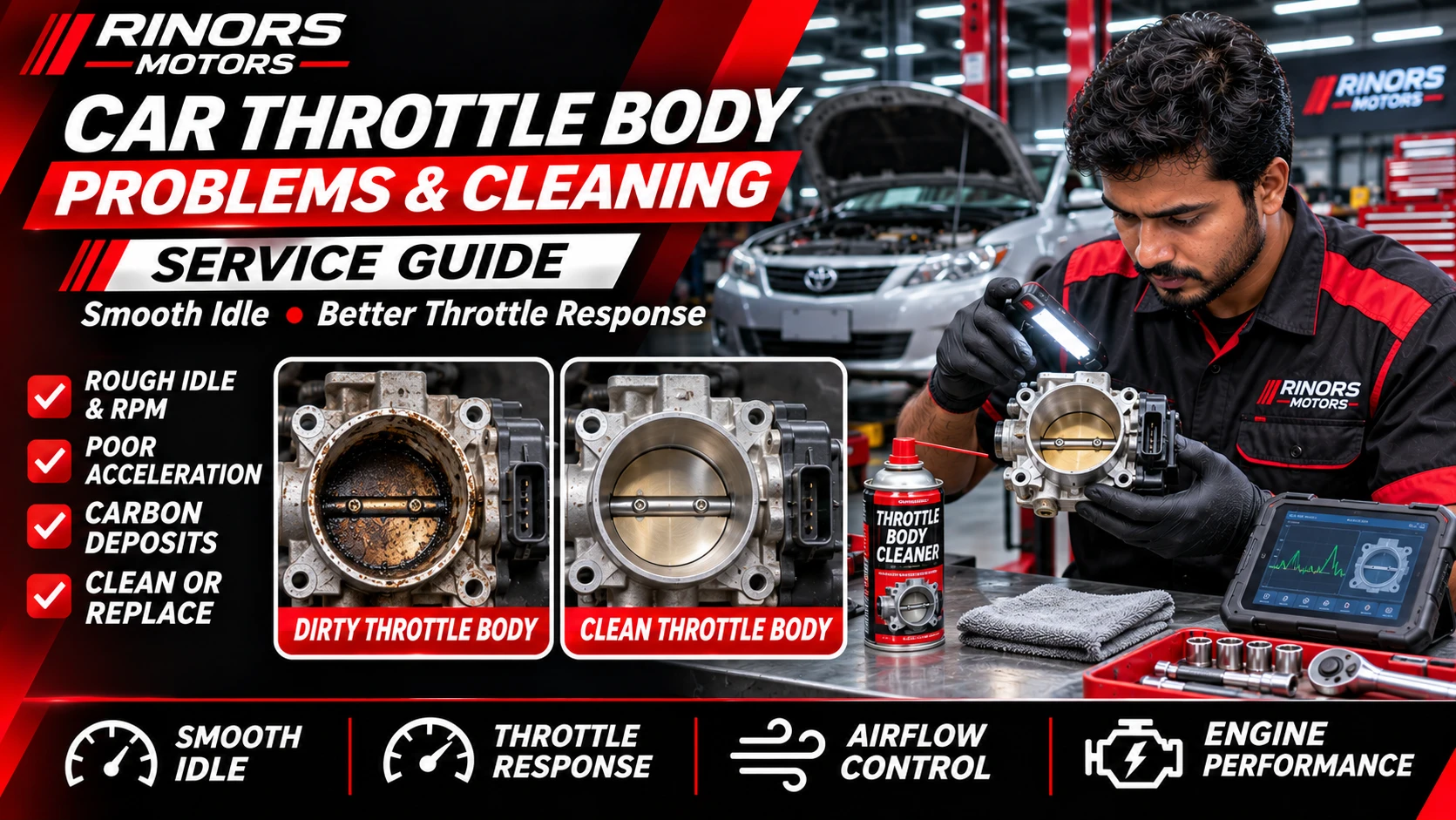
1. Rough Engine Idle
One possible sign of throttle body contamination is rough idling.
When the vehicle is stationary and the engine is running, you may notice unusual shaking or unstable engine operation.
Carbon deposits around the throttle plate can sometimes interfere with the airflow needed for smooth idle control.
However, rough idling may also result from:
Worn spark plugs.
Faulty ignition coils.
Fuel injector problems.
Intake air leaks.
Engine mechanical faults.
Other sensor or control-system problems.
A diagnostic inspection should determine whether the throttle body is responsible.
2. Engine RPM Fluctuation
If engine RPM repeatedly rises and falls while the vehicle is stationary, inconsistent idle airflow control may be one possible cause.
A contaminated throttle plate, electronic control fault, or incorrect idle adaptation can contribute to unstable engine speed.
Drivers may notice:
RPM moving up and down.
Engine speed remaining higher than expected.
RPM dropping unusually low.
Engine shaking when returning to idle.
These symptoms are not unique to throttle body problems.
3. Poor Acceleration
A malfunctioning electronic throttle system may affect how the engine responds to accelerator pedal input.
Symptoms may include:
Sluggish accelerator response.
Hesitation during acceleration.
Reduced engine power.
Unusual throttle behavior.
Engine performance warnings.
Fuel delivery problems, ignition faults, and transmission issues can cause similar symptoms, so proper diagnosis is necessary.
4. Engine Stalling at Idle
An engine that stalls when coming to a stop or while idling may have an airflow control problem.
In certain situations, deposits around the throttle plate can interfere with the engine's ability to maintain appropriate airflow.
However, engine stalling can also result from fuel pressure problems, sensor faults, or other electrical and mechanical issues.
Repeated stalling should be investigated promptly because it can create driving hazards.
5. Check Engine Light
A throttle control system fault may trigger the check engine warning light.
Depending on the vehicle, relevant diagnostic codes may include:
P0121: Throttle/Pedal Position Sensor/Switch A Circuit Range/Performance.
P2101: Throttle Actuator Control Motor Circuit Range/Performance.
P2119: Throttle Actuator Control Throttle Body Range/Performance.
These are generic examples. Exact diagnostic meanings and testing requirements depend on the vehicle.
A fault code does not automatically mean the throttle body assembly needs replacement.
Electrical wiring, sensors, actuator controls, or other engine management components may also be responsible.
6. Reduced Engine Power Mode
Certain vehicles use a protective operating strategy when a serious electronic throttle control problem is detected.
This is sometimes called reduced-power mode or limp mode.
Possible symptoms include:
Limited accelerator response.
Restricted engine performance.
Dashboard warning messages.
Reduced vehicle speed or power.
If your vehicle enters reduced-power mode, avoid demanding driving conditions and arrange professional diagnosis.
7. Difficulty Starting or Maintaining Idle After Startup
Some throttle control faults or significant airflow restrictions may contribute to starting or idle problems.
The engine may start and then stall, or struggle to maintain a stable idle.
However, battery condition, fuel delivery, ignition components, and other engine systems must also be considered.
8. Persistent High Idle After Cleaning or Battery Work
Some vehicles may experience temporarily abnormal idle behavior after throttle body cleaning, battery disconnection, or certain engine repairs.
This can occur when the engine control system requires an adaptation or relearn procedure.
However, high idle may also indicate:
An intake air leak.
Incorrect gasket installation.
A throttle plate problem.
Electronic control faults.
An incomplete model-specific relearn procedure.
Cleaning the throttle body again is not automatically the correct solution.
Why Does a Throttle Body Become Dirty?
Air entering an engine passes through the intake system.
Over time, deposits may accumulate near the throttle plate and its surrounding passage.
1. Oil Vapour From the PCV System
Many engines use a Positive Crankcase Ventilation (PCV) system.
Oil vapour and crankcase gases can enter the intake system as part of normal engine operation.
In some conditions, residue can accumulate around the throttle body.
2. Dust and Air Intake Contamination
Dust and airborne contamination may enter the intake system, especially if the air filter or intake seals are damaged or incorrectly installed.
Contamination can contribute to deposits and affect nearby components.
3. Carbon and Oily Deposits
A combination of oily residue and other contaminants may form deposits around the throttle plate.
Deposits near the plate edges can be particularly relevant because precise airflow control is important at idle.
4. Engine Age and Operating Conditions
Deposit formation depends on engine design, operating conditions, crankcase ventilation, maintenance, and other factors.
Not every engine accumulates significant throttle body deposits.
5. Other Engine System Problems
Abnormal oil vapour carryover, air filtration problems, and certain intake-system faults may increase contamination.
If deposits return unusually quickly, the underlying cause should be investigated.
Throttle Body Cleaning vs Replacement: What's the Difference?
Car owners frequently ask whether a dirty throttle body should be cleaned or replaced.
The answer depends on the actual problem.
When Throttle Body Cleaning May Help
Cleaning may be appropriate when inspection confirms that deposits are interfering with airflow or throttle plate operation.
Possible examples include:
Noticeable deposits around the throttle plate.
Contamination affecting idle airflow.
Certain low-speed drivability complaints.
Manufacturer-supported cleaning procedures for the specific unit.
A properly performed cleaning service may restore the intended airflow characteristics when contamination is the actual cause.
When Throttle Body Replacement May Be Necessary
Replacement may be appropriate when testing confirms:
A defective throttle actuator motor.
An internal throttle position sensor failure.
Damaged internal gears.
Serious mechanical damage.
An irreparable electrical fault within the assembly.
A damaged housing or throttle mechanism.
A manufacturer-specified non-serviceable component failure.
Cleaning cannot repair a failed electronic motor, broken internal gear, or defective circuit.
Why Diagnosis Comes First
Rough idling or poor acceleration does not automatically mean the throttle body is dirty.
Replacing a healthy throttle body can result in unnecessary expense without solving the original problem.
How Is Professional Throttle Body Cleaning Performed?
Throttle body cleaning procedures vary depending on the vehicle and component design.
A professional cleaning service may include the following stages.
Step 1: Initial Engine Diagnosis
The technician checks the symptoms, relevant trouble codes, and engine operating data.
This helps determine whether throttle body inspection is appropriate.
Step 2: Inspect the Air Intake System
The air intake duct, connections, and accessible components are examined for leaks, damage, or contamination.
Step 3: Examine the Throttle Body
The technician checks the throttle plate and bore for deposits or mechanical problems.
Step 4: Follow the Manufacturer-Approved Cleaning Procedure
If cleaning is required, a product and method suitable for the particular throttle body are used.
Some manufacturers require removal of the throttle body before cleaning.
Certain throttle body designs contain protective coatings that can be damaged by aggressive chemicals or abrasive cleaning.
Step 5: Protect Electronic Components
The throttle actuator, position sensors, and electrical connectors must be protected from inappropriate cleaning chemicals.
Electronic throttle plates should not be forced open by hand unless the manufacturer's procedure explicitly permits it.
Step 6: Reassemble and Inspect
If removed, the throttle body is reinstalled using the required gasket, fasteners, and specified procedures.
Step 7: Perform Relearn or Adaptation if Required
Some vehicles require an idle or throttle adaptation procedure after cleaning or replacement.
Other vehicles can perform certain adjustments automatically.
Step 8: Verify Engine Operation
The technician checks:
Idle stability.
Accelerator response.
Relevant warning lights.
Diagnostic fault codes.
Intake air leaks.
Overall engine operation.
Important: Electronic throttle bodies contain motorized moving parts. Never place fingers inside a powered throttle body, force the plate open, or spray unsuitable chemicals into electronic components.
Does Every Car Need Regular Throttle Body Cleaning?
No.
There is no universal mileage interval requiring every vehicle to undergo throttle body cleaning.
Some vehicles may operate for extended periods without requiring a separate throttle body service.
Cleaning should be based on:
Manufacturer maintenance recommendations.
Actual throttle body condition.
Relevant symptoms.
Diagnostic findings.
Vehicle-specific service procedures.
Unnecessary cleaning can create risks, especially if electronic components or protective coatings are damaged.
A professional inspection is preferable to automatically cleaning the throttle body at every routine service.
What Is Throttle Body Relearn or Adaptation?
Modern electronic throttle systems use stored or learned control values to manage throttle opening and idle behavior.
After certain repairs, the engine control system may need to adjust these values.
This process is commonly called throttle body relearn, idle relearn, or throttle adaptation.
When Might Relearn Be Necessary?
Depending on the vehicle, adaptation may be required after:
Throttle body cleaning.
Throttle body replacement.
Certain battery disconnections.
Engine control module-related work.
Certain intake-system repairs.
Common Symptoms of Incorrect Adaptation
Unusually high idle.
Unstable RPM.
Stalling at low speed.
Poor throttle response.
Check engine warnings.
Can Every Car Be Relearned the Same Way?
No.
Some vehicles perform automatic learning, while others require a manufacturer-defined sequence or diagnostic scan tool.
There is no single universal relearn procedure suitable for every Toyota, Honda, Nissan, or other vehicle.
Always follow the correct model-specific instructions.
Throttle Body vs Throttle Position Sensor
The throttle body and throttle position sensor are related but different.
Throttle Body
The throttle body is the mechanical assembly that regulates airflow entering the engine.
Throttle Position Sensor
The throttle position sensor provides information about the throttle plate's position.
In many modern electronic throttle assemblies, position sensors are integrated into the throttle body.
Can the Sensor Be Replaced Separately?
This depends on the vehicle.
Some designs use separately serviceable sensors.
Others incorporate the sensors into a complete electronic throttle assembly.
The correct replacement method should be confirmed using manufacturer service information.
Throttle Body vs Mass Airflow Sensor
A Mass Airflow (MAF) sensor and throttle body perform different functions.
Throttle Body
Controls airflow into the engine in applicable systems.
Mass Airflow Sensor
Measures the amount or mass of air entering the engine in systems equipped with a MAF sensor.
Why Are They Confused?
Both components are part of the engine's air management system.
Problems with either component may contribute to:
Rough idling.
Hesitation.
Poor acceleration.
Engine warning lights.
Abnormal fuel consumption.
However, cleaning or replacing one component will not necessarily fix a problem originating from the other.
Some engines use different airflow measurement strategies and may not use a conventional MAF sensor.
Throttle Body Problems vs Fuel Injector Problems
Throttle body and fuel injector faults can produce overlapping engine symptoms.
Throttle Body Problems
May affect airflow regulation, idle stability, and throttle response.
Fuel Injector Problems
May affect the quantity, timing, or distribution of fuel delivered into the engine.
Why Proper Diagnosis Matters
Both can contribute to hesitation, uneven engine operation, and reduced performance.
An accurate diagnostic process should distinguish airflow control problems from ignition and fuel delivery faults before parts are replaced.
How Are Electronic Throttle Body Problems Diagnosed?
A complete diagnostic inspection can include several stages.
Step 1: Confirm the Symptoms
Identify when the problem occurs.
Examples include:
Engine startup.
Idling.
Acceleration.
Deceleration.
After battery replacement.
After previous engine maintenance.
Step 2: Scan for Diagnostic Trouble Codes
Read stored fault codes and relevant engine operating data.
Step 3: Inspect the Air Intake
Check for damaged intake ducts, disconnected hoses, contamination, and possible air leaks.
Step 4: Inspect Electrical Connections
Examine throttle body connectors, wiring, power supply, and ground circuits where applicable.
Step 5: Check Throttle Control Data
A technician may compare commanded throttle operation with actual throttle position information using suitable diagnostic equipment.
Step 6: Evaluate the Accelerator Pedal Sensor
If required, inspect accelerator pedal position signals and related control-system information.
Step 7: Inspect Deposits and Mechanical Condition
Determine whether the throttle plate is contaminated, mechanically obstructed, or damaged.
Step 8: Perform Appropriate Repair
The actual fault may require cleaning, wiring repair, adaptation, or component replacement.
Step 9: Verify Performance
After servicing, confirm that the vehicle operates correctly and that the relevant symptoms have been resolved.
Toyota Throttle Body Problems in Bangladesh
Toyota vehicles are widely used in Bangladesh, but their throttle body designs and maintenance requirements vary by engine.
Toyota Corolla and Axio
Different Corolla and Axio generations use different engine management and throttle control systems.
Possible complaints may include rough idling, acceleration hesitation, or unstable engine speed.
A technician should inspect the air intake, ignition, and fuel systems before deciding whether throttle body cleaning is necessary.
Toyota Premio and Allion
Toyota Premio and Allion models use different engine configurations depending on production year and variant.
If throttle-related symptoms occur, the exact engine and electronic throttle system should be identified before ordering replacement parts.
Toyota Aqua Hybrid
The Toyota Aqua uses a petrol-electric hybrid powertrain.
Its petrol engine has an air intake and throttle control system, but engine operation differs from that of a conventional petrol-only vehicle.
The petrol engine may stop automatically while the hybrid system remains ready to drive.
This normal behavior should not automatically be mistaken for throttle body failure or engine stalling.
Toyota Corolla Axio Hybrid
The Axio Hybrid also uses engine management systems designed for hybrid operation.
Throttle body diagnostics should follow the specific model's service procedures.
Hybrid Safety: Petrol engine servicing must be performed with appropriate vehicle shutdown procedures. Hybrid vehicles can start their petrol engines automatically when the system is active.
Honda and Nissan Throttle Body Problems
Honda Civic, Grace, Vezel, Nissan X-Trail, and other vehicles may use electronically controlled throttle assemblies.
However, their components and relearn requirements can differ.
Some vehicles require a specific idle learning procedure after certain throttle body repairs.
Before replacing components, confirm the exact vehicle model, engine code, and relevant manufacturer instructions.
How Much Does Throttle Body Cleaning Cost in Bangladesh?
Throttle body cleaning prices depend on several factors.
Main Cost Factors
Vehicle brand and model.
Engine configuration.
Throttle body accessibility.
Electronic or mechanical throttle design.
Whether throttle body removal is necessary.
Cleaning requirements.
Replacement gasket or seal requirements.
Diagnostic scanning.
Relearn or adaptation requirements.
Workshop labor.
A basic cleaning service may cost less than a complete electronic throttle body replacement.
However, cleaning should only be recommended when appropriate for the diagnosed condition.
Throttle Body Replacement Cost in Bangladesh
Replacing a complete electronic throttle body can be significantly more expensive than cleaning.
The total cost depends on:
Vehicle manufacturer.
Engine model.
Original or compatible aftermarket component.
Integrated throttle actuator and sensor design.
Component availability.
Installation labor.
Diagnostic requirements.
Necessary adaptation or programming procedures.
Product warranty.
The correct part number should be confirmed before purchasing a replacement.
Avoid replacing an expensive throttle body based only on rough idle symptoms.
How to Choose the Correct Replacement Throttle Body
Throttle bodies are not universally interchangeable.
Even visually similar assemblies may have different specifications.
Important Information to Verify
Vehicle brand.
Exact model.
Production year.
Engine code.
Chassis or VIN.
Original part number.
Electrical connector configuration.
Throttle bore and mounting design.
Electronic control compatibility.
Original vs Aftermarket Throttle Bodies
Original-equipment and compatible aftermarket throttle bodies may be available.
However, a replacement must meet the vehicle's electrical, mechanical, and operating specifications.
An incompatible component may cause warning lights, poor acceleration, or incorrect throttle operation.
Why Product Quality Matters
Electronic throttle bodies are precision components.
Their actuator motor, sensors, and control characteristics must operate correctly with the vehicle's engine management system.
Choose a reliable replacement with appropriate compatibility information and warranty support.
Can You Drive With a Faulty Throttle Body?
The risk depends on the nature of the fault.
Minor contamination affecting idle quality is different from a serious electronic throttle control malfunction.
A severe fault may cause:
Reduced accelerator response.
Unexpected engine stalling.
Limited engine power.
Unstable engine operation.
Difficulty maintaining safe driving performance.
If the car repeatedly stalls, loses significant power, or displays a serious throttle control warning, stop safely and arrange professional assistance.
Do not continue normal driving with unpredictable throttle response.
How to Help Prevent Throttle Body Problems
1. Maintain the Air Filter
Follow the manufacturer's air filter maintenance recommendations.
Replace damaged or excessively contaminated filters when required.
2. Inspect Air Intake Connections
Damaged intake ducts or loose connections may allow unwanted air or contamination to enter.
3. Maintain the Engine Properly
Follow the recommended engine maintenance schedule.
4. Address Excessive Oil Contamination
If unusually heavy oily deposits appear in the intake, investigate possible contributing engine or ventilation-system problems.
5. Avoid Unnecessary Cleaning
Do not clean the throttle body merely because the vehicle has reached an arbitrary mileage.
6. Use Appropriate Cleaning Products
Cleaning products and methods must be compatible with the exact throttle body design.
7. Protect Electronic Components
Avoid aggressive solvents, excessive liquid exposure, and forcing electronically controlled moving parts.
8. Investigate Rough Idle Promptly
Persistent abnormal idle should be diagnosed rather than ignored.
9. Use Compatible Replacement Parts
Confirm the exact part number and electronic compatibility.
10. Complete Required Relearn Procedures
After certain repairs, follow the manufacturer's specified throttle or idle adaptation process.
Frequently Asked Questions About Throttle Body Problems
Can a Dirty Throttle Body Cause Rough Idle?
Yes. Deposits around the throttle plate can affect idle airflow in certain engines. However, ignition, fuel, intake, and mechanical problems can cause similar symptoms.
Can Throttle Body Cleaning Improve Acceleration?
It may improve drivability when contamination is the actual cause of the problem. Cleaning will not repair a failed actuator motor, sensor, or unrelated engine fault.
How Often Should a Throttle Body Be Cleaned?
There is no universal interval for every vehicle. Follow manufacturer guidance and consider cleaning when inspection confirms a relevant problem.
Can a Bad Throttle Body Increase Fuel Consumption?
Certain throttle control problems may contribute to inefficient engine operation and increased fuel consumption. However, many other factors can produce the same symptom.
Can a Dirty Throttle Body Cause High RPM?
Yes, in certain circumstances. However, high idle may also result from air leaks, control-system faults, or relearn problems.
Why Is My Car Idling High After Throttle Body Cleaning?
Some vehicles require time or a specific procedure to relearn appropriate idle control values. Intake leaks or incorrect installation must also be considered.
Is It Safe to Clean an Electronic Throttle Body at Home?
Incorrect cleaning can damage protective coatings, electronic components, or motorized throttle mechanisms. Professional service following the specific manufacturer's procedure is recommended.
Should I Replace the Throttle Body if the Check Engine Light Is On?
Not automatically. A diagnostic code may relate to sensors, wiring, control systems, or other faults. Complete diagnosis is necessary.
Can a Throttle Body Be Repaired Instead of Replaced?
Some external faults, including certain wiring and connector problems, may be repairable. Internal mechanical or electronic failures may require assembly replacement.
Do Hybrid Cars Have Throttle Bodies?
Many petrol-electric hybrid vehicles use throttle bodies for their petrol engines. The exact design and operating strategy depend on the vehicle.
Car Throttle Body Inspection & Cleaning at Rinors Motors
At Rinors Motors, we understand the importance of smooth engine operation, reliable acceleration, and efficient vehicle performance for drivers in Bangladesh.
If your car experiences rough idling, unstable RPM, poor throttle response, unexpected stalling, or electronic throttle warnings, identifying the actual cause is essential before cleaning or replacing components.
A professional diagnostic assessment can help distinguish throttle body contamination from ignition problems, fuel injector faults, intake air leaks, sensor failures, and other engine management issues.
Whether you own a Toyota, Honda, Nissan, or another vehicle, selecting the correct repair procedure and compatible replacement components is important for reliable operation.
Contact Rinors Motors to discuss throttle body inspection, cleaning requirements, electronic throttle diagnostics, and appropriate replacement options for your vehicle.
Rinors Motors — Your Trusted Automotive Partner in Bangladesh.