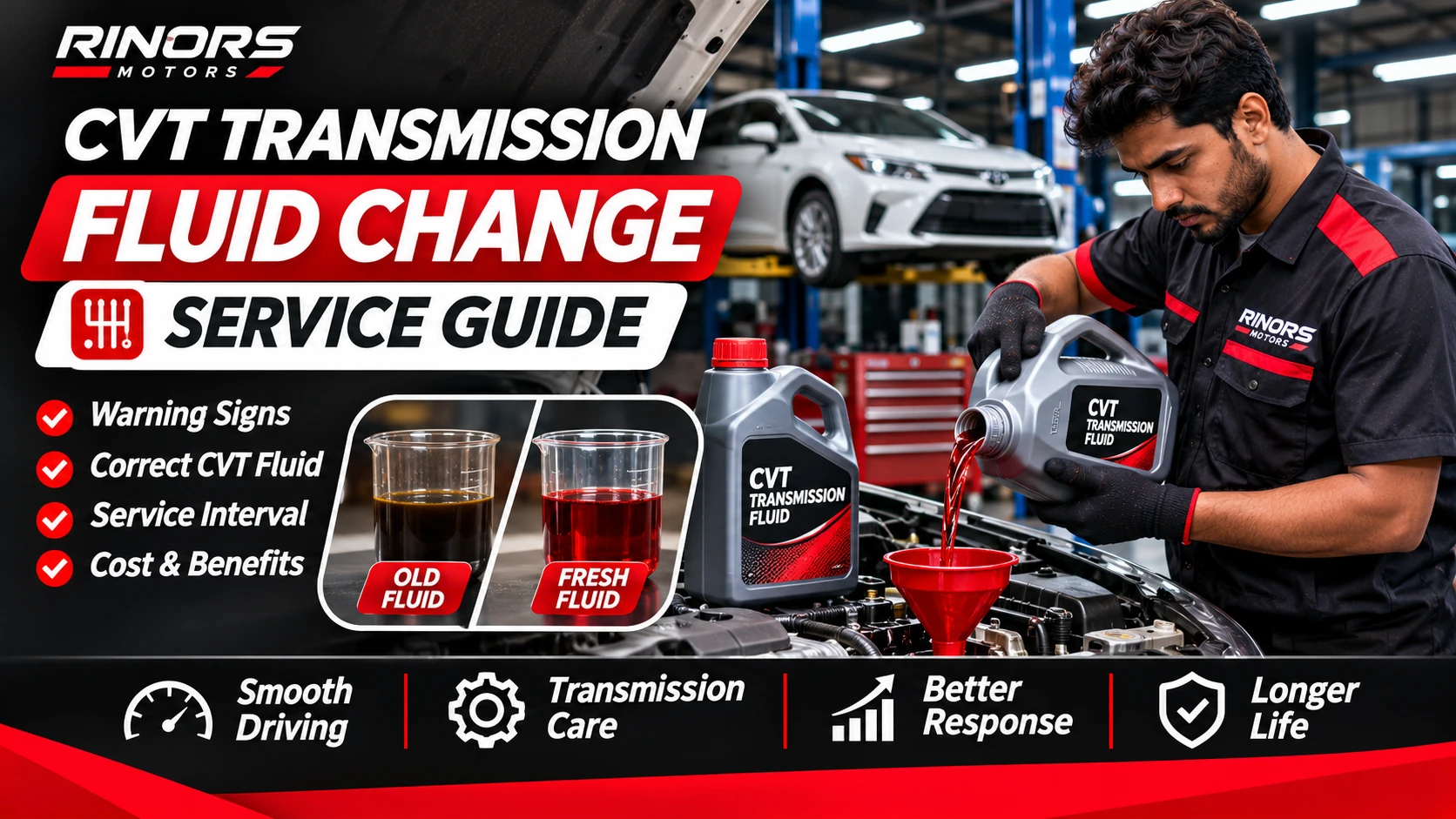
CVT Transmission Fluid Change: Complete Car Owner's Guide
Your car's transmission is responsible for delivering engine power to the wheels efficiently. In vehicles equipped with a Continuously Variable Transmission (CVT), the transmission fluid plays an important role in lubrication, cooling, and hydraulic operation.
In Bangladesh, frequent traffic congestion, hot weather, and demanding driving conditions can place additional stress on transmission systems.
Understanding when to inspect or replace CVT fluid can help maintain smooth driving performance and reduce the risk of expensive gearbox damage.
What Is a CVT Transmission?
A Continuously Variable Transmission (CVT) is a type of automatic transmission that can change its effective gear ratio continuously instead of switching between a fixed set of gears.
Depending on the design, a CVT may use pulleys and a steel belt or chain to transfer engine power.
Benefits of a CVT
Smooth acceleration without conventional gear shifts.
Efficient engine operation under suitable driving conditions.
Comfortable performance during city driving.
Potentially improved fuel economy compared with some conventional transmissions.
However, CVT systems require the correct transmission fluid and maintenance procedures.
7 Warning Signs Your CVT Transmission Needs Attention
1. Jerking or Shuddering During Acceleration
If your vehicle shakes, vibrates, or hesitates while accelerating, the transmission may require inspection. Fluid deterioration, internal wear, and other mechanical problems can cause similar symptoms.
2. Delayed Acceleration
A noticeable delay between pressing the accelerator and vehicle response can indicate a transmission or engine performance issue.
3. Unusual Whining Noise
A whining or humming noise that changes with vehicle speed may originate from transmission bearings, hydraulic components, or other drivetrain parts.
4. Transmission Overheating
High operating temperatures can accelerate transmission fluid degradation. Some vehicles display a transmission temperature warning when overheating occurs.
5. Burning Smell
An unusual burning smell after driving may indicate overheating or leaking fluid contacting hot components. It should be investigated promptly.
6. High Engine RPM Without Normal Acceleration
If engine speed rises unusually without a corresponding increase in road speed, the vehicle may have a transmission-related problem requiring diagnosis.
7. Transmission Warning Light
A dashboard transmission warning or stored diagnostic fault code should be checked using appropriate diagnostic equipment.
These warning signs do not automatically mean the CVT fluid needs replacement. Proper diagnosis is necessary before deciding on repairs.
When Should You Change CVT Transmission Fluid?
There is no universal CVT fluid replacement interval.
The recommended maintenance schedule depends on the vehicle manufacturer, transmission design, model year, operating conditions, and maintenance history.
Vehicles frequently driven in heavy Dhaka traffic may qualify for more demanding operating-condition maintenance schedules.
Follow the manufacturer's service information rather than relying on a fixed mileage recommendation for every vehicle.
Choosing the Correct CVT Fluid
Using the wrong fluid can affect transmission operation and potentially cause serious damage.
Different vehicle manufacturers specify different transmission fluid formulations.
Examples include certain Toyota CVT fluid specifications and Honda CVT fluids, but compatibility varies by model and transmission.
Always confirm the correct specification using the vehicle identification number, owner's manual, or manufacturer service documentation.
Important Note for Hybrid Vehicles
Many Toyota hybrid vehicles, including certain Aqua and Corolla Axio Hybrid models, use an electronic continuously variable transmission (e-CVT).
This design differs from a conventional belt-driven CVT. Its fluid specifications and service procedures may also differ.
Never assume that conventional CVT fluid is appropriate for a hybrid e-CVT transaxle.
How Professional CVT Fluid Servicing Works
A proper CVT maintenance service may include:
Inspecting the transmission for leaks and visible damage.
Reviewing relevant fault codes and transmission performance.
Confirming the manufacturer-approved fluid specification.
Draining the old transmission fluid using the correct procedure.
Inspecting or replacing serviceable filters, gaskets, and seals where required.
Refilling with the specified fluid.
Setting the correct fluid level at the prescribed temperature.
Checking for leaks and carrying out a controlled road test.
Some transmissions require additional electronic procedures. Aggressive transmission flushing is not appropriate for every vehicle.
CVT Fluid Change Cost in Bangladesh
The cost of CVT transmission fluid replacement depends on several factors:
Vehicle brand, model, and transmission type.
Required fluid specification and quantity.
Whether the service includes filters, seals, or gaskets.
Workshop labor and diagnostic requirements.
Additional transmission problems discovered during inspection.
A service quotation should specify the fluid product, quantity, labor, and any replacement components.
Why Regular Transmission Maintenance Matters
Correct transmission maintenance can help:
Maintain consistent driving performance.
Reduce the risk of fluid-related transmission problems.
Support effective transmission cooling and lubrication.
Identify leaks and developing mechanical issues.
Potentially reduce avoidable repair expenses.
Replacing transmission fluid cannot reverse existing internal mechanical damage, so persistent symptoms should always be diagnosed.
CVT Transmission Inspection at Rinors Motors
At Rinors Motors, we understand the challenges of maintaining vehicles in Bangladesh's driving conditions.
Whether you own a Toyota, Honda, Nissan, or another automatic vehicle, a transmission assessment can help identify the correct next step.
Contact Rinors Motors to discuss CVT fluid inspection, transmission diagnostics, and appropriate maintenance for your vehicle.