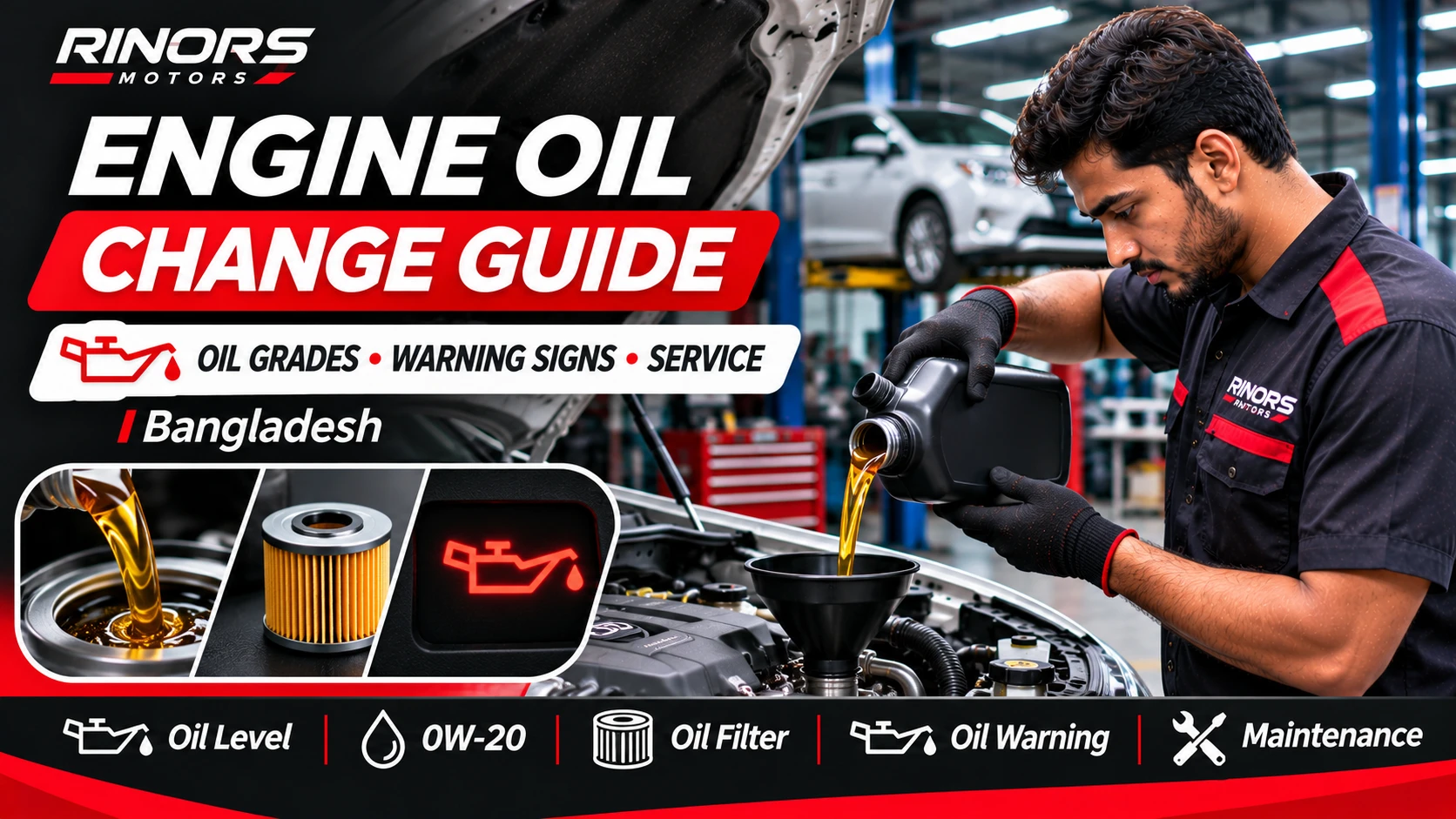
Engine Oil Change Guide in Bangladesh: Everything Car Owners Should Know
Regular engine oil changes are among the most important maintenance tasks for keeping your car's engine running efficiently and reliably.
Whether you own a Toyota Corolla Axio, Toyota Aqua, Toyota Premio, Honda Vezel, Nissan X-Trail, or another vehicle, using the correct engine oil and following the appropriate maintenance schedule can help reduce premature engine wear.
In Bangladesh, heavy traffic, frequent short trips, dust, and demanding driving conditions make proper engine maintenance particularly important.
1. Why Is Engine Oil Important?
Engine oil performs several essential functions:
Lubrication: Reduces friction between moving engine components.
Cooling: Helps transfer heat away from engine parts.
Cleaning: Carries contaminants toward the oil filter and helps control deposits.
Protection: Helps prevent corrosion and premature component wear.
Engine efficiency: Supports smooth operation when the correct oil is used.
Over time, engine oil deteriorates and becomes contaminated. Delaying replacement beyond the recommended interval can increase engine wear.
2. How Often Should You Change Engine Oil?
There is no universal oil-change interval suitable for every vehicle.
The appropriate interval depends on the engine, oil specification, manufacturer's maintenance schedule, and operating conditions.
Some vehicles require relatively frequent oil changes, while others using approved synthetic oils permit longer intervals.
Always follow your vehicle's owner's manual and applicable maintenance schedule. Severe operating conditions may require more frequent servicing.
Record the date, mileage, and oil specification after each service.
3. Understanding Engine Oil Grades: 0W-20 vs. 5W-30
Engine oils carry viscosity ratings such as 0W-16, 0W-20, 5W-30, and 10W-30.
These ratings describe how the oil flows at different temperatures.
0W-20 Engine Oil
0W-20 is a relatively low-viscosity engine oil specified for certain modern engines.
It can support fuel efficiency and cold-start lubrication in engines designed to use it.
5W-30 Engine Oil
5W-30 has a higher high-temperature viscosity than 0W-20.
It is specified for various engines, depending on their design and operating requirements.
Which Engine Oil Is Best for Your Car?
The best oil is not automatically the thickest, most expensive, or most popular product.
Choose an oil that meets your vehicle manufacturer's required viscosity and performance specifications, including applicable API or ILSAC standards.
Never assume that every Toyota or Honda uses the same grade.
4. Synthetic vs. Conventional Engine Oil
Synthetic Engine Oil
Synthetic oils are formulated for controlled performance and may provide improved resistance to oxidation and temperature-related breakdown, depending on the product.
Conventional Engine Oil
Conventional mineral-based oils may be suitable for vehicles whose manufacturers approve them.
The correct choice depends on the engine requirements, oil specification, and service interval—not simply whether the oil is labeled synthetic.
5. Warning Signs Your Engine Oil Needs Attention
Low Engine Oil Level
If the oil level is below the recommended range, the engine may not receive adequate lubrication.
Check the level according to the manufacturer's procedure.
Engine Oil Pressure Warning Light
A red oil-can warning light can indicate dangerously low oil pressure.
If the oil pressure warning appears while driving, stop safely and turn off the engine. Do not continue driving until the cause has been investigated.
Unusual Engine Noise
Ticking, rattling, or knocking noises can have several causes, including lubrication problems.
Persistent unusual engine noises require professional diagnosis.
Oil Leaks
Oil spots beneath the vehicle, wet areas around the engine, or a falling oil level may indicate leakage.
Oil-Change Reminder
A maintenance reminder may indicate that scheduled service is due. It should not be confused with an urgent oil-pressure warning.
Unusual Oil Appearance
Milky oil, a strong fuel smell, or other unusual changes may indicate contamination or mechanical problems.
Dark oil alone does not necessarily mean it must be replaced immediately.
6. How to Check Your Car's Engine Oil Level
For vehicles equipped with a dipstick:
Park on level ground and switch off the engine.
Follow the manufacturer's instructions about waiting before checking.
Remove the dipstick and wipe it clean.
Insert it fully and remove it again.
Check that the oil falls within the indicated range.
Add the specified oil only if necessary, without overfilling.
Some newer cars use electronic oil-level monitoring instead of a conventional dipstick.
7. Why Should You Replace the Oil Filter?
The oil filter captures contaminants circulating through the engine lubrication system.
An old or restricted filter may reduce filtration effectiveness.
Replace the filter according to the manufacturer's service schedule, normally as part of the specified oil-change procedure.
Use a filter compatible with the exact engine model.
8. What Happens During Professional Engine Oil Servicing?
A proper engine oil service typically includes:
Checking the vehicle's oil specification and service requirements.
Inspecting the engine for visible leaks.
Draining the existing engine oil.
Replacing the oil filter and relevant sealing components.
Refilling with the correct quantity and specification of oil.
Checking the oil level and inspecting for leaks.
Resetting the maintenance reminder when appropriate.
Recording the service details for future maintenance.
9. Does a Hybrid Car Need Engine Oil Changes?
Yes. Petrol-electric hybrid vehicles still contain an internal combustion engine that requires lubrication.
Toyota Aqua, Toyota Corolla Axio Hybrid, Toyota Prius, and other petrol-electric hybrids require engine oil servicing according to their respective maintenance schedules.
The electric motor does not eliminate the need for engine oil changes.
10. Common Engine Oil Mistakes to Avoid
Using an oil grade that does not meet manufacturer specifications.
Delaying oil and filter replacement beyond the required interval.
Overfilling or underfilling engine oil.
Ignoring oil leaks or abnormal oil consumption.
Assuming dark oil alone indicates engine damage.
Treating an oil-pressure warning as a routine oil-change reminder.
Frequently Asked Questions
Can I Use 5W-30 Instead of 0W-20?
Only if your vehicle manufacturer permits that substitution for the specific engine and operating conditions. Consult the owner's manual.
Is Synthetic Engine Oil Better?
An approved synthetic oil can offer performance advantages, but correct manufacturer specifications and maintenance intervals remain essential.
Can I Drive With the Red Oil Warning Light On?
No. Safely stop, switch off the engine, and investigate the cause. Continued operation with insufficient oil pressure can result in severe engine damage.
Does Engine Oil Need to Be Changed if the Car Is Rarely Driven?
Yes. Maintenance schedules frequently include both time and mileage limits. Follow whichever requirement becomes due first.
Professional Engine Oil Change Service at Rinors Motors
At Rinors Motors, we understand that proper engine lubrication is essential for reliable vehicle performance.
Our car maintenance and engine oil servicing solutions focus on selecting appropriate oil specifications, replacing service components, and checking for visible maintenance concerns.
Whether you drive a Toyota, Honda, Nissan, or another vehicle, following a proper maintenance schedule helps protect your investment.
Contact Rinors Motors for engine oil changes, oil filter replacement, and professional car maintenance assistance in Bangladesh.