How to Find the Correct Car Spare Parts in Bangladesh
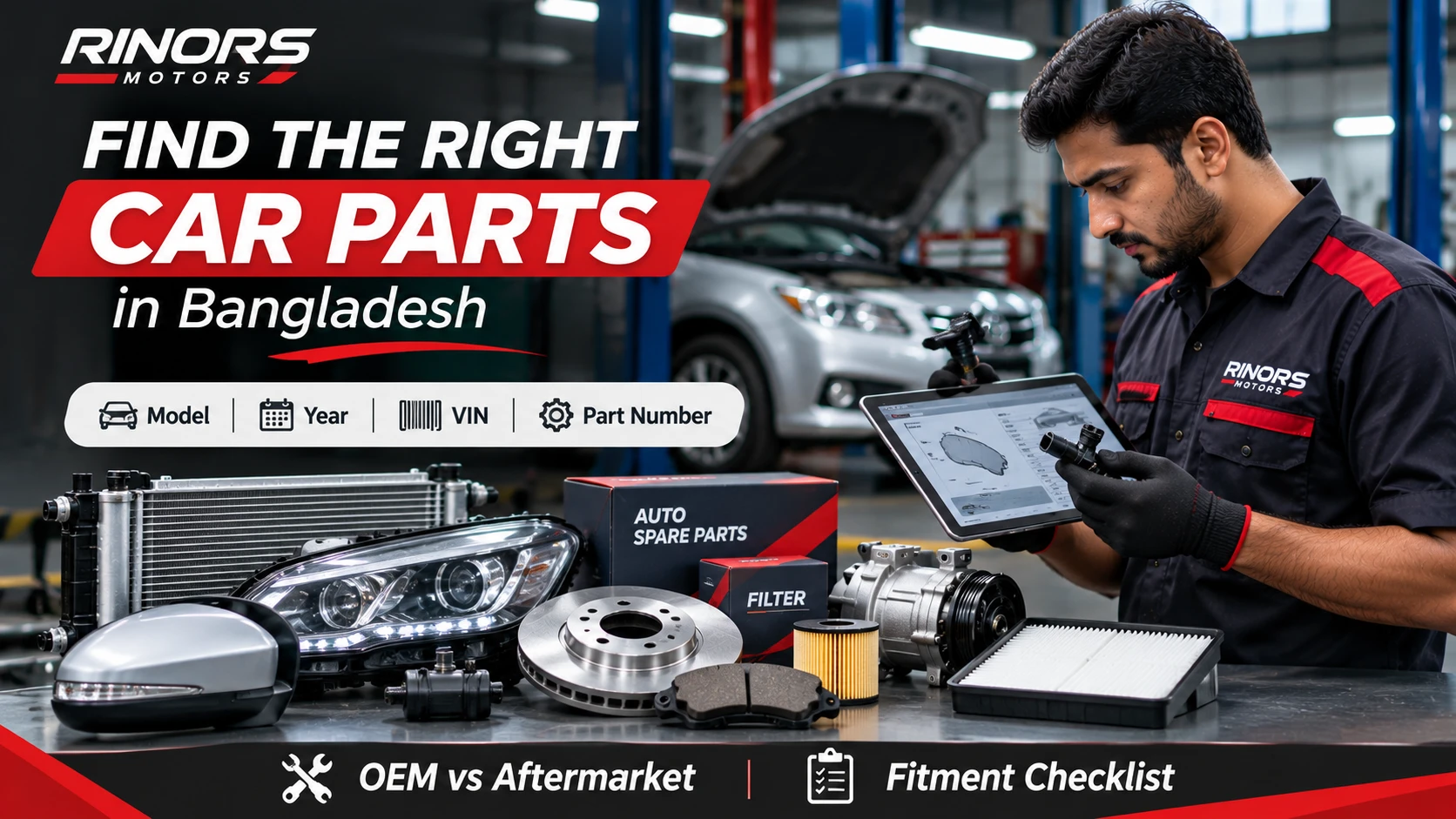
Finding the right car spare parts in Bangladesh can sometimes be challenging, especially when different versions of the same vehicle require different components.
Whether you own a Toyota Corolla Axio, Toyota Aqua, Toyota Premio, Honda Grace, Nissan X-Trail, or another vehicle, choosing the correct replacement part is essential for proper performance, safety, and long-term reliability.
Buying the wrong part can lead to installation difficulties, additional repair costs, and unnecessary delays.
At Rinors Motors, we have over 30 years of experience in the automotive industry. In this guide, we explain how to identify the correct automotive spare parts, compare part types, and make informed purchasing decisions.
Why Choosing the Correct Car Spare Part Matters
Many vehicle owners assume that parts from the same brand or model will always be interchangeable.
However, manufacturers often produce multiple variants of the same vehicle with different engines, transmissions, body designs, electrical systems, and equipment.
For example, components for a Toyota Corolla Axio petrol model may differ from those fitted to a Toyota Corolla Axio Hybrid.
Even two vehicles manufactured in the same year can have different parts depending on their production specifications.
Selecting the correct part helps ensure:
Proper installation and fitment.
Compatibility with existing vehicle systems.
Reliable mechanical and electrical performance.
Reduced risk of repeat repairs.
Avoidance of unnecessary purchasing expenses.
1. Identify Your Vehicle's Exact Model
Before searching for replacement parts, identify your vehicle accurately.
You should know:
Vehicle manufacturer or brand.
Model name.
Manufacturing year.
Model or chassis code.
Engine type and engine code, where relevant.
Petrol, diesel, hybrid, or electric configuration.
Vehicle variant or trim level.
For example, searching only for "Toyota Axio headlight" may produce several different options.
The correct headlight may depend on the model generation, production date, headlight type, and vehicle configuration.
Why Manufacturing Year Alone Is Not Enough
Manufacturers may change components during a production cycle.
A model-year description alone does not always establish the exact production specification.
For accurate identification, use the vehicle's chassis or frame details and verify them against a compatible parts catalogue.
2. Use the VIN or Chassis Number
One of the most reliable ways to identify compatible vehicle parts is through the Vehicle Identification Number (VIN) or the vehicle's chassis/frame number.
These identifiers help determine the specific vehicle configuration when checked against appropriate manufacturer or parts-catalogue information.
Some Japanese domestic-market vehicles use frame numbers rather than the conventional 17-character VIN format.
Where Can You Find This Information?
Depending on the vehicle, identification details may be located:
On the vehicle identification plate.
On the chassis or body.
Near the dashboard or door opening.
In registration documents.
In manufacturer documentation.
Always check the actual vehicle identifier when possible instead of relying only on a number copied from another source.
3. Check the Original Part Number
Automotive manufacturers and suppliers identify components through part numbers.
A part number helps distinguish between similar-looking components that may have different specifications.
For example, two headlights might appear almost identical but use different mounting points, electrical connectors, or lighting systems.
How to Verify a Part Number
Locate the existing component's part number, if visible.
Check the number against the correct vehicle parts catalogue.
Confirm whether the number has been replaced by a newer part number.
Compare the replacement component's fitment information.
Ask the supplier to verify compatibility before ordering.
Part-number matching is especially useful for electrical components, lighting, cooling systems, engine parts, and body components.
4. Understand Genuine, OEM and Aftermarket Car Parts
When shopping for automotive spare parts, you may encounter three commonly used terms.
Genuine Parts
Genuine parts are supplied under the vehicle manufacturer's brand and are intended for specified vehicle applications.
They are generally selected by customers who prioritize manufacturer-branded replacement components.
OEM Parts
OEM refers to Original Equipment Manufacturer.
An OEM supplier may manufacture components used in original vehicle production.
However, a part sold under an OEM supplier's own brand is not automatically identical to every manufacturer-branded replacement part.
Compatibility and specifications should still be verified.
Aftermarket Parts
Aftermarket parts are produced and sold outside the vehicle manufacturer's branded replacement-parts channel.
Their quality, design, price, and compatibility can vary significantly.
Some reputable aftermarket components can be suitable alternatives, while poorly manufactured products may create reliability or installation problems.
The best option depends on the part, manufacturer, vehicle requirements, quality and budget.
For safety-critical components, prioritize verified specifications and reliable suppliers rather than choosing solely by price.
5. Confirm Left, Right, Front and Rear Positions
Many automotive components are designed for a specific installation position.
Examples include:
Left and right headlights.
Left and right side mirrors.
Front and rear bumpers.
Front and rear brake components.
Left and right fenders.
Front and rear suspension parts.
A visually similar component may not fit the opposite side.
Part catalogues generally define left and right from the perspective of someone seated in the vehicle facing forward, but always verify the catalogue's convention.
6. Check Electrical Connectors and Specifications
Electrical components require particularly careful identification.
For example, replacement headlights can differ in:
Connector type.
Number of electrical pins.
Halogen or LED configuration.
Integrated daytime running lights.
Motorized adjustment features.
Control-module requirements.
Similarly, sensors, switches, cooling fans, and other electrical components may differ between vehicle variants.
Matching the physical shape alone is not enough to guarantee electrical compatibility.
7. Common Car Spare Parts Categories in Bangladesh
Vehicle owners frequently need replacement parts for exterior damage, mechanical maintenance, cooling problems, and electrical faults.
Car Lighting Parts
These include headlights, taillights, fog lights, turn signals, and related lighting components.
Before buying, check the correct vehicle generation, installation side, light type, and electrical connector.
Car Body Parts
Common body replacement parts include bumpers, fenders, doors, bonnets, grilles, and other exterior panels.
Check body style, mounting positions, model generation, and any required sensor or camera openings.
Mirrors and Automotive Glass
Side mirrors, door glass, windshields, and rear glass may vary depending on vehicle model and trim.
For mirrors, check electrical adjustment, folding mechanisms, indicators, heating, and camera features where applicable.
Cooling and Air Conditioning Parts
Radiators, condensers, cooling fans, and other AC components must match the vehicle's engine, cooling configuration, and component connections.
Incorrect cooling parts can cause installation problems or reduce system effectiveness.
Braking and Maintenance Components
Brake pads, brake discs, filters, belts, and other maintenance parts should be selected using the correct vehicle specifications.
For braking and other safety-related systems, professional installation and inspection are strongly recommended.
8. How to Compare Car Parts Prices in Bangladesh
Car spare parts prices can vary considerably depending on the brand, origin, supplier, condition, and specifications.
A low price does not necessarily mean a component is the best value.
When comparing prices, consider:
Whether the part is genuine, OEM, or aftermarket.
Whether it is new or previously used.
Manufacturer and supplier reputation.
Confirmed compatibility.
Warranty or replacement conditions.
Delivery charges.
Installation costs.
Avoid Comparing Different Specifications
A basic aftermarket mirror and an electrically folding mirror with an integrated indicator are not equivalent products.
Similarly, two radiators may have different dimensions, fittings, or cooling-system configurations.
Compare identical or technically equivalent specifications before deciding which offer provides better value.
9. Common Mistakes When Buying Car Spare Parts
Buying Based Only on a Photograph
A product photograph does not always reveal mounting differences or technical specifications.
Choosing Parts Based Only on Model Name
Different generations and variants of the same model may require different components.
Ignoring Part Numbers
Failing to verify part numbers can result in purchasing incompatible products.
Choosing the Cheapest Option Without Checking Quality
Poor-quality parts may fail prematurely or create additional repair expenses.
Installing Parts Without Proper Inspection
Some symptoms can be caused by wiring, sensors, installation issues, or other components rather than the part initially suspected.
Professional diagnosis can help avoid unnecessary replacement.
10. What Information Should You Send to a Spare Parts Supplier?
To help identify the correct replacement part, provide:
Vehicle brand and model.
Manufacturing year.
Chassis/frame number or VIN, when appropriate.
Engine or model code, if relevant.
Existing part number, if available.
Photos of the required component.
Left or right installation position.
Relevant specifications or features.
For privacy, share vehicle documents or personal information only through trusted channels and only when necessary.
Frequently Asked Questions
How do I know if a car part fits my vehicle?
Verify the part number, vehicle chassis or VIN details, model code, year, configuration, and technical specifications against a reliable catalogue or knowledgeable supplier.
Are OEM parts better than aftermarket parts?
Not always. Quality varies by manufacturer and product. Genuine, OEM, and aftermarket components should be evaluated based on verified compatibility, specifications, quality, and warranty.
Can I use Toyota Aqua parts in a Toyota Axio?
Certain components may be shared across compatible vehicle platforms, but parts should never be assumed interchangeable merely because both vehicles are made by Toyota. Verify the exact part number and application.
Why do similar-looking spare parts have different prices?
Differences may involve manufacturer, material quality, technical specifications, included accessories, warranty, or product condition.
Where can I buy car spare parts in Bangladesh?
Automotive spare parts are available through dealerships, specialist suppliers, parts retailers, workshops, and online automotive stores. Always verify compatibility and purchase conditions.
Find Automotive Spare Parts at Rinors Motors
At Rinors Motors, we provide automotive spare parts and accessories for different vehicle brands and models, alongside vehicle sales and professional servicing solutions.
Our automotive parts categories include lighting, body components, mirrors, glass, cooling-system parts, and other replacement components.
With over 30 years of automotive industry experience, we understand the importance of selecting suitable components for proper vehicle maintenance.
Looking for car spare parts in Bangladesh?
Explore the available spare parts collection at Rinors Motors, or contact our team with your vehicle model, chassis details, and required part specifications to inquire about availability and compatibility.
Rinors Motors — Your Automotive Partner in Bangladesh.