Japanese Car Auction Sheet Verification in Bangladesh: Complete Buying Guide
Buying a Japanese reconditioned car in Bangladesh can be a significant investment. Whether you are considering a Toyota Aqua, Corolla Axio, Prius, Premio, Allion, Honda Vezel, or Nissan X-Trail, understanding the vehicle's previous condition is essential.
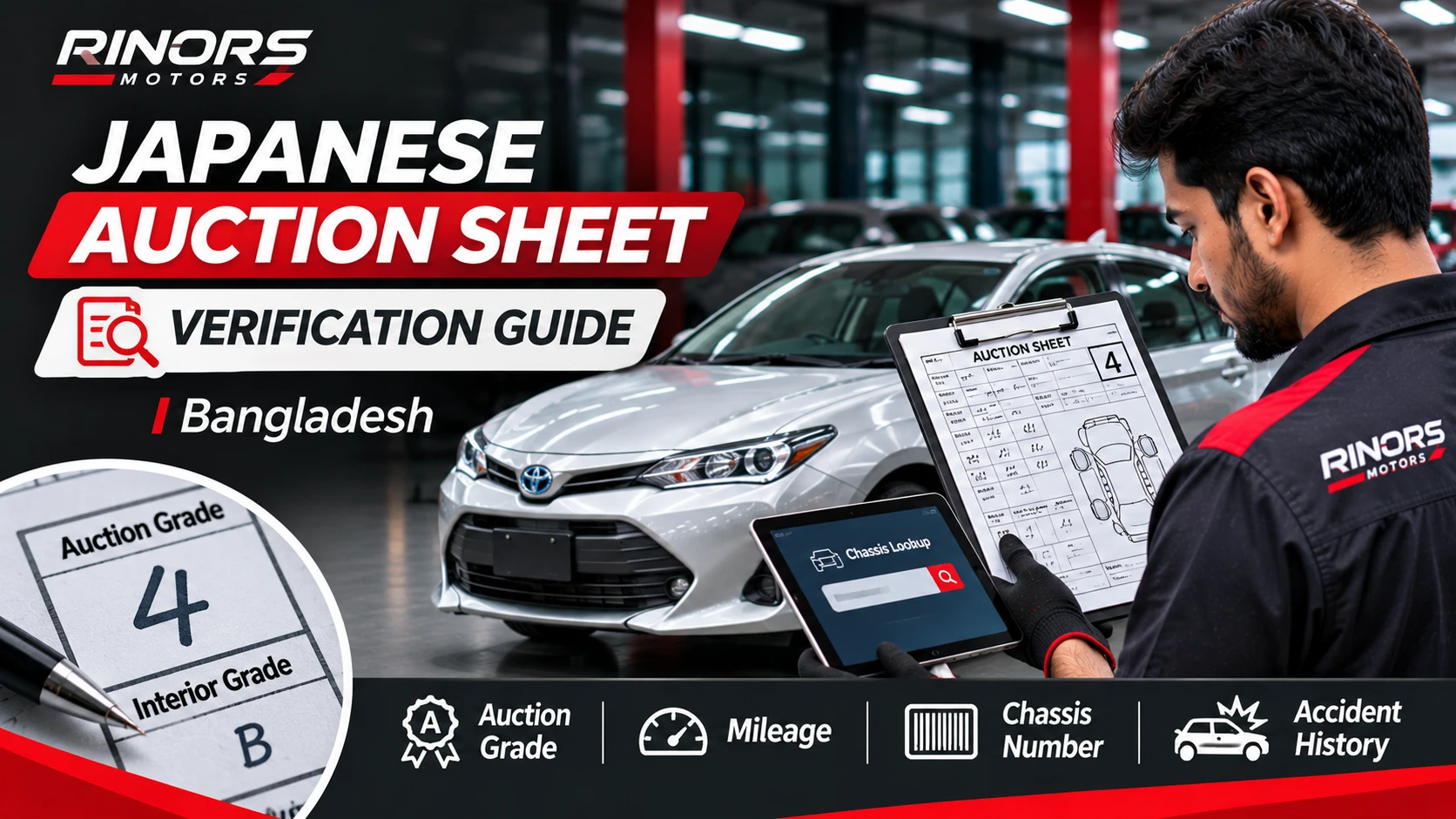
One important document to check is the Japanese Car Auction Sheet, which may contain information about mileage, condition grade, body damage, repairs, and an inspector's observations recorded when the vehicle was offered at auction in Japan.
However, receiving an auction sheet from a seller does not automatically prove that it is genuine.
At Rinors Motors, we have over 30 years of experience in the automotive industry. This guide explains how auction sheets work, how to interpret common grades and damage codes, and how to verify a vehicle before buying it in Bangladesh.
What Is a Japanese Car Auction Sheet?
A Japanese auction sheet is a vehicle condition report prepared for a car offered through a Japanese vehicle auction.
Auction inspectors assess the vehicle according to the auction company's procedures and record relevant findings.
Depending on the auction house, an auction sheet may include:
Vehicle brand and model.
Chassis or frame number.
Manufacturing or registration information.
Mileage recorded at inspection.
Overall auction grade.
Interior and exterior condition grades.
Scratches, dents, and body damage.
Signs of repair or panel replacement.
Inspector's written comments.
Available equipment and vehicle features.
Auction sheets are useful historical documents, but they represent a vehicle's condition at a particular inspection date.
They are not comprehensive mechanical warranties or guarantees of the vehicle's current condition.
Why Is Auction Sheet Verification Important in Bangladesh?
Imported reconditioned cars may undergo cleaning, repairs, detailing, and other preparation before being sold in Bangladesh.
As a result, their appearance at a showroom may differ from their recorded condition at an earlier auction.
1. Verify the Vehicle's Previous Condition
The auction report can provide useful information about visible damage, exterior condition, and repair observations.
2. Check Mileage History
Comparing the mileage recorded at auction with the vehicle's current odometer reading can help identify inconsistencies.
3. Identify Accident or Repair Information
Certain auction grades, body diagrams, and inspector comments may indicate previous repairs or damage.
4. Compare the Asking Price
Two vehicles of the same model and manufacturing year may have different values depending on condition, mileage, accident history, and equipment.
5. Reduce the Risk of Misleading Information
Checking the original auction record helps reduce reliance on an unverified photograph or document supplied by a seller.
Important: Not every imported Japanese vehicle has an accessible auction record. Some vehicles may have been purchased through dealers, private sales, or other channels.
How to Verify a Japanese Auction Sheet in Bangladesh
Step 1: Collect the Chassis or Frame Number
Begin by identifying the vehicle's chassis or frame number.
For Japanese-market cars, the number may use a model code followed by a serial number.
For example:
NHP10-XXXXXXX — illustrative first-generation Toyota Aqua format.
NKE165-XXXXXXX — illustrative Toyota Axio Hybrid format.
NZE161-XXXXXXX — illustrative Toyota Corolla Axio format.
The X characters are placeholders, not real vehicle numbers.
Confirm the number directly from the vehicle and available documentation.
Step 2: Request the Auction Sheet
Ask the seller or importer for the available auction sheet and any related inspection photographs.
Check whether the sheet includes:
Correct vehicle model.
Matching chassis number.
Auction company or event information.
Mileage.
Auction grade.
Body condition diagram.
Inspector remarks.
A clear, complete copy is more useful than a cropped image showing only the grade.
Step 3: Check an Independent Auction Record
Where the record is available, use a reputable auction-record verification provider or another independently accessible record source.
Depending on the provider, you may need:
Chassis or frame number.
Vehicle model.
Approximate auction date.
Auction house name.
Additional identifying details.
Compare the returned report with the seller-provided document.
Not every vehicle or auction event is covered by every verification database, so an unsuccessful search does not automatically indicate fraud.
Step 4: Compare the Important Details
Verify whether the documents show consistent:
Chassis number.
Vehicle model and variant.
Mileage.
Auction date.
Overall grade.
Body damage marks.
Inspector comments.
Differences should be explained and independently checked before payment.
Step 5: Inspect the Actual Vehicle
Even a genuine auction sheet cannot replace physical inspection.
Have the car checked for mechanical problems, accident repairs, structural damage, electrical faults, and hybrid-system issues where applicable.
The condition may have changed after the auction inspection.
Japanese Auction Grades Explained
Japanese auction houses commonly use numerical and letter-based grades to summarize vehicle condition.
However, grading standards are not completely uniform across every auction house.
The following descriptions are general guidelines.
Grade S or 6 — Nearly New Condition
These grades commonly describe vehicles in exceptionally clean or nearly new condition, often with limited use.
Exact requirements depend on the auction company's grading system.
Grade 5 — Excellent Condition
A Grade 5 vehicle generally has very good cosmetic condition and relatively minor visible wear.
It should still be inspected for mechanical or other issues.
Grade 4.5 — Very Good Used Condition
A 4.5 grade often indicates a well-presented used car with relatively minor imperfections.
The grade does not prove that the vehicle is accident-free or free from mechanical problems.
Grade 4 — Good Used Condition
Grade 4 generally indicates a used vehicle in good overall condition with some normal wear.
Small scratches, dents, or other imperfections may still be recorded.
Grade 3.5 — Moderate Wear
A 3.5 grade may indicate more noticeable cosmetic wear or conditions requiring attention.
It does not automatically make a vehicle unsuitable for purchase.
The actual damage, mechanical condition, and price should determine whether it represents good value.
Grade 3 or Below — Additional Inspection Recommended
Lower grades may indicate considerable wear, damage, or other concerns.
Review the complete inspection report and arrange a professional physical inspection.
Grade R or RA — Repair History
Depending on the auction house, R and RA typically indicate a vehicle with accident-related repair or structural repair history.
Their precise definitions and severity thresholds may differ.
A repaired vehicle should not automatically be rejected, but the location, quality, and extent of repairs must be carefully evaluated.
Remember: A higher auction grade is not a guarantee of a better purchase. The vehicle's current condition is more important than one number.
Understanding Interior and Exterior Grades
Japanese auction sheets may also include letter grades for the interior or exterior.
Common examples include:
A: Very clean or excellent condition.
B: Minor wear or marks.
C: More noticeable wear.
D: Significant wear or damage.
Some auction houses use additional grades or different definitions.
An interior grade of B does not mean the entire vehicle has an overall auction grade of B.
Always identify which section each grade describes.
Japanese Auction Sheet Damage Codes
The vehicle diagram on an auction sheet often shows where an inspector recorded visible damage.
Common symbols may include:
A — Scratches
An A marking often identifies an area with scratches.
Examples such as A1, A2, or A3 may indicate increasing severity within the relevant auction company's grading system.
U — Dents
U commonly indicates a dent.
A larger accompanying number can indicate more noticeable damage.
W — Repair or Paint Irregularities
W may indicate panel waviness or signs of previous bodywork or paint repair.
This marking should be examined carefully, especially near structural areas.
X — Replacement Recommended
X commonly indicates a panel or component marked for replacement.
XX — Previously Replaced Panel
XX commonly indicates a panel that has already been replaced.
S or C — Rust or Corrosion
Depending on the auction house, S and C can indicate rust, corrosion, or related surface conditions.
Important: Damage codes and numbering conventions vary across auctions. Always use the auction house's own legend and obtain a reliable translation of the inspector's notes.
How to Check Mileage Using an Auction Sheet
Mileage is one of the factors affecting the price of a used or reconditioned car.
A mileage reading recorded at a Japanese auction can provide a historical reference.
Compare Auction Mileage with Current Mileage
For example, imagine a vehicle has:
Recorded auction mileage: 72,000 km.
Current dashboard mileage: 41,000 km.
This difference requires investigation.
It could indicate a recording error, instrument replacement, an altered odometer, or another issue that needs documentary explanation.
Check Multiple Records
Where available, compare:
Earlier auction records.
Japanese inspection or service history.
Export documentation.
Current odometer reading.
Maintenance records.
An auction mileage reading is not a permanent guarantee of accuracy.
A vehicle may have been offered at multiple auctions, and mileage can change between inspection dates.
Can an Auction Sheet Be Fake or Altered?
A scanned or photographed auction sheet can potentially be modified.
Possible warning signs include:
Chassis number does not match the car.
Auction grade differs from the retrieved historical record.
Mileage information is inconsistent.
Important inspection comments have been omitted.
The supplied sheet is cropped or unusually unclear.
The seller refuses independent verification without a reasonable explanation.
A document that looks professionally formatted is not necessarily authentic.
How to Reduce the Risk
Verify the chassis number against the actual vehicle.
Seek an independently retrieved auction record where possible.
Compare the complete report, including comments and body diagram.
Verify available auction photographs.
Investigate inconsistencies before making an advance payment.
Do not rely exclusively on a seller-provided screenshot or a claimed grade.
What If the Car Has No Auction Sheet?
Not every Japanese vehicle is purchased through an auction, and some historical records may be unavailable.
If an auction sheet cannot be obtained, consider requesting:
Available purchase or import documentation.
Previous maintenance records.
Vehicle registration information.
Export or inspection records, where available.
A professional mechanical inspection.
A body and chassis inspection.
Relevant electronic diagnostic reports.
The absence of an auction sheet is not proof of fraud, but it means you should place greater emphasis on other evidence.
Auction Sheet Verification vs Physical Car Inspection
An auction sheet and a pre-purchase inspection serve different purposes.
Auction Sheet Verification
Helps establish what an auction inspector recorded about the vehicle at a specific point in its history.
Physical Vehicle Inspection
Examines the vehicle's present mechanical, electrical, structural, and cosmetic condition.
For example, a car that received Grade 4.5 in Japan might develop mechanical problems or sustain damage after the auction.
Conversely, a lower-grade vehicle might have received professionally completed repairs, although these must be carefully assessed.
For the strongest buying decision, combine verified history with a thorough current-condition inspection.
10 Things to Check Before Paying for a Reconditioned Car
Match the chassis number with the actual vehicle.
Obtain the complete auction sheet, if available.
Verify the original auction record independently.
Compare mileage records and explanations.
Understand the overall auction grade.
Read the body damage diagram.
Translate the inspector's comments.
Inspect the engine, transmission, and chassis.
Check hybrid battery health where applicable.
Verify purchase documents, registration status, and total agreed price.
Do not make a large payment solely because a seller advertises a high auction grade.
Frequently Asked Questions
What is auction sheet verification?
Auction sheet verification involves checking a Japanese vehicle's available auction inspection record and comparing it with the seller-provided document and actual vehicle details.
Can I verify a Japanese auction sheet using the chassis number?
Often, yes, if the auction record is covered by an accessible database or verification provider. Not every car or auction event has an accessible record.
Does Grade 4.5 mean a car is accident-free?
No. Grade 4.5 is a general condition assessment, not a complete accident-free certificate. Review damage markings, inspector notes, and the current vehicle condition.
What does Grade R mean?
R generally indicates a vehicle with relevant accident or repair history under the auction company's rules. Confirm the exact definition and repair details.
Does an auction sheet prove original mileage?
It provides mileage recorded at the time of inspection, but does not by itself guarantee that the reading is accurate or unchanged throughout the vehicle's life.
How much does auction sheet verification cost in Bangladesh?
Fees vary by provider, coverage, and whether the report includes photographs or translations. Confirm the latest price and the availability of the specific vehicle record before paying.
Is auction sheet verification enough before buying a car?
No. A verified record should be combined with a professional mechanical inspection, document checks, and a suitable test drive.
Buy Your Next Car with Greater Confidence
At Rinors Motors, we offer new, used, and reconditioned cars, automotive spare parts, and professional vehicle servicing in Bangladesh.
With more than 30 years of automotive industry experience, we understand the importance of evaluating a vehicle's condition, documentation, and long-term maintenance requirements.
Planning to buy a Japanese reconditioned car?
Explore available vehicles at Rinors Motors or contact our team to discuss vehicle details, inspection requirements, spare parts, and servicing options.
Rinors Motors — Your Automotive Partner in Bangladesh.