Timing Belt vs Timing Chain: Complete Guide for Car Owners in Bangladesh
Your car's engine depends on precise mechanical timing to operate correctly. One of the most important components responsible for maintaining this timing is the timing belt or timing chain.
These components synchronize the movement of the crankshaft and camshaft, helping the engine's valves open and close at the correct moments.
If the timing system becomes worn, damaged, or incorrectly adjusted, the engine may experience serious performance problems. In certain engines, a timing belt or chain failure can cause extensive internal damage.
For drivers in Bangladesh, understanding the difference between a timing belt and a timing chain is especially useful when maintaining older Japanese vehicles, purchasing a pre-owned car, or investigating unusual engine noises.
Whether you drive a Toyota Corolla, Axio, Premio, Allion, Honda Civic, Nissan, or another vehicle, this guide explains the differences, warning signs, replacement requirements, and maintenance recommendations.
What Is an Engine Timing System?
An internal combustion engine uses pistons and valves to manage the movement of air, fuel, and exhaust gases.
The crankshaft controls piston movement, while one or more camshafts control the opening and closing of engine valves.
The timing system keeps these components synchronized.
Main Functions of the Timing System
Synchronize crankshaft and camshaft rotation.
Control the timing of valve operation.
Maintain correct engine combustion timing relationships.
Help the engine operate smoothly.
Support proper engine power and efficiency.
Prevent incorrect mechanical timing that could damage engine components.
Most passenger-car engines use either a timing belt or a timing chain, depending on the engine design.
What Is a Timing Belt?
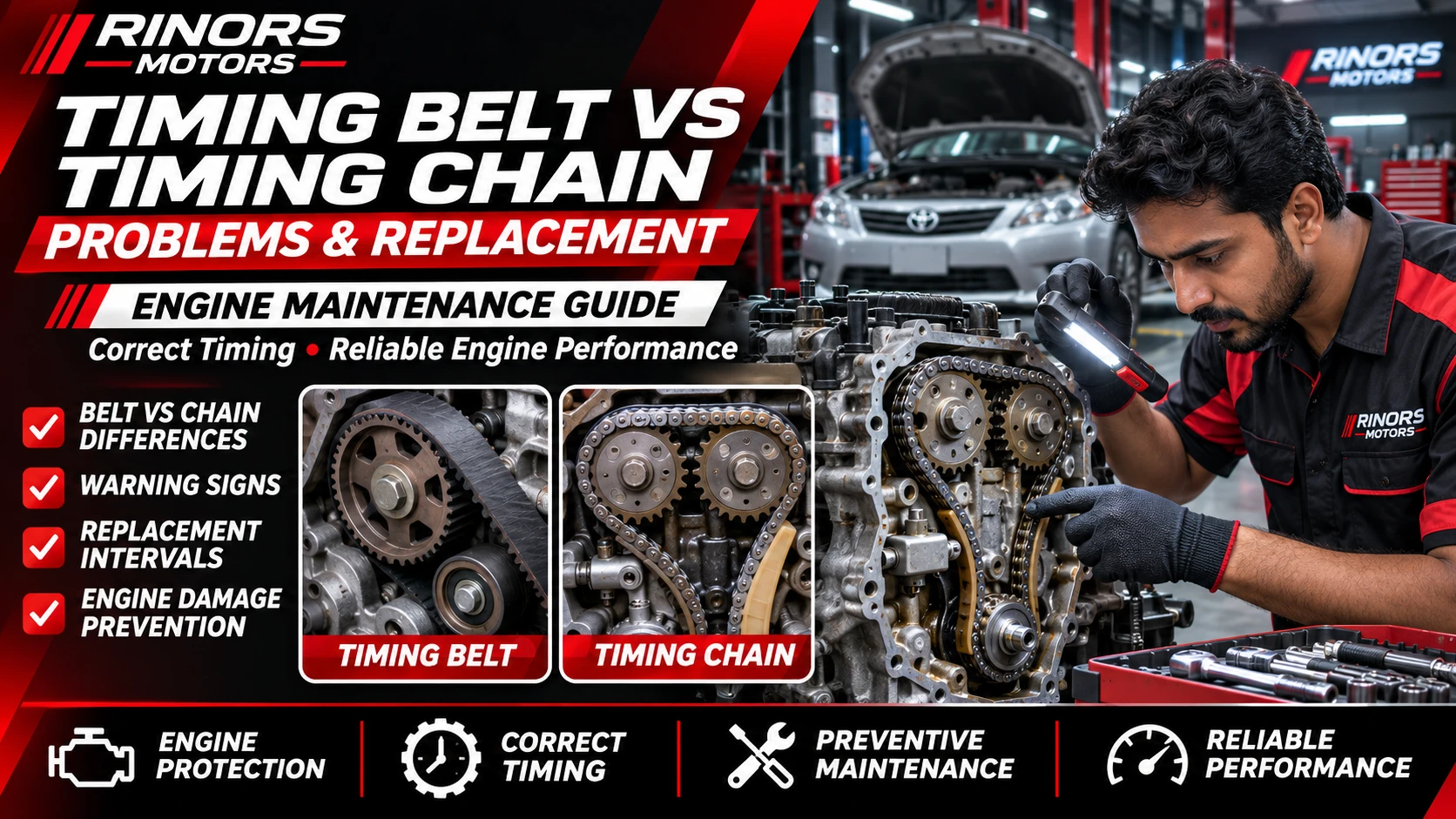
A timing belt is a specially designed toothed belt that connects the crankshaft to the camshaft or camshafts.
Many conventional timing belts are made from reinforced rubber-based materials, although their exact construction varies.
The teeth of the belt fit into matching toothed pulleys, maintaining the required timing relationship.
Advantages of Timing Belts
Generally quieter operation.
Relatively lightweight construction.
Designed for precise mechanical timing.
Replacement procedures may be less complex than certain timing-chain systems.
Limitations of Timing Belts
Most conventional timing belts have specified replacement intervals.
Rubber and reinforcing materials can deteriorate over time.
Incorrect tension or component failure can damage the belt.
Belt breakage may cause serious engine damage.
Some modern engines use oil-immersed timing belts, commonly called wet belts. These have specific oil and maintenance requirements.
What Is a Timing Chain?
A timing chain is a metal chain that connects the engine's crankshaft and camshaft sprockets.
Unlike most conventional dry timing belts, timing chains generally operate inside the engine and receive lubrication from engine oil.
The system typically includes chain guides and tensioning components.
Advantages of Timing Chains
Durable metal construction.
Often designed for extended service life.
Many manufacturers do not specify a routine replacement interval.
Suitable for a wide range of modern engine designs.
Limitations of Timing Chains
Chain guides and tensioners can wear or fail.
Oil contamination and poor lubrication can cause problems.
Some failures produce rattling noises.
Replacement can involve substantial engine disassembly.
Timing chains are not guaranteed to last indefinitely.
A timing chain can still require repair or replacement if its condition deteriorates.
Timing Belt vs Timing Chain: Key Differences
1. Construction
A conventional timing belt uses reinforced flexible material with molded teeth.
A timing chain uses metallic links that engage with engine sprockets.
2. Lubrication
Most conventional timing belts operate outside the engine's pressurized oil environment.
Timing chains generally operate with engine oil lubrication.
However, some engines use specialized timing belts designed to operate in oil.
3. Maintenance
Timing belts commonly require replacement according to a manufacturer-defined time or mileage schedule.
Timing chains frequently have no fixed replacement interval, although they still require appropriate maintenance and diagnosis.
4. Noise
Timing belts generally operate quietly.
Timing chains may become noisy if the chain, guides, tensioner, or related components develop problems.
5. Replacement Cost
Replacement costs depend on engine layout, labor requirements, parts, and associated components.
In some engines, timing-chain replacement is more labor-intensive than timing-belt replacement.
6. Service Life
Timing chains are often designed for longer service life, but that does not mean they are maintenance-free.
Timing-belt service life depends on the specific engine, belt design, operating conditions, and manufacturer recommendations.
7 Warning Signs of Timing Belt or Timing Chain Problems
1. Rattling Noise During Engine Startup
A rattling noise during startup can indicate a timing-chain tensioner, guide, or lubrication-related problem.
However, several other engine components can produce similar noises.
The source should be diagnosed rather than assuming the timing chain needs replacement.
2. Unusual Engine Noise
A damaged timing-drive component may produce abnormal rattling, rubbing, or mechanical noise.
The type of noise depends on the engine and the component involved.
3. Engine Misfiring
Incorrect valve timing can affect combustion and contribute to engine misfires.
However, ignition coils, spark plugs, fuel injectors, and other problems can also cause misfires.
4. Difficulty Starting
A significant mechanical timing problem may make the engine difficult to start or prevent it from starting altogether.
5. Reduced Engine Performance
Incorrect camshaft timing can contribute to reduced power, rough engine operation, and poor acceleration.
6. Check Engine Light
Certain timing-system problems can trigger diagnostic trouble codes.
Examples include:
P0016: Crankshaft and camshaft position correlation issue.
P0017: Crankshaft and camshaft position correlation issue involving another sensor or camshaft position.
P0011: Camshaft timing over-advanced or system performance fault in applicable engines.
These codes do not automatically confirm timing-chain or timing-belt failure. Sensors, oil-control components, variable valve timing systems, wiring, and other faults may also cause them.
7. Engine Suddenly Stops Running
A timing belt or chain failure can cause the engine to stop unexpectedly.
If you suspect a major timing-system failure, do not repeatedly attempt to restart the engine.
Arrange professional diagnosis to avoid potentially worsening internal engine damage.
Important: Timing belts can sometimes fail without obvious warning signs. Following the scheduled replacement interval is more reliable than waiting for symptoms.
What Happens if a Timing Belt Breaks?
The consequences depend on the engine's internal design.
Interference Engines
In an interference engine, pistons and valves occupy overlapping spaces at different times during normal operation.
Correct timing prevents them from contacting one another.
If the timing system fails and the crankshaft and camshaft lose synchronization, pistons may strike open valves.
Possible damage includes:
Bent valves.
Damaged pistons.
Cylinder-head damage.
Damage to other internal engine components.
Expensive engine repairs.
Non-Interference Engines
In a non-interference engine, piston-to-valve contact is generally avoided by design.
A broken timing belt can still stop the engine and leave the vehicle unable to operate, but the risk of piston-to-valve damage is typically lower.
The exact failure consequences depend on the engine.
When Should a Timing Belt Be Replaced?
Timing-belt replacement intervals vary significantly between manufacturers and engine models.
Some engines specify replacement at particular mileage intervals, while others also require replacement after a defined number of years.
Factors Affecting Timing Belt Replacement
Vehicle manufacturer.
Engine model and production year.
Timing-belt design.
Vehicle mileage.
Age of the belt.
Driving and environmental conditions.
Contamination or damage.
Previous maintenance history.
There is no single replacement interval suitable for every timing belt.
Always consult the correct manufacturer maintenance schedule.
What if the Previous Replacement Date Is Unknown?
When purchasing a used or reconditioned vehicle, the timing-belt service history may not be available.
If the engine uses a timing belt and replacement history cannot be verified, a qualified technician should determine whether preventive replacement is appropriate.
Waiting for the belt to make noise is not a reliable maintenance strategy.
Does a Timing Chain Need Replacement?
Many timing-chain-equipped engines do not have a scheduled timing-chain replacement interval.
However, chains and their supporting components can still deteriorate.
Conditions That May Require Timing Chain Repair
Excessive chain wear or elongation.
Failed chain tensioner.
Damaged chain guides.
Incorrect mechanical timing.
Confirmed timing-chain-related noise.
Significant chain-drive damage.
Diagnosis should be based on manufacturer procedures and actual inspection findings.
Replacing a timing chain solely because the vehicle has reached a particular mileage may be unnecessary.
Why Do Timing Chains Develop Problems?
Incorrect or Poorly Maintained Engine Oil
Timing chains and many tensioning mechanisms depend on suitable lubrication.
Using incorrect oil or delaying oil changes can contribute to engine deposits, wear, and tensioner problems.
Chain Guide Wear
Plastic or composite chain guides can deteriorate and affect chain movement.
Tensioner Problems
A faulty mechanical or hydraulic tensioner may fail to maintain correct chain tension.
Mechanical Wear
Repeated engine operation can gradually wear the chain links and sprockets.
Previous Installation Errors
Incorrect timing alignment, inadequate tension, or damaged components during repairs can lead to premature failure.
Timing Belt vs Serpentine Belt: Are They the Same?
No. These are different components.
Timing Belt
The timing belt synchronizes crankshaft and camshaft movement.
Failure can disrupt the engine's valve timing.
Serpentine or Accessory Belt
A serpentine belt normally drives external accessories such as the alternator, air-conditioning compressor, or other belt-driven components, depending on the vehicle.
An accessory belt is not responsible for synchronizing valve timing.
Some vehicles have multiple accessory belts, while certain hybrid vehicles use electrically driven accessories.
Always identify the correct belt before arranging service.
Should the Water Pump Be Replaced With the Timing Belt?
In some engines, the timing belt also drives the water pump.
When replacing the timing belt, technicians may recommend inspecting or replacing related components, including:
Timing-belt tensioner.
Idler pulleys.
Water pump, where applicable.
Relevant seals.
Damaged mounting or supporting components.
Replacing accessible related components during scheduled service may reduce the likelihood of repeated labor or premature timing-system failure.
However, not every vehicle requires water-pump replacement during a timing-belt service.
Follow the manufacturer's procedure and inspect the actual condition of the components.
Timing Belt and Timing Chain in Toyota Cars
Toyota manufactures many engines with timing chains, while certain older engines use timing belts.
The correct system depends on the engine rather than the vehicle brand alone.
Toyota Corolla and Axio
Different Corolla and Axio generations have used different engines and configurations.
Many relatively modern petrol variants use timing chains, but the exact engine code should be checked.
Toyota Premio and Allion
Several common petrol-engine configurations use timing chains.
However, servicing requirements must still be confirmed for the specific engine.
Toyota Aqua and Corolla Axio Hybrid
These vehicles use petrol engines alongside electric drive systems.
Their petrol engines also have mechanical valve-timing components.
Owners should follow the manufacturer maintenance instructions for the exact engine variant.
Important Note
Never assume every Toyota engine uses a chain or that every timing chain will last for the vehicle's entire life without problems.
Timing Belt and Timing Chain in Honda and Nissan Cars
Honda and Nissan vehicles also use different timing-drive designs depending on the engine.
Some engines use belts, while others use chains.
For example, certain Honda V6 engines use timing belts, whereas numerous Honda four-cylinder engines use timing chains.
Always confirm the engine code and maintenance schedule before ordering replacement components.
How Are Timing Belt and Timing Chain Problems Diagnosed?
Professional engine timing inspection may include several steps.
Step 1: Vehicle Identification
Confirm the exact vehicle model, production year, and engine code.
Step 2: Service History Review
Check for previous timing-belt replacement or timing-system repairs.
Step 3: Engine Noise Inspection
Investigate abnormal rattling or mechanical noise and identify its actual source.
Step 4: Diagnostic Scanning
Check relevant fault codes and crankshaft-to-camshaft correlation information.
Step 5: Lubrication Inspection
For timing-chain systems, inspect engine-oil condition and relevant lubrication or oil-pressure problems.
Step 6: Mechanical Timing Inspection
Where necessary, verify mechanical timing according to manufacturer procedures.
Step 7: Component Inspection
Check the belt or chain and accessible tensioners, guides, pulleys, and related components as appropriate.
Step 8: Repair and Verification
Replace defective components using correct timing alignment tools and procedures, then verify engine operation.
Incorrect timing installation can cause serious engine damage. This work should be performed by trained technicians.
Timing Belt Replacement Cost in Bangladesh
Timing-belt service costs vary according to the vehicle and engine design.
Main Pricing Factors
Vehicle brand and engine model.
Timing-belt kit specification.
Belt tensioner and idler requirements.
Water-pump replacement, if necessary.
Accessibility of the timing-drive system.
Labor requirements.
Original-equipment or compatible aftermarket parts.
Additional damaged components.
A quotation should specify whether it includes only the belt or a complete timing-belt service kit.
Timing Chain Replacement Cost in Bangladesh
Timing-chain replacement may involve additional parts and extensive engine disassembly.
Pricing factors include:
Timing-chain kit.
Chain tensioners and guides.
Sprockets, where required.
Engine cover seals and gaskets.
Labor and diagnostic requirements.
Oil and other necessary service materials.
Engine damage identified during inspection.
Replacement should only be recommended after confirming the need through appropriate diagnosis.
How to Protect Your Engine Timing System
Follow the manufacturer's timing-belt replacement schedule.
Maintain accurate records of previous timing-system services.
Use engine oil meeting the manufacturer's specifications.
Change engine oil according to the recommended schedule.
Investigate persistent abnormal engine rattling.
Repair oil or coolant leaks that may affect timing-drive components.
Use compatible, good-quality replacement parts.
Have timing-system work performed by qualified technicians.
Diagnose camshaft or crankshaft correlation fault codes properly.
Check the timing-drive maintenance history when purchasing a vehicle.
Frequently Asked Questions
Is a Timing Chain Better Than a Timing Belt?
Timing chains often provide extended service life, while timing belts can be quieter and suitable for efficient engine designs. Neither system is automatically superior in every application.
Can a Timing Chain Last the Life of the Engine?
Some timing chains provide long service life without scheduled replacement. However, wear, lubrication problems, and tensioner or guide failures can still occur.
Does a Timing Belt Make Noise Before Breaking?
Not always. A timing belt can fail without obvious audible warning, which is why scheduled maintenance is important.
Can a Broken Timing Belt Destroy an Engine?
In an interference engine, timing-belt failure can cause piston-to-valve contact and serious internal damage. The consequences differ by engine design.
Can I Drive With a Rattling Timing Chain?
A confirmed timing-chain problem should be investigated promptly. Continuing to drive with significant timing-system damage may lead to engine failure.
How Do I Know Whether My Car Uses a Timing Belt or Chain?
Check the manufacturer's service documentation using the exact vehicle model, engine code, and production year. A qualified technician can also help identify the system.
Timing Belt & Timing Chain Inspection at Rinors Motors
At Rinors Motors, we understand the importance of proper engine maintenance for vehicles operating in Bangladesh.
Whether your car has an unusual engine rattling sound, a suspected timing-chain issue, an overdue timing-belt service, or uncertain maintenance history, identifying the correct engine configuration and service requirements is essential.
Contact Rinors Motors to discuss engine timing-system inspection, maintenance requirements, compatible spare parts, and appropriate repair or replacement options for your vehicle.
Rinors Motors — Your Trusted Automotive Partner in Bangladesh.