Engine & Transmission Services
Car Engine Mount And Transmission Mount Replacement
Professional car engine mount and transmission mount replacement in Bangladesh. Rinors Motors provides engine vibration diagnostics, worn engine mounting inspection, gearbox mount replacement, hydraulic engine mount assessment, excessive engine movement troubleshooting, and mounting system repair for Toyota, Honda, Nissan, hybrid, and other vehicles.
About this service
Professional Car Engine Mount and Transmission Mount Replacement in Bangladesh
Is your car vibrating excessively while idling, producing a knocking sound when shifting gears, or experiencing unusual engine movement during acceleration?
At Rinors Motors, we provide professional car engine mount inspection, transmission mount diagnostics, and engine and gearbox mounting replacement services for Japanese, hybrid, and other commonly driven vehicles in Bangladesh.
Engine mounts and transmission mounts are designed to securely support the engine and transmission assembly while reducing the transfer of vibration and movement to the vehicle body.
These components typically contain rubber, metal, hydraulic damping elements, or a combination of materials.
Over time, rubber deterioration, fluid leakage, repeated movement, road impacts, and general wear may cause mounting components to lose their effectiveness.
A damaged engine or transmission mount can contribute to excessive vibration, unusual knocking noises, drivetrain movement, and reduced driving comfort.
Our service approach focuses on identifying the actual source of vibration and movement before recommending engine mount or transmission mount replacement.
Our Engine Mount and Transmission Mount Services
1. Complete Engine Mount Inspection
Engine mounts secure the engine assembly to the vehicle structure while allowing controlled movement and reducing vibration transmission.
Our engine mounting inspection services include:
Engine mount condition assessment
Rubber mount deterioration inspection
Mounting bracket condition checks
Visible engine movement evaluation
Engine vibration investigation
Engine mount bolt and fastener inspection
Hydraulic mount leakage assessment
Engine mounting alignment checks
Engine mount replacement recommendations
Different vehicles use different numbers, designs, and mounting arrangements.
An inspection should identify the specific mount responsible for the problem rather than assuming that every mount requires replacement.
2. Engine Mount Replacement
A deteriorated engine mount may allow excessive engine movement or transmit more vibration to the vehicle body.
Our engine mount replacement services include:
Identification of the damaged engine mount
Compatible replacement mount selection
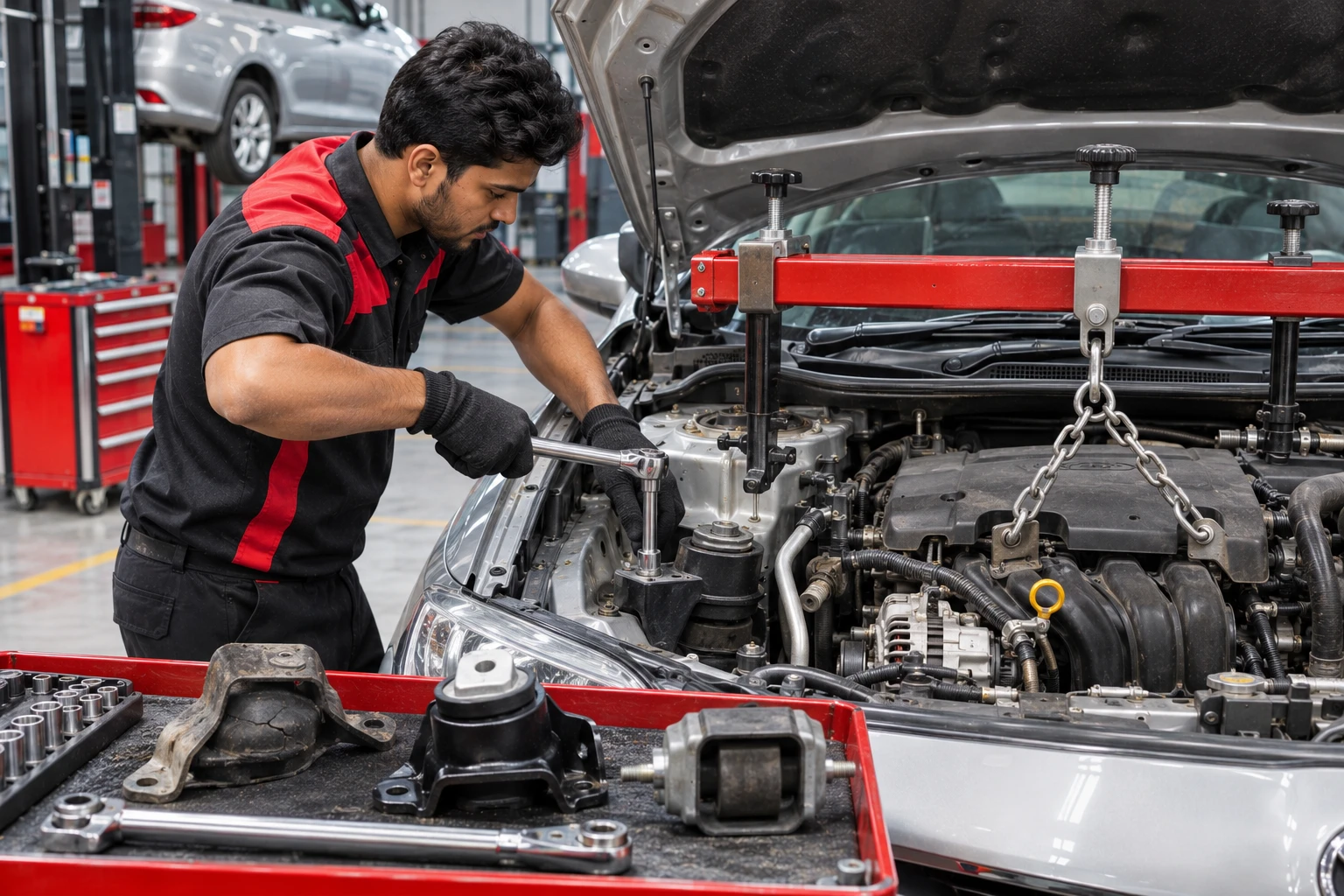
Engine support and mounting preparation
Damaged engine mount removal
Engine mounting bracket inspection
Replacement mount installation
Manufacturer-specified fastener tightening
Engine positioning verification
Post-replacement vibration assessment
Mount replacement procedures vary by vehicle model and engine configuration.
The engine and transmission assembly must be appropriately supported before removing a mount that carries part of their weight.
3. Transmission Mount Inspection and Replacement
Transmission mounts, also called gearbox mounts, support the transmission assembly and help manage drivetrain movement.
Our transmission mounting services include:
Transmission mount condition inspection
Gearbox mounting bracket assessment
Transmission mount rubber deterioration checks
Excessive gearbox movement investigation
Mount-related vibration assessment
Damaged mount identification
Transmission mount replacement
Post-installation mounting verification
A worn transmission mount may contribute to vibration or clunking during gear engagement, acceleration, or deceleration.
However, not every gear-related noise or vibration is caused by a transmission mount.
4. Engine Vibration Diagnostics
Excessive vibration while the engine is idling can make a vehicle uncomfortable to drive.
Engine mounting deterioration is one possible cause, but engine misfires, rough idle, exhaust contact, and other faults may produce similar symptoms.
Our diagnostic assessment includes:
Engine idle vibration evaluation
Mounting system condition checks
Engine movement inspection
Vibration in Drive or Reverse investigation
Cabin vibration assessment
Relevant engine running condition evaluation
Mounting bracket and rubber condition inspection
Additional engine diagnostic recommendations where necessary
Accurate diagnosis helps distinguish mount-related vibration from engine performance problems.
5. Hydraulic Engine Mount Inspection
Some vehicles use hydraulic engine mounts containing fluid-filled chambers to provide vibration isolation.
These mounts may deteriorate internally or develop leaks.
Our services include:
Hydraulic mount exterior inspection
Visible fluid leakage assessment
Rubber and metal housing condition checks
Excessive vibration investigation
Hydraulic mount deterioration diagnosis
Compatible hydraulic mount replacement assessment
A hydraulic mount may fail without obvious external leakage.
Mount condition should be evaluated alongside the vehicle's symptoms and manufacturer-specific inspection procedures.
6. Torque Mount and Engine Roll Stop Inspection
Some vehicles use additional torque mounts, also known as torque struts or engine roll stops, to limit drivetrain rotation during acceleration and deceleration.
Our applicable services include:
Torque mount condition assessment
Engine roll movement evaluation
Rubber bushing inspection
Mounting bracket condition checks
Acceleration-related knocking investigation
Torque strut replacement assessment
A damaged torque mount may allow excessive drivetrain movement during changes in engine load.
7. Engine Mount Rubber and Bushing Damage Assessment
Rubber components absorb vibration and accommodate controlled movement.
Over time, heat, aging, fluid contamination, and mechanical stress may contribute to deterioration.
We inspect for:
Cracked mounting rubber
Separated rubber and metal components
Excessive deformation
Hardened or deteriorated rubber
Torn mounting bushings
Collapsed engine mounts
Mounting bracket damage
Oil contamination affecting rubber components
Some mounts contain bonded rubber assemblies that must be replaced as complete units when damaged.
8. Engine Knocking and Clunking Noise Investigation
Unusual noises during acceleration, deceleration, or gear engagement may indicate excessive drivetrain movement.
Our diagnostic support includes:
Engine movement-related knocking assessment
Clunking during gear engagement
Acceleration-related mounting noise investigation
Deceleration-related vibration checks
Engine mount bracket inspection
Transmission mounting assessment
Related suspension or drivetrain fault recommendations
Loose suspension components, worn drivetrain joints, exhaust contact, and other mechanical faults can produce similar noises.
A physical inspection is necessary before identifying the cause.
9. Engine Mounting Bracket Inspection and Repair
Engine mounting brackets connect the mounting system to the engine, transmission, or vehicle body.
Damaged or incorrectly installed brackets can affect mount positioning and drivetrain support.
Our services include:
Engine mounting bracket inspection
Transmission mounting bracket assessment
Mounting bolt condition checks
Visible bracket cracking or deformation assessment
Mounting point alignment checks
Bracket replacement recommendations
Mounting hardware inspection
Mounting brackets and fasteners should meet the requirements of the specific vehicle.
Damaged structural mounting points may require specialized repair procedures.
10. Excessive Engine Movement During Acceleration
The engine and transmission naturally experience controlled movement during acceleration and deceleration.
Worn mounts may allow this movement to become excessive.
Possible symptoms include:
Sudden engine movement under load
Clunking during acceleration
Vibration when releasing the accelerator
Unusual movement during gear engagement
Excessive drivetrain rocking
Our inspection evaluates the mounting system and relevant related components.
Any dynamic testing must be performed using appropriate safety precautions and manufacturer-approved procedures.
11. Engine Mount Replacement After Collision Damage
A vehicle involved in an accident may develop damaged mounting brackets, misaligned components, or excessive drivetrain movement.
Our applicable inspection services include:
Engine mounting condition checks after impact
Transmission mounting inspection
Mounting bracket damage assessment
Visible mounting point alignment checks
Rubber mount condition evaluation
Replacement requirements identification
If an accident has affected the vehicle's structural mounting points or subframe, specialized structural inspection may be required before fitting replacement mounts.
12. Hybrid Vehicle Engine Mount Inspection
Hybrid vehicles equipped with gasoline engines also use engine mounting systems.
However, their vibration behavior may differ because the gasoline engine can start and stop automatically during normal operation.
Our applicable hybrid engine mounting services include:
Hybrid engine mount condition assessment
Engine start-stop vibration investigation
Hybrid drivetrain mounting inspection
Engine mount rubber condition checks
Excessive engine movement evaluation
Mounting bracket inspection
Compatible engine mount replacement assessment
Common compatible models include:
Toyota Corolla Axio Hybrid
Toyota Prius
Toyota Aqua
Toyota Noah Hybrid
Toyota Voxy Hybrid
Honda Grace Hybrid
Honda Vezel Hybrid
Some hybrid vehicles use integrated transaxle assemblies instead of conventional transmission configurations.
Mounting arrangements and replacement procedures must follow the specifications of the exact vehicle.
Common Signs of Bad Engine Mounts
Your car may need engine mount inspection if you notice:
Excessive vibration while idling
Increased vibration inside the passenger cabin
Knocking when accelerating
Clunking when shifting between Drive and Reverse
Unusual vibration when the air conditioner is operating
Visible excessive engine movement
Vibration during acceleration or deceleration
Increased noise transmitted into the cabin
Cracked or separated mounting rubber
Visible hydraulic mount fluid leakage
Engine or transmission mounting components appearing damaged
These symptoms may have multiple causes and should be evaluated through appropriate diagnosis.
Common Signs of a Bad Transmission Mount
A worn transmission mount may produce:
Excessive drivetrain movement
Clunking when engaging a gear
Vibration during acceleration
Unusual vibration while idling in gear
Knocking during changes in engine load
Visible mount rubber deterioration
Transmission mounting bracket movement
A defective transmission mount does not automatically mean the transmission itself is damaged.
Similarly, internal transmission faults should not be diagnosed as mount problems without supporting inspection findings.
Engine Mount vs Transmission Mount: What's the Difference?
Although these components have related functions, they support different parts of the drivetrain.
Engine Mount
An engine mount secures and supports the engine assembly.
Its functions include:
Supporting engine weight
Limiting engine movement
Reducing vibration transmission
Maintaining appropriate engine positioning
Transmission Mount
A transmission mount supports the transmission or transaxle assembly.
Its functions include:
Supporting the transmission assembly
Reducing drivetrain vibration
Limiting excessive movement
Maintaining appropriate drivetrain positioning
Torque Mount
A torque mount or torque strut helps control drivetrain rotation during changes in engine load.
Depending on vehicle design, these components work together to provide stable engine and transmission support.
What Causes Engine Mounts to Fail?
Engine and transmission mounts can deteriorate for several reasons.
Age and Material Deterioration
Rubber and hydraulic damping components can lose their original properties over time.
Heat Exposure
Repeated exposure to engine-bay temperatures can contribute to rubber deterioration.
Oil or Fluid Contamination
Leaking engine oil or other fluids may degrade certain rubber mounting components.
Excessive Engine Movement
Engine performance problems or damaged related mounts may place additional stress on the mounting system.
Road Impacts
Severe road impacts or accidents may damage brackets or mounting points.
Previous Incorrect Installation
Improper component selection, incorrect alignment, or unsuitable tightening procedures may affect mount performance and durability.
Can a Bad Engine Mount Cause Vibration?
Yes. A worn or damaged engine mount can transfer more engine vibration to the vehicle body.
However, excessive vibration may also result from:
Engine misfires
Rough idle
Damaged exhaust mounting components
Transmission-related problems
Worn suspension or drivetrain components
Incorrect engine operating conditions
Other mechanical faults
The source of vibration must be identified before recommending mount replacement.
Is It Safe to Drive With a Bad Engine Mount?
The risk depends on the severity and nature of the damage.
A mildly worn mount may initially cause increased vibration or noise.
A severely damaged mount can allow excessive drivetrain movement and place additional stress on nearby hoses, wiring, exhaust components, and other connected parts.
If a mount is broken, the drivetrain is visibly displaced, or the vehicle produces severe knocking or movement, arrange professional inspection before continued driving.
Engine Mount Repair vs Replacement
In many modern vehicles, engine mounts are supplied as complete bonded rubber, hydraulic, or electronically controlled assemblies.
When Limited Repair May Be Suitable
Minor issues involving surrounding components may sometimes be corrected without replacing the entire mount.
Examples include:
A loose serviceable mounting connection
A damaged replaceable mounting bracket
Incorrectly positioned associated components
An installation-related issue that can be corrected safely
When Mount Replacement Is Recommended
Replacement is generally appropriate when:
Rubber is cracked or separated.
The mount has collapsed.
Hydraulic fluid has leaked from a defective mount.
The mount is structurally damaged.
The mounting assembly no longer controls movement correctly.
The manufacturer specifies assembly replacement.
Repairing deteriorated bonded rubber or damaged hydraulic mounts using improvised methods is not a reliable substitute for suitable replacement.
Should All Engine Mounts Be Replaced Together?
Not necessarily.
Whether one or multiple mounts should be replaced depends on:
The condition of each mount
The vehicle's mounting arrangement
Manufacturer recommendations
The severity of deterioration
Relevant labor requirements
The results of inspection
Replacing every mount without confirming its condition may create unnecessary expense.
However, multiple mounts can deteriorate over time, so inspecting the full mounting system is advisable when one mount has failed.
Our Engine Mount and Transmission Mount Replacement Process
Step 1: Initial Vehicle Assessment
We review vibration complaints, unusual noises, driving conditions, and previous repair history.
Step 2: Engine and Transmission Mount Inspection
Relevant mounting components, rubber isolators, brackets, and visible connections are inspected.
Step 3: Vibration and Movement Diagnostics
Appropriate diagnostic procedures are used to evaluate engine movement, transmission movement, and vibration characteristics.
Step 4: Fault Identification
The inspection findings are reviewed to identify damaged mounts or related mechanical problems.
Step 5: Replacement Recommendation
We explain which mount requires attention and whether additional related components should be inspected or replaced.
Step 6: Engine or Transmission Support
The affected engine or transmission assembly is secured with suitable professional support equipment before removing a load-bearing mount.
Step 7: Mount Removal and Replacement
The damaged mount is removed, and a compatible replacement is installed using appropriate procedures and specified mounting hardware.
Step 8: Final Verification
Mount positioning, secure installation, relevant vibration behavior, and drivetrain movement are evaluated after the repair.
Engine Mount Replacement for Popular Car Brands
We provide relevant engine mounting and transmission mounting inspection support for commonly driven vehicles in Bangladesh.
Toyota Engine Mount Replacement
Toyota Corolla
Toyota Corolla Axio
Toyota Premio
Toyota Allion
Toyota Prius
Toyota Aqua
Toyota Noah
Toyota Voxy
Honda Engine Mount Replacement
Honda Civic
Honda Grace
Honda Fit
Honda Vezel
Honda City
Nissan Engine Mount Replacement
Nissan X-Trail
Nissan Note
Nissan Serena
Nissan Sunny
Mitsubishi Engine Mount Replacement
Mitsubishi Outlander
Mitsubishi Lancer
Mitsubishi Pajero
Hyundai Engine Mount Replacement
Hyundai Tucson
Hyundai Elantra
Hyundai Sonata
Mounting design, mount quantity, compatibility, and replacement procedures vary according to vehicle model, engine type, transmission configuration, trim level, and production year.
Why Choose Rinors Motors?
Experience in automotive maintenance and repair
Engine vibration diagnostic support
Engine mount condition inspection
Transmission and gearbox mounting assessment
Rubber and hydraulic mount damage identification
Drivetrain movement troubleshooting
Japanese and hybrid vehicle servicing support
Vehicle-specific replacement part identification
Inspection-based repair recommendations
Automotive replacement parts and maintenance assistance
How to Maintain Your Car's Engine Mounting System
Although engine mounts typically do not have a regular lubrication or adjustment schedule, appropriate maintenance can help identify related problems.
Recommended practices include:
Investigate unusual engine vibrations promptly.
Have excessive engine movement inspected.
Address engine oil leaks that may contaminate rubber mounts.
Avoid ignoring repeated clunking during acceleration.
Inspect mounting components after severe road impacts.
Maintain proper engine operation and address rough-idle problems.
Use compatible replacement mounts.
Follow manufacturer-specified installation procedures.
Have mounting brackets inspected after collision damage.
Check related mounting components when replacing a failed mount.
Frequently Asked Questions
Why Is My Car Vibrating While Idling?
Possible causes include worn engine mounts, engine misfires, rough idle, or other mechanical faults.
A proper inspection is needed to identify the source.
How Do I Know If My Engine Mount Is Bad?
Common signs include excessive idle vibration, knocking during acceleration, increased engine movement, and visibly deteriorated mounting rubber.
Can a Bad Transmission Mount Cause Jerking?
A worn transmission mount may contribute to clunking or noticeable movement during changes in drivetrain load.
However, actual transmission shifting problems may have different causes and should be diagnosed separately.
Can Engine Mounts Be Repaired?
Some surrounding brackets or mounting issues may be serviceable, but many damaged rubber or hydraulic engine mounts require complete replacement.
How Long Do Engine Mounts Last?
Service life depends on mount design, material, vehicle conditions, heat exposure, engine performance, and operating environment.
There is no single replacement interval for every vehicle.
Do I Need to Replace All Engine Mounts?
Not always. Replacement decisions should be based on inspection findings and manufacturer recommendations.
Can Bad Engine Mounts Cause Cabin Noise?
Yes. Deteriorated mounts can transmit more vibration and noise from the drivetrain into the passenger cabin.
Do Hybrid Cars Have Engine Mounts?
Yes. Hybrid vehicles equipped with gasoline engines have mounting systems that support the engine and related drivetrain components.
Is Engine Mount Replacement a Major Repair?
Repair complexity varies by vehicle design and mount location.
Some mounts are relatively accessible, while others may require significant component removal and specialized support equipment.
Why Does My Car Vibrate More in Drive Than in Neutral?
Engine load and drivetrain positioning may change when a gear is engaged, making mount-related vibration more noticeable.
However, rough idle, transmission faults, and other mechanical problems may produce similar symptoms.
Book Your Car Engine Mount and Transmission Mount Replacement Service
If your vehicle is experiencing excessive engine vibration, unusual knocking sounds, excessive drivetrain movement, or suspected damaged engine and transmission mounts, contact Rinors Motors for professional inspection and replacement assistance in Bangladesh.
We help assess engine mounting condition, identify vibration-related faults, and recommend suitable engine mount or transmission mount replacement solutions based on your vehicle's requirements.
Restore proper drivetrain support, reduce unwanted vibration, and maintain comfortable driving through appropriate engine mount and transmission mount inspection and replacement.