Wheel Alignment & Balancing
Car Wheel Alignment And Balancing
Professional car wheel alignment and balancing services in Bangladesh. Rinors Motors provides wheel alignment checks, toe and camber inspection, steering wheel alignment assessment, computerized wheel balancing, tire vibration diagnosis, and uneven tire wear troubleshooting for Japanese, hybrid, and other vehicles.
About this service
Professional Car Wheel Alignment and Balancing in Bangladesh
Is your car pulling to one side, experiencing steering wheel vibration, showing uneven tire wear, or feeling unstable while driving?
At Rinors Motors, we provide car wheel alignment and balancing services to help identify wheel positioning problems, tire imbalance, steering irregularities, and handling concerns for Japanese, hybrid, and other commonly driven vehicles in Bangladesh.
Proper wheel alignment and tire balancing contribute to comfortable driving, stable vehicle handling, consistent tire contact, and improved tire wear characteristics.
Bangladesh's road conditions, potholes, speed bumps, and frequent urban driving can expose steering, suspension, and wheel-related problems.
Our approach focuses on inspecting the relevant components and identifying the cause of alignment or vibration complaints before recommending adjustments, balancing, or additional repairs.
Our Car Wheel Alignment and Balancing Services
1. Computerized Wheel Alignment
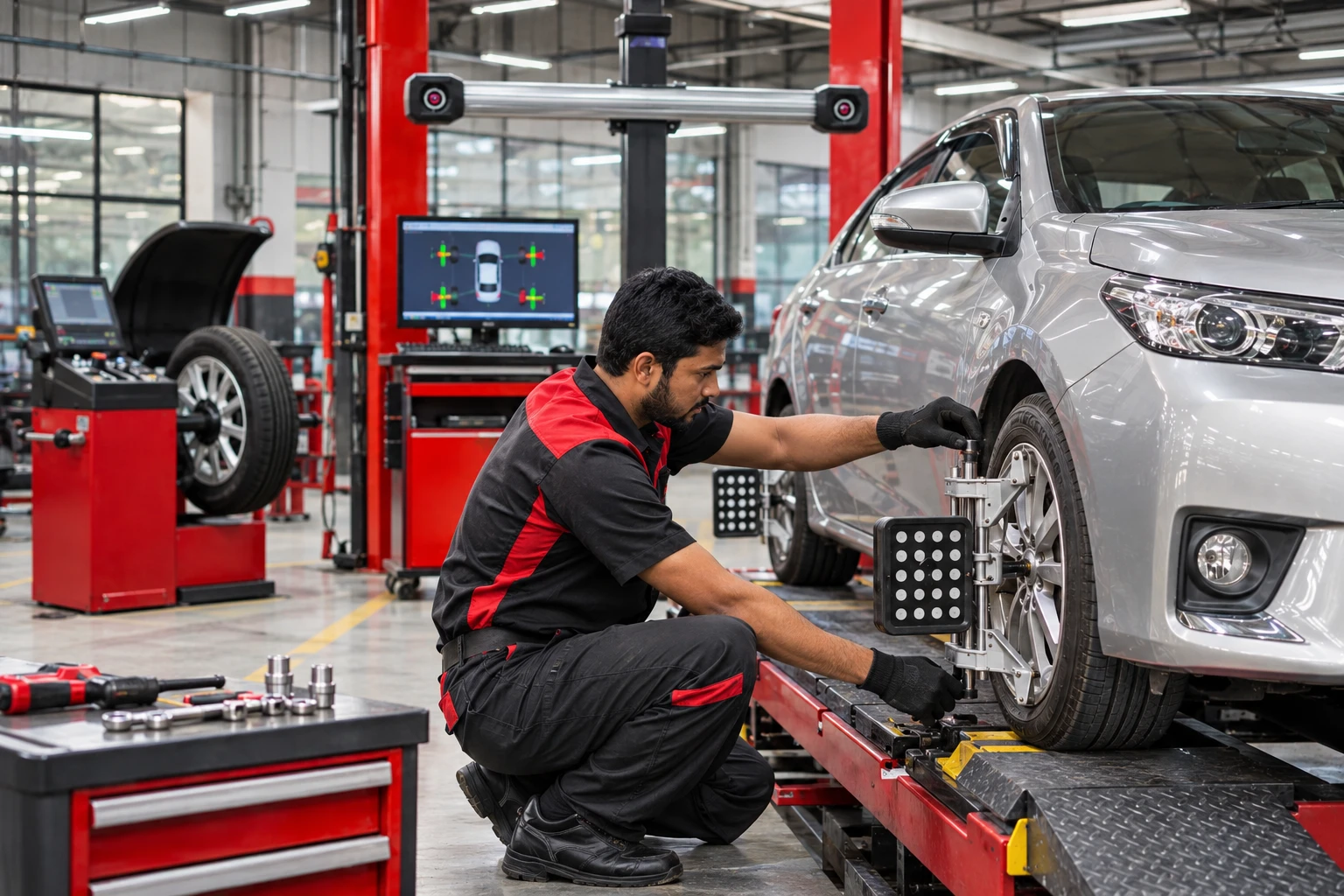
Wheel alignment involves checking and, where supported, adjusting the angles of the wheels relative to the vehicle and the manufacturer's specifications.
Our applicable services include:
Front wheel alignment inspection
Four-wheel alignment assessment
Wheel toe measurement and adjustment
Camber angle assessment
Caster angle evaluation
Steering wheel centering checks
Alignment specification comparison
Post-adjustment alignment verification
Not all wheel angles are adjustable on every vehicle. Adjustment capabilities depend on suspension design and manufacturer specifications.
2. Front and Rear Wheel Alignment
Both front and rear wheel positioning can affect vehicle handling and tire wear.
Depending on vehicle design, our services may include:
Front axle alignment inspection
Rear axle alignment measurement
Front toe adjustment
Rear toe adjustment where supported
Rear camber assessment
Thrust angle evaluation
Steering wheel position verification
Four-wheel geometry assessment
Some vehicles require inspection or repair of damaged suspension components before correct alignment can be achieved.
3. Computerized Wheel Balancing
Wheel balancing is used to correct uneven mass distribution in a wheel and tire assembly.
Imbalance may cause vibration that becomes noticeable at particular driving speeds.
Our balancing-related services include:
Wheel and tire imbalance assessment
Computerized dynamic wheel balancing
Wheel balance weight inspection
Suitable balancing weight installation
Front and rear wheel balancing
Wheel vibration investigation
Post-balancing verification
Balancing should be performed using suitable equipment and correct wheel mounting procedures.
4. Steering Wheel Alignment and Vehicle Pulling Diagnosis
A steering wheel that does not remain centered while driving straight may indicate an alignment or steering-related issue.
We investigate:
Off-center steering wheel position
Vehicle pulling left or right
Steering response irregularities
Uneven front tire wear
Steering linkage condition
Relevant suspension geometry
Tire pressure differences
Other possible causes of directional pull
Vehicle pulling is not always caused by alignment. Tire condition, braking faults, and suspension damage can also contribute.
5. Toe, Camber and Caster Inspection
Three important wheel alignment angles are toe, camber, and caster.
Toe Alignment
Toe describes the direction the wheels point relative to the vehicle's longitudinal centerline when viewed from above.
Incorrect toe settings can cause rapid or irregular tire wear and affect straight-line handling.
Camber Alignment
Camber describes the inward or outward tilt of a wheel when viewed from the front or rear of the vehicle.
Excessive positive or negative camber can affect tire contact and wear patterns.
Caster Alignment
Caster describes the steering axis inclination when viewed from the side.
Caster influences steering stability, return-to-center behavior, and directional handling.
Wheel angles must be evaluated against the specifications for the vehicle being serviced.
6. Tire Vibration and Wheel Imbalance Diagnostics
Unusual vibration may result from wheel imbalance, damaged tires, bent wheels, suspension wear, or other mechanical problems.
Our inspection services include:
Steering wheel vibration assessment
Speed-related vibration investigation
Tire and wheel condition checks
Visible wheel rim damage inspection
Tire wear pattern analysis
Wheel balancing assessment
Suspension component inspection recommendations
Additional drivetrain troubleshooting recommendations where needed
Wheel balancing cannot correct every source of vibration. Identifying the actual cause is essential.
7. Uneven Tire Wear Inspection
Uneven tire wear may indicate wheel alignment problems, inflation issues, worn suspension components, or incorrect tire maintenance.
We assess:
Inner-edge tire wear
Outer-edge tire wear
Irregular tread wear patterns
Feathering-related wear
Possible toe misalignment
Possible camber-related wear
Tire pressure condition
Steering and suspension component condition
Correcting wheel alignment may help prevent further alignment-related wear, but it cannot restore tread that has already worn away.
8. Wheel Alignment After Suspension or Steering Repair
Alignment inspection is often appropriate after repairs involving components that influence wheel geometry.
Examples include:
Tie rod replacement
Control arm replacement
Ball joint replacement
Steering rack repairs
Strut replacement where alignment geometry is affected
Suspension component replacement
Relevant collision damage repairs
Alignment requirements depend on the repair procedure and vehicle manufacturer's recommendations.
9. Wheel Alignment for Hybrid Vehicles
Hybrid vehicles require accurate alignment and wheel balancing just like conventional vehicles.
Our applicable service support covers compatible hybrid models, including:
Toyota Corolla Axio Hybrid
Toyota Prius
Toyota Aqua
Toyota Noah Hybrid
Toyota Voxy Hybrid
Honda Grace Hybrid
Honda Vezel Hybrid
Certain vehicles equipped with advanced driver assistance systems may require steering angle calibration or ADAS calibration after specific alignment or suspension procedures.
These requirements should follow manufacturer instructions and use appropriate diagnostic equipment.
Wheel Alignment vs Wheel Balancing: What's the Difference?
Although often performed during the same workshop visit, wheel alignment and wheel balancing are different procedures.
Wheel Alignment
Wheel alignment concerns the positioning and angles of the wheels relative to the vehicle.
Incorrect alignment may contribute to:
Vehicle pulling to one side
Off-center steering wheel
Uneven tire wear
Handling instability
Wheel Balancing
Wheel balancing concerns the distribution of mass around the rotating wheel and tire assembly.
Wheel imbalance may contribute to:
Steering wheel vibration
Vehicle vibration at certain speeds
Reduced driving comfort
Irregular tire wear in some circumstances
A vehicle can need alignment, balancing, both procedures, or neither. Proper inspection helps identify which service is appropriate.
Common Signs Your Car Needs Wheel Alignment or Balancing
Your car may need inspection if you notice:
Vehicle pulling left or right
Steering wheel not centered when driving straight
Steering wheel vibration at certain speeds
Uneven tire tread wear
Abnormal steering response
Vehicle instability while driving
Vibration after installing tires or wheels
Handling changes after hitting a pothole
Steering or suspension repairs completed without alignment verification
If the vehicle pulls sharply, feels difficult to control, or has visible tire or wheel damage, arrange a safety inspection before continued driving.
Our Wheel Alignment and Balancing Process
Step 1: Initial Vehicle Assessment
We review the customer's steering, handling, vibration, and tire wear concerns.
Step 2: Tire and Wheel Inspection
Relevant tires, wheels, inflation pressures, and visible damage are checked.
Step 3: Suspension and Steering Assessment
Components that may affect wheel geometry, such as tie rods, ball joints, and control arms, are assessed where necessary.
Step 4: Alignment Measurement
Suitable alignment equipment is used to compare wheel positioning against applicable manufacturer specifications.
Step 5: Alignment Adjustment
Supported wheel angles are adjusted according to vehicle requirements, where appropriate.
Step 6: Wheel Balancing
If balancing is required, the wheel and tire assembly is checked using a suitable balancing machine, and corrective weights are installed as needed.
Step 7: Final Verification
Relevant alignment readings, wheel balance results, and vehicle operation are checked after servicing.
When Should Wheel Alignment and Balancing Be Checked?
Inspection may be appropriate:
When the steering wheel is visibly off-center
When the car pulls to one side
When tires develop unusual wear patterns
After certain suspension or steering repairs
After a significant impact with a pothole or road obstacle
When speed-related wheel vibration develops
After wheel or tire installation if vibration or other concerns arise
According to the vehicle manufacturer's maintenance recommendations
There is no single alignment or balancing interval that applies to every vehicle.
Car Brands and Models We Service
We provide relevant wheel alignment and balancing support for commonly driven vehicle models in Bangladesh.
Toyota
Toyota Corolla
Toyota Corolla Axio
Toyota Premio
Toyota Allion
Toyota Prius
Toyota Aqua
Toyota Noah
Toyota Voxy
Honda
Honda Civic
Honda Grace
Honda Fit
Honda Vezel
Nissan
Nissan X-Trail
Nissan Note
Nissan Serena
Mitsubishi and Hyundai
Mitsubishi Outlander
Mitsubishi Lancer
Mitsubishi Pajero
Hyundai Tucson
Hyundai Elantra
Hyundai Sonata
Alignment specifications, adjustment procedures, and wheel balancing requirements vary by model, wheel size, suspension design, and production year.
Why Choose Rinors Motors?
Experience in automotive maintenance and repair
Wheel alignment and tire vibration troubleshooting
Steering and suspension inspection support
Vehicle-specific alignment specification assessment
Uneven tire wear investigation
Japanese and hybrid vehicle maintenance support
Inspection-based servicing recommendations
Automotive parts and repair assistance
How to Maintain Proper Wheel Alignment and Tire Balance
Good driving and maintenance practices can help reduce premature tire wear and identify wheel-related issues early.
Consider the following:
Maintain tire pressure according to vehicle specifications.
Avoid striking potholes and road obstacles where possible.
Have unusual steering behavior inspected.
Check tires for uneven wear.
Follow the recommended tire rotation schedule.
Investigate speed-related vibration.
Inspect suspension components after major impacts.
Use suitable wheel and tire combinations.
Follow manufacturer guidance after steering or suspension repairs.
Frequently Asked Questions
Why Is My Car Pulling to One Side?
Possible causes include wheel misalignment, uneven tire pressure, tire defects, braking problems, or worn suspension components.
A proper inspection is required to determine the cause.
Can Wheel Alignment Stop Steering Wheel Vibration?
Wheel alignment may improve certain handling issues, but speed-related vibration is often associated with wheel imbalance, tire defects, or other mechanical faults.
Balancing or additional inspection may be necessary.
Do I Need Wheel Alignment After Replacing Tires?
Replacing tires does not automatically require a wheel alignment.
However, alignment inspection is advisable if the vehicle pulls, the steering wheel is off-center, or abnormal tire wear is present.
Is Four-Wheel Alignment Better Than Front-Wheel Alignment?
Four-wheel alignment evaluates the positioning of both axles. Whether adjustment is possible or required depends on vehicle design and manufacturer specifications.
Can Poor Alignment Damage Tires?
Yes. Incorrect wheel angles can contribute to uneven or accelerated tire wear.
Do Hybrid Cars Need Wheel Balancing?
Yes. Hybrid vehicles require wheel and tire balancing just like conventional vehicles.
Book Your Car Wheel Alignment and Balancing Service
If your vehicle is pulling to one side, showing uneven tire wear, experiencing steering wheel vibration, or developing handling problems, contact Rinors Motors for wheel alignment and balancing assistance in Bangladesh.
We help identify wheel positioning, tire balance, and related suspension concerns to recommend suitable maintenance or repair.
Maintain stable handling, comfortable driving, and more consistent tire wear with appropriate wheel alignment and balancing services.