Fuel System Services
Car Fuel Pump Testing And Replacement
Professional car fuel pump testing and replacement in Bangladesh. Rinors Motors provides fuel pressure diagnostics, electric fuel pump inspection, fuel delivery troubleshooting, fuel pump relay and wiring checks, fuel pump module replacement, and engine no-start diagnosis for Toyota, Honda, Nissan, hybrid, and other vehicles.
About this service
Professional Car Fuel Pump Testing and Replacement in Bangladesh
Is your car having difficulty starting, losing power during acceleration, stalling unexpectedly, or experiencing fuel delivery problems?
At Rinors Motors, we provide professional car fuel pump diagnostics, fuel pressure testing, electric fuel pump inspection, and fuel pump replacement services for Japanese, hybrid, and other commonly driven vehicles in Bangladesh.
The fuel pump is an essential component of your vehicle's fuel delivery system. It supplies fuel from the tank toward the engine at the pressure and flow required by the vehicle's fuel injection system.
A weak, damaged, or malfunctioning fuel pump can contribute to hard starting, engine hesitation, poor acceleration, stalling, and other fuel delivery problems.
However, similar symptoms may also be caused by clogged fuel filters, electrical faults, fuel pressure sensors, injectors, ignition system problems, or engine management issues.
Our diagnostic approach focuses on identifying the actual cause of the problem before recommending fuel pump repair or replacement.
Our Car Fuel Pump Testing and Replacement Services
1. Complete Car Fuel Pump Diagnostics
Fuel pump problems can originate from the electric pump motor, fuel supply restrictions, electrical wiring, relays, control modules, or other related components.
Our applicable diagnostic services include:
Fuel pump operation assessment
Fuel delivery problem investigation
Fuel pump electrical supply testing
Fuel pump connector and wiring inspection
Fuel pressure assessment
Fuel pump activation checks
Relevant diagnostic trouble code scanning
Engine no-start and hard-start investigation
Fuel system performance evaluation
Fuel pump replacement requirement assessment
Accurate diagnosis helps distinguish an actual fuel pump failure from other engine or electrical problems.
2. Fuel Pressure Testing and Diagnostics
Correct fuel pressure is essential for proper fuel delivery.
Insufficient or unstable fuel pressure may contribute to engine hesitation, reduced performance, or starting difficulties.
Our fuel pressure diagnostic services include:
Fuel pressure measurement where supported
Fuel pressure stability assessment
Low fuel pressure investigation
Fuel pressure-related fault code analysis
Fuel pressure sensor data review
Fuel supply restriction assessment
Fuel pump output evaluation
Manufacturer specification comparison
Fuel pressure testing methods vary by vehicle.
Some systems provide dedicated pressure-testing connections, while others require specialized adapters or electronic diagnostic procedures.
High-pressure fuel injection systems require additional safety precautions and suitable equipment.
3. Electric Fuel Pump Testing
Many modern gasoline vehicles use electrically operated fuel pumps located inside the fuel tank.
These pumps are responsible for supplying fuel to the engine's fuel delivery system.
Our applicable services include:
Electric fuel pump function assessment
Fuel pump power supply inspection
Pump motor electrical testing
Fuel pump connector inspection
Fuel pump circuit checks
Pump activation troubleshooting
Pump-related noise investigation
Fuel pump replacement recommendations
A fuel pump that does not operate may be defective, but it may also have a faulty power supply, ground connection, relay, or electronic control circuit.
The electrical system should be inspected before replacing the pump.
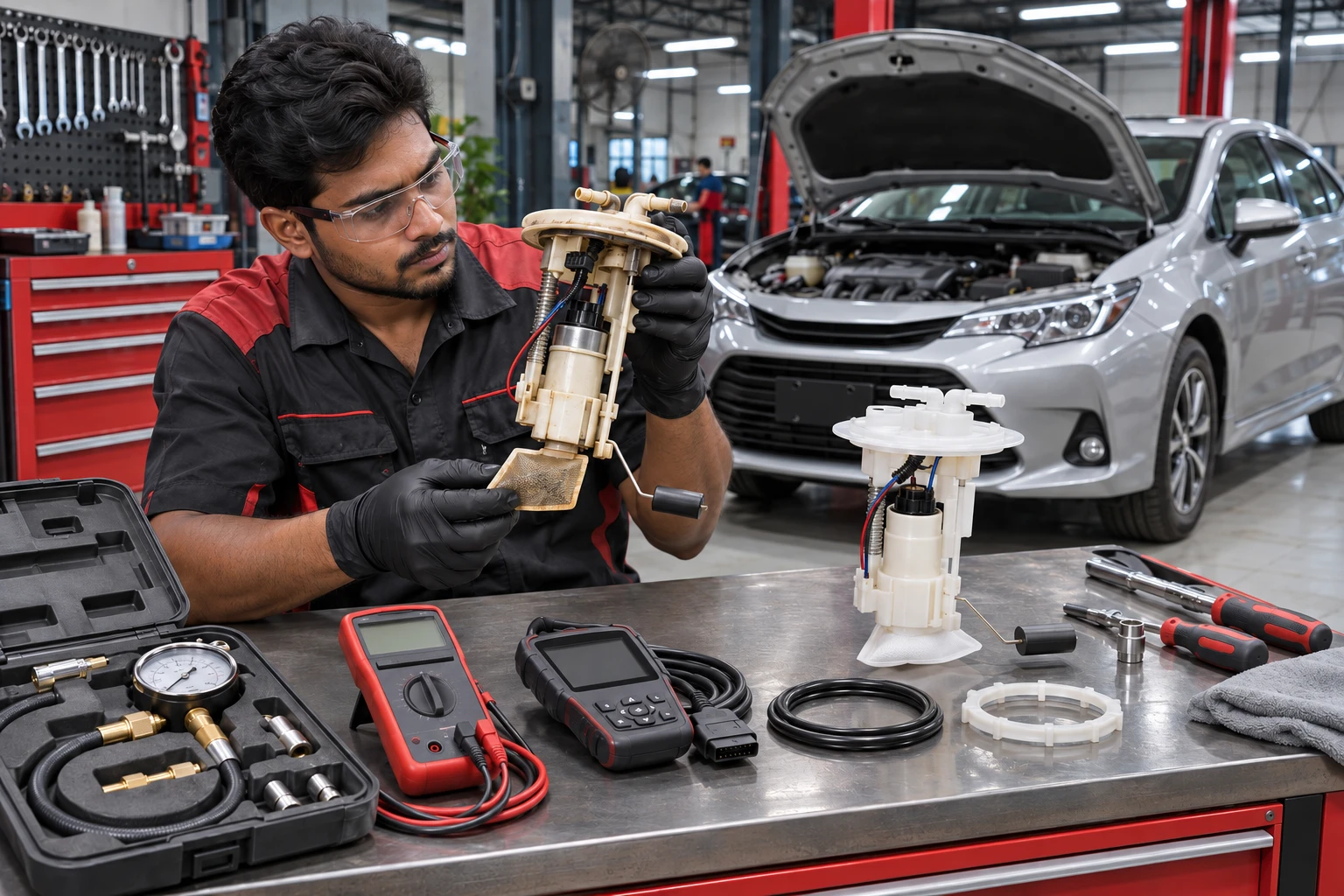
4. In-Tank Fuel Pump Module Replacement
Many modern vehicles use an integrated fuel pump module installed inside the fuel tank.
Depending on the design, the module may contain the electric pump, strainer, fuel level sender, pressure regulation components, and associated connections.
Our applicable replacement services include:
Fuel pump module condition inspection
Compatible replacement module identification
Fuel tank access assessment
Old fuel pump module removal
Fuel pump mounting and sealing inspection
Replacement pump module installation
Electrical connector verification
Fuel line connection inspection
Post-installation leakage checks
Fuel pump access procedures differ between vehicles.
Some models provide an access panel beneath the rear seat or cargo floor, while others require additional disassembly or fuel tank removal.
Manufacturer-specific procedures must be followed.
5. Fuel Pump Relay and Fuse Inspection
A fuel pump may fail to operate because of an electrical control problem.
Our diagnostic services include:
Fuel pump relay testing
Relevant fuse inspection
Fuel pump activation circuit checks
Electrical power supply assessment
Pump ground connection testing
Relay socket and connector inspection
Related wiring fault investigation
Repeated fuse failure or abnormal electrical behavior may indicate an underlying circuit problem that requires diagnosis.
Replacing a fuse without identifying the reason it failed may not resolve the issue.
6. Fuel Pump Wiring and Connector Repair
Fuel pump electrical connections can deteriorate because of corrosion, loose terminals, heat, vibration, or previous electrical modifications.
Our applicable services include:
Fuel pump wiring harness inspection
Electrical connector condition checks
Pump circuit voltage testing
Ground circuit assessment
Electrical continuity testing
Connector corrosion investigation
Wiring damage identification
Electrical repair recommendations
Electrical work near fuel system components requires particular care because fuel vapors can create a fire hazard.
7. Fuel Pump Strainer and Fuel Filter Inspection
Fuel pump strainers and fuel filters help prevent contamination from reaching sensitive fuel system components.
A restricted filter or strainer may reduce fuel flow and contribute to performance problems.
Our services include:
Fuel pump strainer condition assessment
Fuel filter restriction investigation
Fuel contamination inspection
Fuel delivery restriction diagnosis
Fuel filter replacement assessment
Fuel pump module contamination checks
Fuel filter arrangements vary by vehicle.
Some vehicles use a separate serviceable fuel filter, while others incorporate filtration components within the fuel pump module.
8. Engine No-Start and Hard-Start Diagnostics
A malfunctioning fuel pump can prevent the engine from receiving adequate fuel.
However, a no-start condition can have several possible causes.
Our diagnostic assessment considers:
Fuel pump operation
Fuel pressure availability
Fuel pump relay and electrical supply
Engine management faults
Fuel injector control
Ignition system condition
Crankshaft and camshaft sensor-related problems
Battery and starting system performance
Immobilizer or security-related faults
An engine that cranks but does not start should not automatically be diagnosed as having a defective fuel pump.
Proper testing helps avoid unnecessary component replacement.
9. Engine Hesitation and Acceleration Problems
A weak fuel pump or restricted fuel supply may become more noticeable when the engine requires additional fuel.
Possible symptoms include:
Engine hesitation during acceleration
Reduced power under load
Inconsistent engine performance
Engine stumbling
Poor throttle response
Stalling under certain driving conditions
Our applicable inspection includes fuel pressure assessment, fuel pump operation checks, and relevant engine diagnostics.
Other potential causes, such as ignition faults, airflow problems, and transmission-related issues, may also need to be considered.
10. Fuel Pump Noise Investigation
Some electric fuel pumps produce an audible operating sound.
However, an unusually loud whining, buzzing, or intermittent noise may indicate a problem.
Our diagnostic support includes:
Fuel pump noise assessment
Pump operation checks
Fuel delivery performance investigation
Pump mounting condition inspection
Relevant electrical fault assessment
Fuel supply restriction evaluation
A change in fuel pump noise is not enough by itself to confirm pump failure.
Further testing is necessary.
11. Fuel Pressure Regulator Diagnostics
Fuel pressure regulation helps maintain appropriate fuel delivery conditions.
Depending on the vehicle, pressure regulation may be integrated into the fuel pump module, fuel rail, or electronic fuel delivery controls.
Our applicable services include:
Fuel pressure regulation assessment
Abnormal fuel pressure investigation
Fuel pressure sensor data analysis
Fuel pressure-related diagnostic checks
Pressure regulator replacement assessment
Related electrical control inspection
The location and operation of pressure regulation components vary by engine design.
12. Gasoline Direct Injection High-Pressure Pump Inspection
Some modern gasoline engines use direct injection systems that include a high-pressure fuel pump driven by the engine.
This component is different from the electric low-pressure pump commonly installed inside the fuel tank.
Our applicable diagnostic support may include:
Direct-injection fuel pressure fault investigation
Low-pressure supply assessment
High-pressure fuel system diagnostic data review
Fuel pressure control fault evaluation
High-pressure pump-related trouble code analysis
Manufacturer-specific replacement assessment
Important: Gasoline direct-injection high-pressure systems can retain dangerous pressure after the engine is switched off. Testing or replacing these components requires specialized procedures, equipment, and training.
Conventional low-pressure fuel pump testing methods are not automatically suitable for high-pressure injection systems.
13. Fuel Pump-Related Check Engine Light Diagnostics
Fuel system and fuel pressure problems may trigger the Check Engine Light.
Relevant diagnostic trouble codes can include:
P0087: Fuel Rail/System Pressure Too Low
P0088: Fuel Rail/System Pressure Too High
P0191: Fuel Rail Pressure Sensor Circuit Range/Performance
P0230: Fuel Pump Primary Circuit Malfunction
P0231: Fuel Pump Secondary Circuit Low
P0232: Fuel Pump Secondary Circuit High
These are general OBD-II descriptions. Code availability and exact diagnostic interpretation depend on the vehicle.
A code relating to fuel pressure or fuel pump circuitry does not automatically mean that the pump itself requires replacement.
Electrical testing, fuel pressure checks, sensor analysis, and related diagnostics may be necessary.
14. Hybrid Vehicle Fuel Pump Diagnostics
Hybrid vehicles equipped with gasoline engines also require fuel delivery systems.
Depending on the design, they may use electric in-tank fuel pumps and additional fuel system components.
Our applicable hybrid fuel pump diagnostic support includes:
Hybrid gasoline engine fuel delivery assessment
Low-pressure electric fuel pump checks
Fuel pump-related fault code investigation
Hybrid engine hard-start diagnosis
Fuel pressure-related troubleshooting
Fuel pump electrical circuit inspection
Compatible replacement pump assessment
Common vehicle examples include:
Toyota Corolla Axio Hybrid
Toyota Prius
Toyota Aqua
Toyota Noah Hybrid
Toyota Voxy Hybrid
Honda Grace Hybrid
Honda Vezel Hybrid
Hybrid vehicles may automatically start the gasoline engine while in READY mode.
Fuel system servicing must follow manufacturer-specific procedures to prevent unintended engine operation and maintain electrical safety.
Common Signs of a Bad Fuel Pump
Your car may require fuel pump inspection if you notice:
Engine cranking but not starting
Difficulty starting after the vehicle has been parked
Engine hesitation during acceleration
Reduced engine power
Intermittent engine stalling
Inconsistent throttle response
Fuel pressure-related warning codes
Unusual fuel pump noises
Poor engine performance under load
Repeated fuel delivery-related faults
These symptoms may have several possible causes.
A fuel pump should not be replaced solely based on symptoms without appropriate diagnostic confirmation.
How Does a Car Fuel Pump Work?
A fuel pump transfers fuel from the vehicle's fuel tank into the fuel delivery system.
Step 1: Fuel Supply
Fuel is stored inside the vehicle's fuel tank.
Step 2: Fuel Pump Activation
Depending on the vehicle, the engine control system activates the electric fuel pump when required.
Step 3: Fuel Delivery
The pump supplies fuel through the vehicle's fuel lines and applicable filtration components.
Step 4: Fuel Pressure Regulation
The fuel system regulates pressure according to the engine's requirements.
Step 5: Fuel Injection
Fuel injectors deliver the required quantity of fuel for engine combustion.
The exact operating process depends on whether the vehicle uses port fuel injection, gasoline direct injection, or another fuel system configuration.
Low-Pressure Fuel Pump vs High-Pressure Fuel Pump
These components perform related but different functions.
Low-Pressure Fuel Pump
A low-pressure pump generally transfers fuel from the tank toward the engine's fuel delivery system.
Many gasoline vehicles use an electric in-tank pump.
High-Pressure Fuel Pump
Some gasoline direct-injection engines use a separate high-pressure pump to supply fuel at substantially higher pressure to the direct-injection system.
Why the Difference Matters
Each pump has different operating conditions, testing requirements, and potential failure symptoms.
Using the wrong testing or replacement procedure can damage components or create serious safety hazards.
Fuel Pump vs Fuel Injector: What's the Difference?
Fuel Pump
The fuel pump supplies fuel to the engine's injection system.
A pump problem may affect the fuel supply available to multiple cylinders.
Fuel Injector
A fuel injector meters and delivers fuel according to the engine management system's commands.
An injector problem may affect a particular cylinder or the overall engine operation, depending on the fault.
Fuel Filter
A fuel filter helps remove contamination from the fuel before it reaches sensitive components.
Restrictions in the fuel supply system may resemble fuel pump failure.
Testing the complete system helps identify the affected component.
What Causes a Fuel Pump to Fail?
Fuel pump deterioration can have several causes.
Normal Wear and Aging
The pump's internal electrical and mechanical components may deteriorate over time.
Fuel Contamination
Water, dirt, or other contaminants may damage the pump or restrict its fuel intake.
Electrical Problems
Poor connections, faulty wiring, inadequate power supply, or control circuit faults may affect pump operation.
Fuel Supply Restrictions
A blocked strainer or restricted filter can interfere with fuel delivery.
Heat and Operating Conditions
Operating conditions, inadequate fuel supply, and other factors may contribute to pump stress, depending on the pump design.
Improper Installation
Incorrect replacement parts, damaged seals, or unsuitable installation procedures can lead to fuel delivery problems or leakage.
Fuel Pump Repair vs Replacement: Which Is Better?
Not every fuel pump-related problem requires replacing the pump assembly.
When Repair May Be Suitable
Repair may be possible when the problem involves:
A damaged electrical connector
A serviceable wiring fault
A faulty relay
A restricted replaceable fuel filter
A serviceable fuel line connection
Another related component that can be repaired safely
When Replacement May Be Necessary
Fuel pump replacement may be recommended when:
The electric pump motor has failed.
Internal pump components are damaged.
Fuel delivery remains insufficient despite other faults being excluded.
The pump assembly is severely deteriorated.
The pump cannot be reliably repaired.
Manufacturer procedures require replacement.
Many modern electric in-tank pumps are supplied as sealed or integrated units that are generally replaced rather than internally repaired.
Should the Entire Fuel Pump Module Be Replaced?
The answer depends on the vehicle and the nature of the fault.
Some fuel pump modules allow certain internal components to be replaced separately.
Others are designed to be replaced as complete assemblies.
The decision should consider:
Manufacturer recommendations
Pump module design
Availability of compatible parts
Condition of the fuel level sender
Condition of the strainer and internal connections
Module sealing requirements
Reliability and overall repair cost
Replacing the entire module is not automatically necessary for every fuel pump-related problem.
Our Car Fuel Pump Testing and Replacement Process
Step 1: Initial Vehicle Assessment
We review the customer's complaints, including starting problems, engine hesitation, stalling, and fuel delivery-related warning lights.
Step 2: Diagnostic Code Scanning
Relevant engine and fuel system fault codes are checked where appropriate.
Step 3: Electrical System Inspection
Fuel pump power supply, ground connections, relays, fuses, and control circuits are assessed as necessary.
Step 4: Fuel Pressure and Delivery Assessment
Appropriate fuel pressure or delivery-related diagnostic procedures are performed according to the vehicle's fuel system design.
Step 5: Fault Identification
The results are reviewed to determine whether the fault involves the fuel pump, electrical system, fuel restrictions, pressure regulation, or another component.
Step 6: Repair or Replacement Recommendation
We explain whether electrical repair, related component maintenance, fuel pump replacement, or further diagnostics are necessary.
Step 7: Approved Fuel Pump Service
The agreed work is completed using compatible replacement components and manufacturer-appropriate safety procedures.
Step 8: Final Verification
The serviced system is checked for fuel leakage, electrical operation, relevant fuel pressure concerns, and engine starting or running performance.
Car Fuel Pump Services for Popular Vehicle Brands
We provide applicable fuel pump inspection and replacement support for vehicles commonly driven in Bangladesh.
Toyota Fuel Pump Services
Toyota Corolla
Toyota Corolla Axio
Toyota Premio
Toyota Allion
Toyota Prius
Toyota Aqua
Toyota Noah
Toyota Voxy
Honda Fuel Pump Services
Honda Civic
Honda Grace
Honda Fit
Honda Vezel
Honda City
Nissan Fuel Pump Services
Nissan X-Trail
Nissan Note
Nissan Serena
Nissan Sunny
Mitsubishi Fuel Pump Services
Mitsubishi Outlander
Mitsubishi Lancer
Mitsubishi Pajero
Hyundai Fuel Pump Services
Hyundai Tucson
Hyundai Elantra
Hyundai Sonata
Fuel pump design, fuel pressure requirements, electrical controls, and replacement part compatibility vary by engine type, model, trim level, and production year.
Why Choose Rinors Motors?
Experience in automotive maintenance and repair
Fuel pump diagnostic support
Fuel pressure-related troubleshooting
Engine hard-start and no-start diagnosis
Electric fuel pump circuit inspection
Fuel pump relay and wiring assessment
Fuel pump module replacement support
Japanese and hybrid vehicle maintenance assistance
Vehicle-specific replacement part identification
Inspection-based repair recommendations
How to Maintain Your Car's Fuel Delivery System
Appropriate maintenance can help reduce the risk of certain fuel system problems.
Recommended practices include:
Use fuel that meets the vehicle manufacturer's requirements.
Follow the recommended fuel filter replacement schedule where applicable.
Investigate repeated hard-starting problems.
Have persistent fuel pressure-related faults diagnosed.
Address fuel contamination concerns promptly.
Avoid ignoring unusual fuel pump noises.
Repair damaged electrical connections.
Use compatible fuel pump replacement components.
Follow manufacturer recommendations for fuel system maintenance.
Arrange immediate inspection if fuel leakage is suspected.
Fuel pump replacement should be based on actual system condition and diagnostic findings rather than an assumed universal mileage interval.
Frequently Asked Questions
What Are the Symptoms of a Bad Car Fuel Pump?
Possible symptoms include engine cranking without starting, hard starting, hesitation, reduced power, stalling, and fuel pressure-related diagnostic faults.
However, these symptoms can also result from other problems.
Can a Bad Fuel Pump Cause a Car Not to Start?
Yes. A malfunctioning fuel pump may prevent sufficient fuel from reaching the engine.
Other starting system and engine management faults should also be considered.
Can a Weak Fuel Pump Cause Engine Hesitation?
Yes. Inadequate fuel delivery may contribute to engine hesitation or reduced performance, particularly under increased engine load.
Can a Fuel Pump Be Repaired?
Certain related electrical connections or serviceable components may be repaired.
However, many modern electric fuel pumps are sealed assemblies that require replacement when internally defective.
How Long Does a Car Fuel Pump Last?
Fuel pump service life varies with pump design, operating conditions, fuel quality, electrical system condition, and vehicle maintenance.
There is no universal replacement interval for every vehicle.
Does a P0230 Code Mean the Fuel Pump Is Bad?
Not necessarily.
P0230 generally indicates a fuel pump primary circuit malfunction.
The problem may involve wiring, a relay, a control circuit, or the pump itself.
Can a Clogged Fuel Filter Cause Fuel Pump Symptoms?
Yes. A restricted fuel filter may reduce fuel flow and cause symptoms resembling fuel pump failure.
Can a Bad Fuel Pump Increase Fuel Consumption?
Certain fuel delivery or engine management problems can affect combustion and vehicle efficiency.
However, replacing a fuel pump does not guarantee improved fuel economy.
Do Hybrid Cars Have Fuel Pumps?
Yes. Hybrid vehicles equipped with gasoline engines use fuel delivery systems and generally have a fuel pump.
The exact system configuration varies by model.
Can I Drive With a Failing Fuel Pump?
A failing fuel pump may cause unexpected stalling or loss of engine power.
If fuel delivery problems are suspected, arrange professional inspection rather than continuing to drive.
Is Fuel Pump Replacement Dangerous?
Fuel system work can involve flammable gasoline, fuel vapors, pressurized connections, and electrical components.
Replacement should be performed using appropriate equipment, ventilation, and manufacturer-specified safety procedures.
Book Your Car Fuel Pump Testing and Replacement Service
If your vehicle is experiencing hard starting, engine hesitation, repeated stalling, reduced acceleration, or suspected fuel pump problems, contact Rinors Motors for professional fuel pump testing and replacement assistance in Bangladesh.
We help investigate fuel delivery faults, assess fuel pump operation, examine relevant electrical circuits, and recommend suitable replacement components when necessary.
Maintain consistent fuel delivery, reliable engine starting, and dependable vehicle performance through appropriate fuel pump diagnostics and replacement services.