Engine & Timing System Services
Car Timing Belt And Timing Chain Inspection And Replacement
Professional car timing belt and timing chain inspection and replacement in Bangladesh. Rinors Motors provides engine timing system diagnostics, timing belt replacement, timing chain assessment, tensioner and guide inspection, camshaft and crankshaft timing checks, and engine timing repair for Toyota, Honda, Nissan, and other compatible vehicles.
About this service
Professional Car Timing Belt and Timing Chain Inspection and Replacement in Bangladesh
Is your car producing rattling noises during engine startup, experiencing rough idling, showing camshaft timing-related fault codes, or approaching its recommended timing belt replacement interval?
At Rinors Motors, we provide professional car timing belt inspection, timing chain diagnostics, engine timing system troubleshooting, and timing component replacement services for Japanese and other commonly driven vehicles in Bangladesh.
The timing belt or timing chain is responsible for maintaining precise synchronization between the engine's crankshaft and camshaft.
This synchronization ensures that engine valves open and close at the correct time relative to piston movement.
Incorrect engine timing can cause poor performance, misfires, starting difficulties, and potentially serious internal engine damage.
Depending on the engine design, a vehicle may use a rubber timing belt, a metal timing chain, or another manufacturer-specific arrangement.
Our service approach focuses on inspecting the engine timing system, identifying component wear or malfunction, and recommending suitable maintenance or replacement procedures according to manufacturer specifications.
Our Car Timing Belt and Timing Chain Services
1. Complete Engine Timing System Inspection
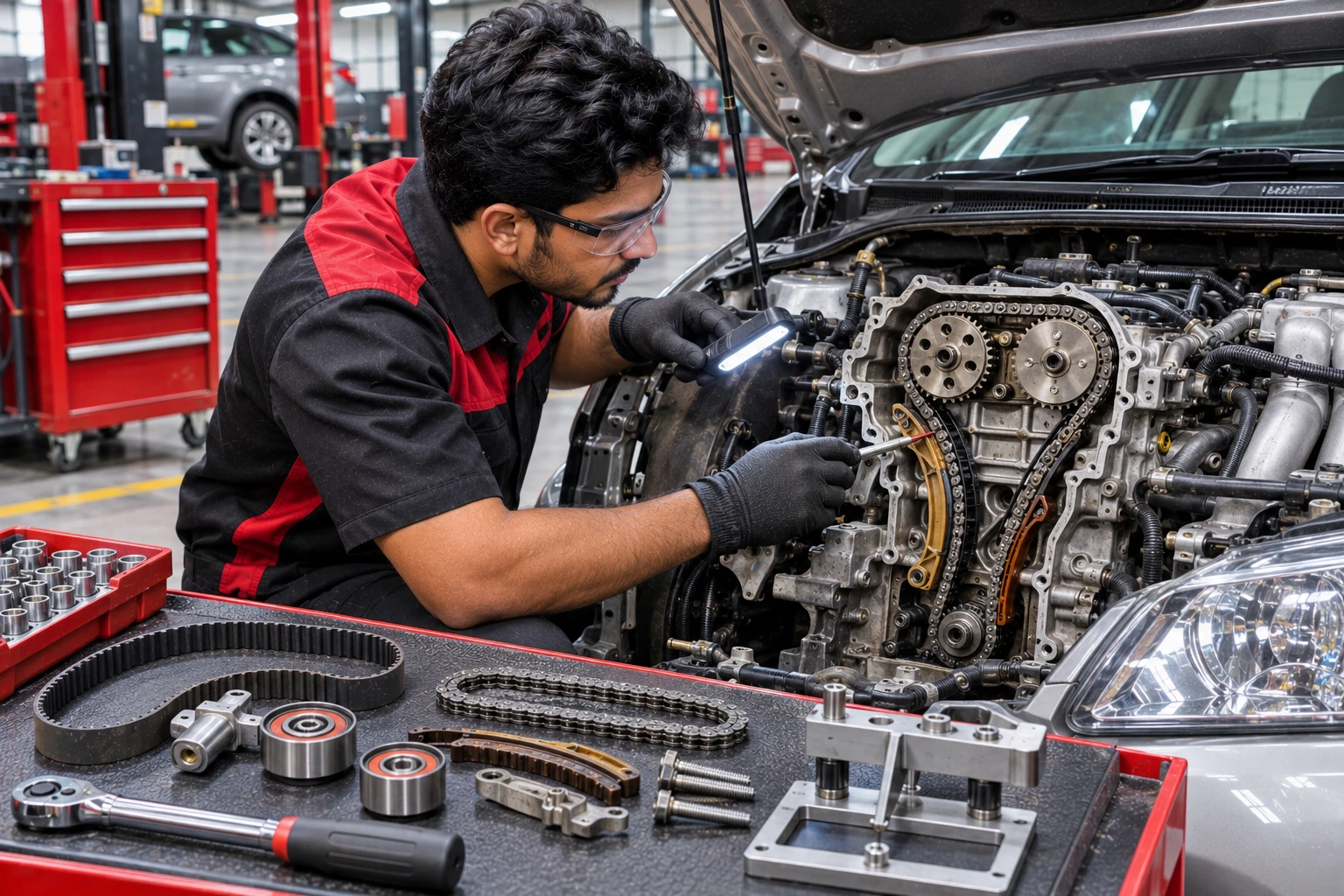
The engine timing system contains several components that work together to coordinate crankshaft and camshaft movement.
Our applicable inspection services include:
Timing belt condition assessment
Timing chain-related diagnostic checks
Timing tensioner inspection
Timing chain guide assessment
Timing belt idler pulley inspection
Camshaft and crankshaft synchronization evaluation
Timing cover condition checks
Engine timing-related noise investigation
Timing system oil leakage assessment
Manufacturer-specific maintenance requirement verification
Some timing components are enclosed inside the engine and cannot be inspected directly without disassembly.
The inspection procedure depends on the engine design, symptoms, and available access.
2. Car Timing Belt Replacement
A timing belt is typically a reinforced toothed belt that maintains synchronization between the crankshaft and camshaft.
Timing belts are subject to material deterioration and wear.
Unlike many timing chains, timing belts commonly have scheduled replacement intervals specified by the vehicle manufacturer.
Our applicable services include:
Timing belt replacement interval verification
Timing belt condition assessment
Timing belt tension inspection
Timing cover removal where required
Existing timing belt removal
Timing sprocket condition checks
Compatible replacement timing belt installation
Timing alignment verification
Manufacturer-specified belt tensioning
Post-replacement engine operation assessment
Timing belt replacement must follow the exact engine manufacturer's procedure.
Incorrect installation may cause valve timing errors or serious mechanical damage.
3. Timing Chain Inspection and Replacement
A timing chain is a metal chain designed to synchronize the engine's crankshaft and camshaft.
Timing chains are generally lubricated by engine oil and are designed for long service life.
However, chains, tensioners, guides, and associated components can still deteriorate or fail.
Our services include:
Timing chain-related noise investigation
Timing chain condition assessment
Chain tensioner inspection
Timing chain guide inspection
Camshaft and crankshaft timing correlation checks
Timing chain wear or elongation assessment
Timing component replacement recommendations
Timing chain replacement where required
Final synchronization verification
A timing chain should not automatically be replaced simply because a vehicle has reached a particular mileage.
Replacement depends on manufacturer requirements, diagnostic findings, and component condition.
4. Timing Belt Tensioner and Idler Pulley Replacement
Timing belt tensioners and idler pulleys help maintain proper belt tension and guide belt movement.
A faulty tensioner or pulley can affect timing belt performance and reliability.
Our applicable services include:
Timing belt tensioner inspection
Idler pulley condition checks
Pulley bearing noise assessment
Belt tracking inspection
Tensioner mounting checks
Timing belt kit replacement recommendations
Compatible tensioner and pulley installation
Post-installation timing verification
When replacing a timing belt, associated serviceable tensioners and pulleys may also need replacement according to the manufacturer's recommended maintenance procedure.
5. Timing Chain Tensioner Inspection
Timing chain tensioners help maintain appropriate chain tension during engine operation.
Depending on the design, they may use hydraulic pressure, spring force, mechanical locking mechanisms, or a combination of systems.
Our applicable services include:
Timing chain tensioner condition assessment
Startup rattling noise investigation
Chain tension-related fault diagnosis
Engine oil pressure-related considerations
Tensioner guide contact inspection
Timing chain tensioner replacement assessment
A malfunctioning chain tensioner may allow excessive chain movement and create rattling noises.
However, similar sounds can originate from other engine components, so diagnosis is essential.
6. Timing Chain Guide Inspection and Replacement
Timing chain guides help control chain movement and maintain its intended path.
Many guides use engineered plastic contact surfaces supported by metal or composite structures.
Over time, guide materials may wear, crack, or break.
Our inspection services include:
Timing chain guide condition checks
Guide rail wear assessment
Broken guide investigation
Chain contact surface inspection
Timing-related rattling diagnosis
Damaged guide replacement
Relevant timing component inspection
Broken guide material may enter the engine lubrication system in certain failure scenarios.
Additional engine inspection may therefore be required.
7. Camshaft and Crankshaft Timing Diagnostics
Correct crankshaft and camshaft synchronization is essential for proper engine operation.
Timing-related faults may result from mechanical wear, incorrect installation, sensor problems, or variable valve timing system malfunctions.
Our diagnostic services include:
Camshaft timing-related fault investigation
Crankshaft and camshaft correlation checks
Relevant OBD-II diagnostic scanning
Engine synchronization problem assessment
Timing alignment verification where accessible
Camshaft position sensor-related diagnosis
Crankshaft position sensor-related diagnosis
Mechanical timing inspection recommendations
A camshaft or crankshaft correlation fault does not automatically prove that the timing belt or chain has failed.
Sensor signals, wiring, engine oil control, and variable valve timing components may require separate testing.
8. Engine Rattling and Timing Chain Noise Diagnostics
Unusual engine rattling, particularly during startup, can sometimes indicate a problem with the timing chain, tensioner, or related components.
Our diagnostic approach considers:
Cold-start rattling noises
Timing cover area noise
Chain tensioner operation
Engine oil level and condition
Timing chain guide deterioration
Camshaft timing-related symptoms
Other possible engine noise sources
A brief noise during startup does not automatically confirm timing chain failure.
However, persistent or severe metallic rattling should be investigated promptly.
9. Timing Belt Oil and Coolant Contamination Inspection
Timing belts are designed to operate under specific conditions.
On engines with conventional dry timing belts, oil or coolant contamination can damage the belt material and reduce reliability.
Our inspection may include:
Timing cover oil leakage assessment
Camshaft seal condition checks
Crankshaft front seal inspection
Coolant leakage investigation
Timing belt contamination assessment
Associated sealing component replacement recommendations
Some modern engines use oil-immersed timing belts specifically designed for operation in engine oil.
These systems require manufacturer-specific belt materials, oil specifications, and service procedures.
10. Water Pump Inspection During Timing Belt Replacement
On certain engines, the timing belt also drives the water pump.
When replacing the timing belt, inspecting or replacing the water pump may be appropriate depending on the vehicle's design and maintenance recommendations.
Our applicable services include:
Water pump condition assessment
Water pump leakage checks
Pump bearing condition inspection
Timing belt-driven water pump replacement assessment
Compatible pump installation
Cooling system inspection after applicable repairs
Not every water pump is driven by the timing belt.
Some engines use accessory belts, timing chains, separate mechanical drives, or electric water pumps.
11. Variable Valve Timing System Diagnostics
Many modern engines use Variable Valve Timing (VVT) systems to adjust camshaft timing according to operating conditions.
A VVT-related problem may sometimes resemble a mechanical timing chain fault.
Our applicable diagnostic support includes:
Camshaft timing performance assessment
VVT-related fault code scanning
Engine oil condition review
Oil control valve-related troubleshooting
Camshaft timing actuator fault investigation
Timing correlation assessment
Mechanical timing fault evaluation
Toyota VVT-i, Honda VTEC-related engine control systems, Nissan variable timing systems, and other technologies differ in design and operation.
Diagnosis must follow the specific engine's configuration.
12. Timing System Repair After Incorrect Timing Installation
Incorrect timing belt or timing chain installation can cause poor engine performance or internal damage.
Possible symptoms include:
Engine failing to start
Engine running roughly
Engine misfires
Reduced power
Timing correlation fault codes
Abnormal engine noise
Our applicable inspection includes mechanical timing verification, relevant diagnostic checks, and assessment of whether further internal engine inspection is necessary.
If an interference engine has experienced timing belt or timing chain failure, internal valve or piston damage may have occurred.
A new belt or chain alone may not restore the engine.
13. Hybrid Vehicle Engine Timing System Inspection
Hybrid vehicles equipped with gasoline engines also use camshaft and crankshaft timing systems.
Many Toyota hybrid gasoline engines use timing chains, but the exact design should be confirmed by engine code and manufacturer information.
Our applicable hybrid engine timing support includes:
Hybrid gasoline engine timing-related diagnostics
Timing chain noise investigation
Camshaft and crankshaft correlation checks
Engine timing-related fault code assessment
Engine oil-related timing system evaluation
Chain tensioner and guide inspection recommendations
Timing component replacement assessment
Compatible vehicle examples may include:
Toyota Corolla Axio Hybrid
Toyota Prius
Toyota Aqua
Toyota Noah Hybrid
Toyota Voxy Hybrid
Honda Grace Hybrid
Honda Vezel Hybrid
Hybrid vehicles can start their gasoline engines automatically while in READY mode.
Manufacturer-specific isolation procedures are necessary before working on engine timing components.
Timing Belt vs Timing Chain: What's the Difference?
Although both components synchronize engine timing, they use different materials and have different maintenance requirements.
Timing Belt
A timing belt generally uses reinforced rubber or another engineered polymer material with precisely formed teeth.
Typical characteristics include:
Toothed belt construction
Often enclosed behind protective covers
Usually requires scheduled replacement where specified
Operates with dedicated tensioners and pulleys
May drive additional components on certain engines
Timing Chain
A timing chain uses metal links and sprockets to synchronize engine components.
Typical characteristics include:
Metal chain construction
Often operates inside the engine
Generally relies on engine lubrication
Uses guides and tensioners
Designed for long service life
Replacement commonly depends on condition and manufacturer instructions
Neither design is automatically trouble-free.
The correct maintenance approach depends on the actual engine.
Common Signs of Timing Belt or Timing Chain Problems
Your vehicle may require timing system inspection if you notice:
Rattling noises near the engine timing cover
Unusual engine noise during startup
Camshaft or crankshaft correlation codes
Engine misfires
Rough engine operation
Engine hesitation or reduced power
Difficulty starting
Unexpected engine stalling
Timing belt replacement interval approaching
Visible timing belt damage where accessible
Abnormal timing chain tensioner noises
Timing-related Check Engine Light warnings
These symptoms may have causes unrelated to the timing belt or timing chain.
Mechanical inspection and appropriate diagnostic testing are necessary.
Important: If severe mechanical timing failure is suspected, avoid repeatedly starting or cranking the engine. On interference engines, incorrect timing can allow pistons and valves to collide, causing significant internal damage.
Does Every Car Have a Timing Belt?
No. Engine timing systems differ significantly between vehicles.
Some engines use:
Timing belts
Timing chains
Gear-driven timing arrangements
Other manufacturer-specific combinations
Even vehicles sold under the same model name may use different timing systems depending on engine code, production year, and market.
For example, two Toyota or Honda models may look similar but have different engines and timing maintenance requirements.
Before recommending a timing belt or timing chain replacement, the exact engine configuration should be confirmed.
When Should a Timing Belt Be Replaced?
Timing belt replacement intervals are specified by the engine manufacturer.
These intervals may be based on:
Vehicle mileage
Time since installation
Operating conditions
Engine design
Belt construction
Manufacturer maintenance requirements
Some engines specify replacement by mileage or years, whichever occurs first.
There is no single replacement interval appropriate for all vehicles.
A timing belt can deteriorate with age even when the vehicle has relatively low mileage.
The correct interval should be verified using the specific engine's maintenance schedule.
When Should a Timing Chain Be Replaced?
Many timing chains do not have a routine scheduled replacement interval.
A timing chain may require attention when diagnostic testing identifies:
Excessive chain wear or elongation
Damaged timing chain guides
Faulty chain tensioners
Persistent timing-related mechanical noise
Confirmed mechanical timing misalignment
Relevant manufacturer-specified replacement requirements
Replacing a timing chain without a confirmed need can create unnecessary repair expense.
What Causes Timing Belt Failure?
Normal Aging and Wear
Belt materials can deteriorate with time and engine operation.
Tensioner or Pulley Failure
A damaged tensioner or pulley can cause incorrect belt tension, tracking problems, or belt damage.
Oil or Coolant Contamination
On dry-belt systems, fluid contamination may damage belt materials.
Incorrect Installation
Improper belt tension or incorrect timing alignment can shorten service life and cause engine damage.
Overdue Maintenance
Operating beyond the manufacturer's replacement schedule can increase the risk of failure.
What Causes Timing Chain Problems?
Chain and Sprocket Wear
Mechanical wear can affect chain condition and synchronization.
Tensioner Problems
A faulty tensioner may allow excessive chain movement.
Guide Deterioration
Damaged guides may affect chain support and operation.
Lubrication Problems
Incorrect engine oil, oil contamination, low oil pressure, or inadequate maintenance may affect chain-driven timing systems.
Mechanical Damage
Related component failure, improper installation, or abnormal engine operating conditions may contribute to timing system faults.
Timing Belt Replacement vs Timing Chain Replacement
The correct service depends on the engine's design and condition.
Timing Belt Replacement
A timing belt is commonly replaced as part of scheduled preventive maintenance.
Associated components such as tensioners, pulleys, seals, and sometimes the water pump may also require attention.
Timing Chain Replacement
A timing chain is commonly inspected or replaced following diagnosis of a timing-related problem or when required by manufacturer procedures.
Chain guides, tensioners, and sprockets may need inspection or replacement during the work.
Why Professional Installation Matters
Incorrect camshaft and crankshaft alignment can result in poor engine operation or mechanical damage.
Specialized locking tools, alignment procedures, torque specifications, and other manufacturer-specific requirements may apply.
Can a Broken Timing Belt Damage the Engine?
Yes, depending on the engine's design.
Interference Engines
In an interference engine, pistons and valves can occupy overlapping areas of the combustion chamber at different times.
If valve timing is lost, components may collide.
This can result in bent valves, damaged pistons, or other internal engine damage.
Non-Interference Engines
In certain non-interference engine designs, timing belt failure may stop the engine without causing piston-to-valve contact.
However, towing and appropriate inspection may still be required.
The exact risk must be determined using the engine's design and manufacturer specifications.
Timing Belt, Timing Chain and Serpentine Belt: Key Differences
These parts are sometimes confused, but they perform different jobs.
Timing Belt
Synchronizes internal engine valve timing in engines designed to use one.
Timing Chain
Performs a similar synchronization function using a metal chain.
Serpentine Belt
Drives external engine accessories such as the alternator, air conditioning compressor, or other components, depending on the vehicle.
A serpentine belt is not automatically a timing belt.
Replacing an accessory belt does not fulfill a timing belt maintenance requirement.
Our Timing Belt and Timing Chain Service Process
Step 1: Initial Vehicle Assessment
We review the customer's symptoms, maintenance history, engine noise, starting issues, and timing-related warning lights.
Step 2: Engine Identification
The vehicle's model, engine code, and timing system design are identified before determining the appropriate service requirements.
Step 3: Diagnostic Inspection
Relevant fault codes, engine operating conditions, timing-related noises, and accessible components are evaluated.
Step 4: Timing System Assessment
Where necessary and appropriate, the timing system is inspected using manufacturer-specified access and diagnostic procedures.
Step 5: Repair Recommendation
We explain whether scheduled timing belt replacement, timing chain repair, tensioner replacement, or additional engine diagnostics are required.
Step 6: Engine Preparation
The engine is safely switched off, relevant components are removed, and appropriate engine support or timing alignment tools are used where necessary.
Step 7: Timing Component Replacement
The approved belt, chain, guide, tensioner, or related components are replaced using manufacturer-specific alignment and installation procedures.
Step 8: Timing Verification
Crankshaft and camshaft timing alignment and relevant mechanical installation requirements are verified before engine operation.
Step 9: Final Inspection
Engine operation, unusual noise, relevant diagnostic codes, leaks, and the original complaints are reassessed after servicing.
Timing Belt and Timing Chain Services for Popular Car Brands
Rinors Motors provides applicable engine timing system inspection and replacement support for vehicles commonly driven in Bangladesh.
Toyota
Toyota Corolla
Toyota Corolla Axio
Toyota Premio
Toyota Allion
Toyota Prius
Toyota Aqua
Toyota Noah
Toyota Voxy
Honda
Honda Civic
Honda Grace
Honda Fit
Honda Vezel
Honda City
Nissan
Nissan X-Trail
Nissan Note
Nissan Serena
Nissan Sunny
Mitsubishi
Mitsubishi Outlander
Mitsubishi Lancer
Mitsubishi Pajero
Hyundai
Hyundai Tucson
Hyundai Elantra
Hyundai Sonata
Note: These vehicle lists represent timing system diagnostic and maintenance coverage, not a claim that every listed model uses both a timing belt and a timing chain.
The exact timing system, component specifications, and replacement procedures depend on the engine code, model year, and vehicle configuration.
Why Choose Rinors Motors?
Experience in automotive maintenance and engine repair
Timing belt inspection and replacement assessment
Timing chain diagnostic support
Engine timing-related noise investigation
Tensioner and guide condition evaluation
Camshaft and crankshaft correlation diagnostics
Vehicle-specific timing component identification
Japanese and hybrid vehicle maintenance assistance
Inspection-based repair recommendations
Automotive replacement parts and service support
How to Maintain Your Car's Engine Timing System
Appropriate maintenance can help reduce the risk of timing-related failures.
Recommended practices include:
Follow the manufacturer's timing belt replacement schedule.
Keep records of previous timing belt replacement.
Use the correct engine oil specification.
Change engine oil according to the manufacturer's recommendations.
Investigate unusual timing-related engine noises.
Address engine oil leaks promptly.
Avoid ignoring camshaft or crankshaft correlation fault codes.
Use compatible replacement timing components.
Inspect related tensioners and guides when required.
Follow correct installation and timing verification procedures.
Timing belts and timing chains should not be treated as having identical maintenance requirements.
Frequently Asked Questions
How Do I Know If My Car Has a Timing Belt or Timing Chain?
The timing system depends on the specific engine.
It can be identified using the engine code, vehicle identification information, or manufacturer service documentation.
How Often Should a Timing Belt Be Replaced?
Replacement intervals vary by manufacturer and engine.
Follow the specified mileage or time interval for your vehicle.
Does a Timing Chain Need Regular Replacement?
Many timing chains are not assigned a routine replacement interval.
Replacement may be necessary when wear, damage, or a timing system fault is confirmed.
What Are the Symptoms of a Bad Timing Chain?
Possible symptoms include rattling noises, timing correlation codes, rough engine operation, and starting problems.
These symptoms can also have other causes.
Can a Bad Timing Belt Cause Engine Misfires?
Yes. Incorrect mechanical timing may affect combustion and engine performance.
However, misfires can also result from ignition, fuel delivery, or other engine problems.
Can a Timing Chain Cause a Check Engine Light?
Yes. Certain timing chain, tensioner, or variable valve timing problems may cause camshaft and crankshaft correlation faults.
What Does a P0016 Trouble Code Mean?
P0016 generally indicates a crankshaft and camshaft position correlation problem.
Possible causes include mechanical timing issues, sensor faults, wiring problems, or variable valve timing malfunctions.
Further diagnosis is required.
Can I Drive With a Rattling Timing Chain?
A persistent or severe timing-related rattle can indicate a problem that may worsen.
Avoid continued driving when serious timing system damage is suspected and arrange professional inspection.
Should I Replace the Water Pump With the Timing Belt?
Some engines use timing belt-driven water pumps and may benefit from pump replacement during scheduled timing belt servicing.
The correct decision depends on the engine design, pump condition, and manufacturer recommendations.
Can Timing Chain Problems Be Caused by Engine Oil?
Yes. Certain timing chain tensioners and variable valve timing systems depend on correct oil pressure and lubrication.
Poor lubrication or unsuitable oil may contribute to timing system problems.
Is Timing Belt Replacement Expensive?
The cost depends on the vehicle, engine layout, labor requirements, timing belt kit, and related components.
Some engines require extensive disassembly, while others are more accessible.
Can a Broken Timing Belt Damage Pistons and Valves?
Yes. On interference engines, loss of correct timing can cause internal component contact and serious engine damage.
Do Hybrid Cars Have Timing Chains?
Many gasoline-hybrid vehicles use timing chains, but the exact design depends on the specific engine.
Is Timing Belt Replacement the Same as Serpentine Belt Replacement?
No. A timing belt synchronizes engine valve timing, while a serpentine belt generally drives external accessories.
They require different maintenance procedures.
Book Your Car Timing Belt and Timing Chain Inspection and Replacement Service
If your vehicle is approaching its scheduled timing belt replacement interval, producing unusual engine timing noises, showing camshaft or crankshaft correlation codes, or experiencing suspected timing system problems, contact Rinors Motors for professional inspection and repair assistance in Bangladesh.
We help assess engine timing system condition, identify worn timing components, investigate timing-related faults, and recommend suitable maintenance or replacement solutions based on your vehicle's specifications.
Protect your engine's mechanical synchronization, reduce the risk of timing-related damage, and maintain reliable engine operation with appropriate timing belt and timing chain inspection and replacement.